Yearly Archives: 2013

Doctors and empathy

nelson-mandela

“My back is killing me doctor, I’ve barely been able to get out of the house for the last few days, I’ve hardly slept, I’m in agony”

“uh huh … and, um, when did it start?”

“A few days ago … I’m really worried, I’ve got two kids, I’m on my own and if I don’t get to work I don’t get paid, I’ve been in tears all morning, I can’t cope any more …”

“mmm, right, and er, have you had pain like this before?”

“yes, but never this bad, sorry -[cries] do you have any tissues?”

“oh, yeah, sure, there you go. So, um, have you taken anything for it?”

etc.

I wonder why it is that not a single medical practitioner has said to me that they are sorry to hear I am ill. Such a banal social convention: I am sorry to hear about your illness. Why does this convention cease to apply as soon as one enters a hospital ward or a doctor’s clinic? Havi Carel, Illness.

When I read this, barely three months ago, I pulled up, like a race-horse in front of a fence that I expected to clear without breaking my reading stride. “She’s talking about me!” In my haste to make a diagnosis, rule out a serious cause or uncover my patients’ ideas, concerns or expectations, I all too rarely showed concern, expressed sorrow or sympathy. I was good at showing interest I think, but never showed a social convention so banal as, “I’m so sorry,” on giving a diagnosis of cancer, or “that sounds awful for you,” to someone whose operation went badly, or “I can barely imagine how hard that must be, tell me how do you cope?” to someone who is depressed, or, “I can see you’re frightened, it’s ok, I’m going to look after you”, to someone having an asthma attack.

I don’t think I’m a bad doctor, or even an indifferent or cruel one. But I’ve long suspected that empathy is not one of my strengths. I tested this hypothesis by asking my wife and close friends and they concurred. Sceptical about their easy agreement and this unscientific method, I completed an online empathy test, which showed that I ‘have a lower than average ability for understanding how others feel and responding appropriately’. My friends knew this already, but when I shared the results via social media (twitter) it was met with general disbelief from people who know me only through my writing.

This raises several questions. What is empathy? Are we faking it and does that matter? Why is everyone talking about empathy now? Can it be lost? Can it be taught? What is empathy for?

What is empathy?

Studies about empathy,  such as those listed at the end of this article, tend to have somewhat idiosyncratic definitions of empathy. I wasn’t surprised to discover that it has been described as ‘difficult to define and hard to measure’.

“Empathy is the feeling that persons or objects arouse in us as projections of our feelings and thoughts. It is evident when “I and you” becomes “I am you,” or at least, “I might be you.” Spiro

[E]mpathy is a multi-step process whereby the doctor’s awareness of the patient’s concerns produces a sequence of emotional engagement, compassion, and an urge to help the patient. Benbassat and Baumal

A predominantly cognitive (as opposed to affective or emotional) attribute that involves an understanding (as opposed to feeling) of patients’ experiences, concerns, and perspectives combined with a capacity to communicate this understanding. An intention to help by preventing and alleviating pain and suffering is an additional feature of empathy in the context of patient care. Hojat et al. 

In writing about the moral development of medical students, Branch describes moral behaviour in a very similar way,

[the] components that contribute to moral behaviour [are]- moral sensitivity, commitment and implementation, in addition to moral reasoning.

Many take care to make a distinction between empathy and sympathy, for example,

“Sympathy is ‘concern for the welfare of the other’, while empathy is the ability to appreciate the emotions and feelings of others” Smajdor

I looked into the crowed waiting room and saw two small children playing happily. I had been on duty for nearly 5 hours without a break and was exhausted. I had agreed to see them after speaking to their mum on the phone earlier. She said they had been up all night and were feverish and struggling to breathe. Now they were jumping up and down. I watched them irritably for a short while, I felt far more unwell than they looked. Perhaps I should keep them waiting while I made some more phone calls or checked some blood results. ‘Why are they here?’ I muttered to myself, ‘they’re obviously not ill’. My subsequent consultation was brief and brusque.

Three years later, I’m struggling. I’m at work at 7pm on Thursday night with two patients left to see. I’ve not slept in days. At home my 2 children have been run-down with colds for the last week, noses completely blocked, they’ve been getting up several times at night crying and /or climbing into my bed and then wriggling, snoring and coughing constantly. A couple of times I tried and failed to sleep on the floor or in one of their 4 foot beds. I was woken last night by a feverish, shivering child beside me. I cannot think clearly, my mind is grinding through the gears like a tractor going up the side of a mountain. It takes me twice as long to make a decision as it should and I can barely remember what my patients have told me when I try to type up their notes. Now I know something of what it’s like to be up all night with a sick child, how hard it is to make a rational decision when the night’s fog rolls through the clear light of day, of the enormous contrast between the pale, feverish, wheezing child of the night and the happy, playful child of the day.

“You look shattered”, is the first thing I say to the mum as she brings her children in. “You too doctor”, she replies. We understand each-other. The subsequent consultation was friendly and productive.

Cognitive and affective empathy.

According to psychology Professor Simon Baron Cohen it is helpful to distinguish between two types of empathy: cognitive and affective (emotional). Empathy is distributed unevenly among us, so that we can have low, average or high levels of either type. Baron Cohen’s area of research is autism and at the severe end of the autistic spectrum, people have very low levels of cognitive empathy as a result of a strong drive to systematize things. This includes attempting to systematize people’s emotions and behaviour, which cannot be clearly systematized, and so they find it hard to pick up social cues. Interestingly though, they often have high levels of affective empathy so that they are easily and profoundly moved by other peoples’ emotional states. Baron Cohen contrasts people with autism with people lacking affective empathy. In severe cases, this is characteristic of people with borderline, psychopathic and narcissistic personality disorders. People with psychopathic traits typically have high levels of cognitive empathy, which enables them to manipulate other people, but ‘they don’t have the appropriate emotional response to someone else’s state of mind, the feeling of wanting to alleviate distress if someone’s in pain, [that suggests that] the affective part of empathy is not functioning normally.’

I think that this is a very important distinction and I shall come back to it towards the end of this essay. It is important to note that the none of the studies about medical professionals and empathy make this distinction.

Why is everyone talking about empathy now? Is it being lost? And if so why?

The thought that a healthcare professional might lack the emotional response  necessary to want to alleviate distress is deeply worrying to most people. Recent high profile revelations from Winterbourne View care home for people with learning difficulties, where undercover footage showed staff repeatedly assaulting patients, and from Mid Staffordshire hospital where elderly patients were neglected, has led many people to ask whether health professionals have lost empathy and compassion. The ideas that medical professionals lack empathy and that medical education and clinical culture erode empathy have been hotly debated for years, and as the articles below suggest, the weight of opinion is that there is an erosion of empathy during the process of becoming a doctor. It is easy to think of reasons why:

  • In medical education students do not experience as much care and support from those that teach them as they experience humiliation and neglect
  • The focus of medical education is on learning  facts about diseases rather than learning how to understand people with diseases
  •  Medical education pays little attention to the social and political determinants of health
  • A lack of role models. One study found that 34% of medical students identified a lack of good role models as a barrier to learning about empathy. In the same study, 64% of students said that time pressure was a barrier. These are serious concerns in a medical culture that is increasingly time pressured and in which ever increasing amounts of education are being delivered electronically.
  • The undergraduate curriculum and the working conditions of medical staff are intensely pressured
  • Years of under-funding and under-staffing are now being compounded by cuts and targets
  • An increasingly competitive environment
  • An increasingly threatening environment: Threats cannot make healthcare workers more compassionate
  • The loss of continuity of care which is essential for relationships to develop between patients and professionals

Empathy and the hidden curriculum

The culture of medical education, as distinct from the subjects taught, is referred to as ‘the hidden curriculum’. It is here that behaviour or virtues are learned, as distinct from the ethics taught in the lecture theatres:

… medical training above all else involves the transmission of a distinctive medical morality… To recognise medical training as a process of moral socialisation is to acknowledge medicine’s cultural distinction between attitudes and behaviour for what it is – something much more ideological than rational. What students learn about the core values of medicine and medical work takes place not so much in the content of formal lectures … or at the bedside (medicine’s preeminent metaphor) but via its more insidious and evil twin, “the corridor”. It is time medicine started claiming ownership of both realms. Hafferty 1994

If at one level empathy can be demonstrated by a ‘banal social convention’ such as acknowledging my patient’s suffering, at another, empathy is inseparable from the moral obligation to care. When we say that doctors and nurses lack empathy, at one level we might actually mean that they simply lack basic courtesy and at another deeper level we mean that they don’t actually care.

Perhaps etiquette is a thinner version of empathy as ethicist Anna Smajdor, in an excellent paper about the limits of empathy in medical education and practice concludes. She suggests that we should settle for teaching this stripped down version of empathy. After all, it is clearly in short supply as any patient or health professional will testify. Kate Granger’s experiences of being a patient with cancer, led to her powerful call for healthcare professionals to introduce themselves. #hellomynameis has made a great and lasting impression.

What is empathy for?

Smajdor is not alone in suggesting that we settle for a limited version of empathy, Hojat et. al. in common with, and more explicitly than other authors, share the opinion that cognitive empathy is good for doctor patient relationships, but affective empathy, which is more like sympathy, is bad

Cognitively defined empathy always leads to personal growth, career satisfaction, and optimal clinical outcomes, whereas affectively defined sympathy can lead to career burnout, compassion fatigue, exhaustion, and vicarious traumatization.

I can understand the risks, I experience the emotional labour of care every day, I know what it is like to visit a dying patient at home and then see a mother with post-natal depression and another 20 patients in a single morning and then repeat work of the same emotional intensity in the afternoon, and the next day and the next. But if an excess of affective empathy can lead to burn out, then losing the ability to engage emotionally is a sign that we are burning out. Empathetic, emotional encounters are the highlights of my working life. They may be bitter-sweet, but I wouldn’t ever wish to be without them. This isn’t something that GPs need but not surgeons. After an extraordinary and profoundly empathetic account of trying and failing, to save a young man’s life, South African tauma-surgeon, Bongi concludes,

I no longer wanted to be what i am. i no longer wanted to struggle and fight in theater against the odds to stave off the inevitability of death. i no longer wanted to see the snuffing out of promise and life. i no longer wanted to think about the devastation left in the wake of the disasters that cross my table. i no longer wanted to be a surgeon. Thumbs Up

You have to read the full account to appreciate that his is not an essay about the dangers of too much empathy, but an account of the great pain that is sometimes, in extraordinary circumstances a necessary and essential part of care. It makes our work deep and meaningful. Whilst it is possible to suffer from too much empathy and over-identify with patients, I think we worry too much about this, even if there are times when we are not as composed as our patients need us to be,

“I could see you struggling not to cry and I thought God if my doctor is crying, it must be bad, really bad. I needed you to be strong then, strong for me…………” GP, Dr Michelle Sinclair

We cannot, as professionals engage with the same degrees of empathy at all times, and yet I am deeply concerned that the growing interest in teaching empathy is an attempt to pour oil on a storm brewing in an ocean of medical (and more broadly, social/political) culture. As noted above, it is neither bioethics lectures or clinical skills training that shape doctors’ moral character and empathy for their patients, but the hidden curriculum, the cultures in which we living and working. Smajdor and other seem resigned to this,

What students can learn in their ‘soft skills’ training is perhaps more akin to the McDonalds style, ‘You have a nice day now’ than to the rich nuanced and individualised conception of empathy… But this is no bad thing – as long as we are able to recognise that this is the case and ensure that our doctors have at least this basic ability. As Jodi Halpern writes:’… physicians today are increasingly caring for strangers in bureacracies’. In these circumstances we lack the resources to be truly empathetic.’ Smajdor 2010

A culture that lacks the resources to be truly empathetic, for reasons I’ve suggested above and more, destroys that capacity for affective empathy most of all. A thin veil of courtesy may be all that remains after trying to look after too many patients with too few resources for too long in a threatening and bullying culture torn between cuts and targets. As Baron Cohen notes, people lacking affective empathy share is a childhood scarred by abuse and neglect. If we treat our healthcare workers this way, what we risk creating, is no less that what Baron Cohen described above, doctors and nurses trained in high levels of cognitive empathy, but stripped of affective empathy, in essence, psychopaths.

Empathy and the critic

English professor Ann Jurecic has written an excellent book, Illness and narrative about the multiple ways in which we read and interpret literature about illness and suffering. She pays particular attention to the complex nature and often conflicting uses of empathy, for example,

when public figures such as writers, entertainers, and politicians, evoke positive or negative emotions—from empathy and love to fear, agony, and shame—these feelings serve existing structures of power. Compassion, for instance, has been claimed by politicians across the political spectrum. In his 2000 presidential campaign, George W. Bush advocated a politics of “compassionate conservatism.” He used the term to suggest that dependence on free-market economics demonstrated compassion for society as a whole and justified reduction of the social safety net for the disadvantaged. To Bush’s opposition, the phrase came to signify a cynical politics that favored the wealthy while obscuring the deepening political and economic divide between the “haves” and “have nots.”

One reason empathy can serve power is by standing in the way of understanding. This can have important implications for doctors and patients. Brene Brown, one of the most widely quoted researchers in the field of empathy, says that ‘staying out of judgement’ is one of the four qualities of empathy. Patients often complain about being judged by doctors, and teaching empathy to doctors seeks, in part to overcome this. But a lack of judgement is at odds with critical, analytical, skeptical or otherwise thoughtful ways of responding to what our patients tell us about their illnesses. The practice of medicine is especially demanding because we are expected to be empathetic and skeptical at the same time.

It is also important to note that patients do not always want or need empathy so much as thorough professionalism. In her essay about living in pain, author Hilary Mantel describes meeting a neurologist,

His hour with me stands as a shining example of good practice. His history taking was so structured, so searching, so thorough, that I felt for the first time my pain was being listened to. The consultation itself was theraputic.

In her essay, Empathy and the Critic, Jurecic warns those who want to teach empathy to doctors,

the lived complexity of empathy cannot be reduced to an outcome to be assessed, a feeling to be argued out of, or a neurological response. For these writers, empathy is instead an inexhaustible subject for the practices of contemplation, exploration,  and creation.

Rescuing empathy.

Empathy depends on how we care for and relate to one another. The importance of continuity of care cannot be stated often enough. Its failure is encountered as often in general practice as it is in outpatient departments and hospital beds. Dr Kate Granger, in her book, The Other Side written to teach doctors what they can learn from her experience of being a patient with cancer writes,

A middle aged woman breezes into my room without knocking and announces her unpronounceable name, which I have no hope of remembering as she does not wear a name badge. She says she is a Gynaecology Registrar and has been assigned presenting my case at the MDT meeting. I think this strange as I have never met her before but continuity of care has already been sadly lacking since my admission. She continues to ask me inane questions in broken English, which make me think she has not even read my medical notes. I am really not in the mood to repeat myself yet again so am polite but relatively short with her in my manner.   She then says something that I still cannot fully comprehend to this day. She asks me why I am upset to which I respond “because I’m 29 years old and I’ve got cancer”. Her astonishing reply to my frank yet accurate answer is “do not be silly, this won’t turn out to be cancer, you are too young.”

Continuity of care is part of the price paid for convenience and consumerism as the government forces on the NHS ever-increasing opening hours, spreading human resources ever thinner. It is undermined by fragmented care from multiple providers, increasing specialisation and a loss of general medical and nursing skills as professionals find lower paid assistants take over ever more of their duties,

It is an enormous defect of health-care organizations that professionals often cannot express this commitment [to continuity] because there are constant territorial disruptions over who stays how long and does what. This structured disruption of continuity of relational care is more than an organization problem; it is a moral failure of health care, deforming who patients and clinicians can be to and for each other. Arthur Frank

The relationship between doctors and patients depends on trust. This is because far more often than we care to admit, illness undermines autonomy, so that when we are sick we need to be able to hand over our bodies, our children or our elderly relatives to professionals to take care of them. The imbalance in power is inescapable, so we need to demand higher moral standards than mere etiquette. The relationship is, to borrow a legal term, ‘fiduciary’,

A fiduciary duty[3] is the highest standard of care at either equity or law. A fiduciary (abbreviation fid) is expected to be extremely loyal to the person to whom he owes the duty (the “principal“): he must not put his personal interests before the duty, and must not profit from his position as a fiduciary, unless the principal consents.

Until now, I’ve argued vehemently that patients are not customers, clients or consumers, but my detractors have stuck to their insistence that patients are customers. The process of patients becoming customers is beautifully portrayed in the satirical play, Knock, A Study in Medical Cynicism, The traditional model of medicine as a vocation, health care as a public good and the sick patient as a vulnerable citizen who has a right to care (and for whom the clinician has a duty of care) is steadily being replaced by a new era of market values where medicine is a business, health care a transaction and the sick patient a customer.

The consequence of this change in culture, as we shall see, increasingly I fear, is that empathy becomes little more than a mask to cover up and compensate for a culture that makes empathic behaviour extraordinarily hard.

It is not empathy training that we need, but a change in culture, in medical education, clinical practice and managerial and political culture, one based on mutual respect, trust, kindness and meaningful relationships,

we should emphasize that empathy is multidimensional, flawed, fascinating, and inescapably—for better and worse—at the heart of social relationships. Jurecic. Empathy and the Critic

As I concluded in my essay about kindness,

The relentless focus on efficiency and productivity in healthcare highlights the intrusion of market values into the NHS. There is an urgent need to to defend the values of social solidarity and rediscover an intellectual and emotional understanding that self-interest and the interests of others are bound together and acting upon that understandingBy committing ourselves to a change of culture that nurtures kindness we may yet rescue the NHS.


References and further reading:

What is Empathy?

Empathy doesn’t have to be intuitive to be real. Lovely article with Ethicist, Deborah Bowman. June 4th 2014

The Empathy Exams. An actress writes about receiving empathy when playing patients during medical student exams. Wonderful writing

A Compassionate New Year’s resolution? There is no compassion left in the NHS. Or so many reports would have us believe. Guardian 28/12/2013

What is empathy and can it be taught? Spiro 1992

Commentary by Spiro 

 What Is Empathy, and How Can It Be Promoted during Clinical Clerkships? Academic Medicine 2004

Thinking about empathy

Empathy’s failures. It’s easier to care for fewer people than more. Badscience 2010

Clarifying misconceptions about compassionate care Dewar 2013

The empathic surgeon: Thumbs up 

The Empathic GP, too much empathy?

The Doctors are not alright. “Recently one of my colleagues told me that they are emotionally incapable of caring for their patients any more. How can I help them?”

How your doctor feels about you could affect your care: The Hidden Curriculum 3.30-4.00  There is the explicit curriculum – what you’re taught and the hidden curriculum, what you see in practice. Also see paper on role models and empathy. 6.00 Clinical curiosity is a form of empathy. 10.50 Most of us when we’re sick want to be taken care of

Why doctors should be more empathic, but not too much more. Scientific American 2011

Empathy lost and found

When do medical students lose their empathy? Kevin MD 2013

Help, I’m losing patient-centredness! Experiences of medical students and their teachers. ASME 2010

Empathy, lost or found in medical education?

Is There Hardening of the Heart During
Medical School? 

The Devil is in the Third Year: A Longitudinal Study of Erosion of Empathy in Medical School AAMC 2009

Reports of the Decline of Empathy During Medical Education Are Greatly Exaggerated Colliver 2011

Teaching empathy

Empathy’s blind spot. John Slaby. Medicine, Health and Philosophy.

Teaching empathy to medical students: an updated, systematic review. December 2013

Teaching the Human Dimensions of Care in Clinical Settings

The limits of empathy: problems in medical education and practice Smajdor 2010

 From detached concern to empathy. Humanising medical practice

The hidden curriculum, ethics teaching, and the structure of medical education 

Supporting the Moral Development of Medical Students Branch 2000

The Ethics of Caring and Medical Education.

Is ethical development impeded in young doctors? Branch 2001 

Care for Nurses Only? Medicine and the Perceiving Eye

Medical Students’ Perspectives on Clinical Empathy Training

Should medical schools be schools for virtue?

Better learning, better doctors, better community: how transforming clinical education can help repair society Hirsh 2013

Patients’ Trust in Physicians: Many Theories, Few Measures, and Little Data Pearson 2000

On Kindness, John Launer: “I’m not a clever doctor, but I am a kind one.”

Association of Perceived Medical Errors With Resident Distress and Empathy

Reification and compassion in medicine: A tale of two systems

Compassion in healthcare Zulueta. Clinical Ethics December 2013 It is clear that attempting to force individuals to be compassionate whilst creating systems that militate against it will fail. Trying to harmonise conflicting ideologies is also undoubtedly a very difficult task. Perhaps we do need a radical paradigm shift

Clinical Ethics

Compassion isn’t the key to NHS failings according to UEA report (above)

The last thing the NHS needs is a compassion pill. Penny Campling, author of Kindness in Healthcare

Zero degrees of empathy. Simon Baron Cohen

Test your empathy

Phenomenology and its application in medicine

Patient enablement requires physician empathy: a cross-sectional study of general practice consultations in areas of high and low socioeconomic deprivation in Scotland

Empathy flowing both ways: The empathic patient

The Developing Physician, becoming a Professional  NEJM

A prescription for what ails: We need to promote great medical education today, and this requires that we renew our focus on building meaningful relationships between three essential people: the learner, the educator, and the patient

Brene Brown, The Power of Empathy Open Culture
The Emotional Labour of Care

A response to Medicine Unboxed Voice 2013

I was 17 years old, working as a health care assistant on an elderly care ward at Winchester hospital in 1988. I remember a morning shift when I was responsible for helping six patients get washed and dressed. No matter how demented or unaware of their surroundings, we wanted every patient to be properly dressed and “sat out”. Maureen was 81 years old, suffering from Alzheimer’s disease, her confusion compounded by a recent stroke and a urine infection. She was lying in bed, calling out, “Na! Na! Na! Na! Na! Na! Na! Naaaaaa!” I pushed my trolley with a bowl of warm soapy water, wipes, fresh clothes and clean linen up to her bed and pulled the curtains around. I squeezed her hand and said, “Good morning Maureen, I’ve come to help you get ready for the day”. She looked at me and continued saying, “Na!” I pulled back the sheet and saw that she had managed to pull off her padded incontinence knickers, faeces were all over the sheets, down her legs, up her back all the way to the nape of her neck and in her hair. She seemed completely unaware. I had been working on the ward for a month and was used to bodily fluids, but the smell still made me retch. I quickly stepped outside the curtains as my mouth filled with saliva and my stomach tightened. I concentrated on my breathing for a minute and went back inside to see Maureen holding her faeces-covered hands in front of her face. I grabbed a cloth and without having time to put on gloves or an apron, wrapped it around her hands. Instinctively she snatched them away – she shocked me with her strength and left my bare-hands covered in brown slime.

Eventually, she was sitting in the chair beside her bed, washed and dressed; it was 8.30am. I had another 5 patients to go. As I pulled back the curtains, I heard an unmistakeable squelching sound and its accompanying smell. Perhaps, I hoped, I was mistaken. Other patients were lying in soiled sheets and incontinence pads, calling out for help, or too confused or weak to call. Briefly I looked at Maureen, my bag full of soiled cloths, the bowl of tepid dirty, soapy water and the clock on the breakfast trolley, slowly cooling porridge congealing. Should I pull the curtains around again, start all over again? Keep the other patients waiting? I didn’t know, I really didn’t. I closed my eyes, gritted my teeth and I moved on to my next patient.

Eight years later I was 25 years old, working as a casualty doctor in Greenwich. It was about 2.30am, there were perhaps 12 patients waiting to be seen and the time between arrival and my assessment was about 3 hours: about average for that time of the night. The call came out on the PA to say that a serious trauma call was coming in by ambulance. I made my apologies to the tearful young woman who was having a miscarriage and ran to the desk. It was only my fifth day as a junior casualty doctor and it was my first trauma call. The nurse in charge took me aside. She explained that the three young women coming in were already dead, killed in a car crash. It was my job to certify them. All I had to do was go into the ambulance and check their vital signs. I remember standing outside in the icy february night. My heart was pounding in the back of my throat when the ambulance pulled up, blue lights on, siren off. The doors opened and one of the paramedics held the door open. I climbed in. It was the first time I had ever been in an ambulance. I can only remember one of the faces, or perhaps so long after the event what I can remember is an amalgamation of all three. She was the same age as me. Her face was grotesquely twisted, like her unbroken face might have looked like an hour ago, reflected in a broken mirror. Micropore tape held her jaw and temples roughly straight. Her eyes were wide open, each staring, frightened, in different directions. Certification of death meant shining a light into her eyes and listening to her heart and lungs. Kneeling down, praying or sobbing all seemed more appropriate. I performed my duty, solemnly, terrified, utterly unprepared. I walked back into the department, straight into an angry relative, demanding, drunkenly, when – the fuck – I was going to see his wife.

This week aged 42, I finished my morning GP duty session at 1.30pm after taking 53 calls from anxious patients, seeing 10 patients face-to-face and doing one home visit. I sent one woman to hospital with an infected knee, spent 30 minutes with a man who since his teenage daughter was diagnosed with schizophrenia has lost his job, been arrested for drunk driving and bought rat-poison with the intention of suicide, and stopped half the regular prescriptions for an elderly woman who told me she wanted to stop postponing death. I was just about to slip out to get some lunch when the practice manager called to ask if she could speak to me urgently, one of my patients had complained about me and had written to the local newspaper, the MP and the parliamentary health ombudsman. I opened my door to find one of our trainees waiting outside – “Please can you help me?” she asked. My next session was due to start at 2pm, there were 15 patients booked in, I had 43 blood results to check, a boxful of hospital letters, and a message from a social worker about a patient that was expected to die. I hadn’t had anything to eat or drink, or even time to pee since I left home at 7.15.

Work like this constitutes a normal working day for health professionals, but at the same time it is completely abnormal. To do this, and to engage seriously, compassionately and with full attention and moral seriousness demands what Iona Heath has described with eloquent passion as a “Labour of Love”. It is emotional labour. If we expect healthcare professionals to treat care as a vocation and patients with empathy and compassion, we need to appreciate the enormous burden of patient-centred care. We must treat carers with the kindness and respect we expect them to treat their patients. We must make time to help them give the personal care their patients need and time to listen to them. We must listen to their concerns, their doubts, fears and distress.

Not a day goes by without someone in health policy or politics claiming that the NHS has put professionals before patients for too long, or that public service propagates professional complacency or that the threat of competition or prison is needed to improve care or compassion. These claims are profoundly depressing and so far removed from my experiences of 25 years of personal care, so insulting to all the dedicated, caring professionals I’ve worked with, and so, so wrong for patients.

Why Managing Emotion is Such a Crucial Task

Menzies Lyth, the emotional labour of care and social defences, blog by Richard Smith

Thinking about the emotional labour of nursing –
supporting nurses to care Sawbridge Y, Hewison A 2013

How do you care? Wonderful blog by a nurse about how she cares for elderly paitents.

Threats cannot make healthcare workers more compassionate

The last thing the NHS needs is a compassion pill 

Do Doctors Need to be Kind?

Iona Heath Love’s Labours Lost: Why Society is Straitjacketing its Professionals and How We Might Release Them

A very similar experience described by a newly qualified nurse

A child’s tragic story ended my nursing career. Guardian Feb 2016

Charging patients who Do Not Attend (DNA)

Patients should not be charged for failing to attend appointments.

 Originally published in Pulsetoday 

The introduction of a fine, either in terms of a refundable fee for making an appointment or a charge after non-attendance is an example of a zombie policy. Zombie policies, like user-charges for healthcare are repeatedly resurrected and killed.

The point about zombies is that no matter how many times we kill them they keep coming back. No matter how heavily armed I am with evidence or how deadly my arguments I will not kill them for long. Never mind for that matter, how loosely assembled the zombies are; their limbs may fall off with a slight tug or a casual wallop with a shovel, or they auto-decapitate with an accidental bump on a low doorway, they rise up again with a single brainless purpose, “we … will … punish the non-attenders… ”

Evidence for the effectiveness or even cost-effectiveness of zombies in reducing the numbers of DNAs is lacking. Evidence of cost-effectiveness for most health interventions is lacking, so perhaps it’s unfair to pick on zombies. Evidence for the health gain achieved by introducing zombies is also lacking. Ditto many health interventions.

Zombies and zombie policies nevertheless have a cult following. Some evidence comes from a government e-petition set up last year which ‘suggested that patients who DNA “should be given a small fine such as £30 or £50 – this will encourage patients to attend appointments or cancel them if they don’t need them.”The overwhelmingly enthusiastic respondents who have commented raise another important zombie theme, moral outrage. Moral outrage is usually more apparent when there is no evidence to be debated.

According to the comments after the e-petition, patients who DNA are “time-wasters”, “abuse the system”, “inconvenience other patients”, “don’t care”, “cost millions” and so on. A few people tried to raise concerns about the poor, vulnerable, elderly, forgetful and so on, but were outnumbered by those cheering for the zombie-policy.

Perhaps the most thoughtful analysis of why patients do not attend psychiatric outpatient appointments concluded that, “Low and high illness severity predict non-attendance. In other words the most common reason for not attending a first appointment is feeling better but the most serious is feeling too unwell”[i] Patients with mental health problems are the most frequently encountered in general practice, accounting for 30-40% of all appointments. In deprived areas, rural and urban, the proportions are higher. In other words, Zombie policies are a good way of impoverishing people with mental illnesses that are having a bad day.

Armed with this knowledge, a more humane response to a patient who fails to attend would be to phone them up and ask them if they are ok. Patients who are contemplating suicide might discover the will to live, and patients who forgot might be invited in to discuss their failing memory, or otherwise feel adequately chastised that they don’t do it again. If you take continuity of care seriously, then the patient will have their own doctor and a call can be a powerful force for good. But is it an evidence-based intervention for reducing patient DNAs? Who knows? We also have a range of other interventions including texting, emailing, not booking appointments too far in advance, allowing patients to choose times that are convenient for them, and so on.  An appointment system called “Patient Access” claims an 80% reduction in DNA rates as well as fewer A&E attendances, reduced doctor stress and lower patient waiting times.[ii]

But zombies are brain-dead and cannot be fought with arguments about making things better for patients. For them, the fundamental point is that, ‘patients who do not attend are bad, and need to be fined’. Theirs is a moral vacuum, a market society where money governs social relations.

The final zombie-lesson and the reason we cannot kill them, is that they are a reminder of what we have ourselves become; the zombies represent us. Too many doctors are in survival mode, unable to think beyond protecting themselves from a demand they cannot meet and expectations from patients and politicians they cannot satisfy. Zombies are an expression of our brain-dead selves when we are feeling overwhelmed and bunt-out and want to scream, “I just can’t take it any more!”


[i] Mitchell & SelmesWhy don’t patients attend their appointments? Maintaining engagement with psychiatric services  Advances in Psychiatric Treatment (2007) 13: 423-434 doi: 10.1192/apt.bp.106.003202

BMJ Blog on charging patients who DNA

 A Practical Guide to reducing DNA rates in Healthcare settings Mindspace

The mystery of DNAs: Patient Access.

Bureaucratic reasons and fear of being judged behind reasons for young people not attending a diabetic clinic. http://www.ncbi.nlm.nih.gov/m/pubmed/21916969/

Should patients pay to visit their GP? BMJ debate Jan 2016 http://www.bmj.com/content/352/bmj.h6800.full.pdf+html

#hellomynameis

card

If you haven’t been following the wonderful Dr Kate Granger on twitter, #hellomynameis is her bold and brilliant attempt to get healthcare workers to introduce themselves. She was admitted to hospital with a serious medical condition and was seen by a series of doctors and nurses of different grades, none of whom told her their name.

Being ill, or even thinking that you might be ill, is anxiety provoking – it stops you thinking clearly, it makes it very hard to remember almost anything, and some of us, myself included, have problems remembering names at the best of times.

Kate asked for some ideas to give #hellomynameis some traction.

I think every NHS worker, doctors in particular, should carry some cards with their name and position and contact details and give them to the patient or relative/ carer so that they know who they have seen. My father has several different medical conditions and can never remember after an appointment if he saw the consultant, a trainee or a nurse specialist, let alone their name.

My patients are the same, they come back from their outpatient appointments confused by what they’ve been told about their disease and the plans for management and can almost never remember who they’ve seen.

Patients who don’t have their own GP frequently complain that they see a different doctor every time and cannot remember who it was they saw last time, but wouldn’t mind seeing them again, if only so they don’t have to repeat their story.

If in each of these situations the doctor had given the patient a card, then the patient or relative or GP would be able to ask to speak to the right doctor in case of concerns or complications.

Often during an in-patient stay, and sometimes during an outpatient visit patients meet a bewildering number of doctors. To mitigate the confusion of having a box-full of cards to take away, hospitals should take responsibility for the cards which should all include the name of a consultant, so that lines of responsibility are clear.

Once it started to become normal practice, patients would start asking if they weren’t offered one. It would improve continuity of care and accountability, increase trust, reduce anxiety, save time and embarrassment.

For more on #hellomynameis click on names

How to save the NHS

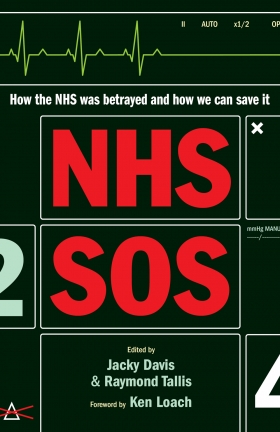
NHS SOS Edited by Raymond Tallis and Jacky Davis. Oneworld publications

nhs-sos-jpeg

Available from Keep Our NHS Public 

There are few things that staff can agree on in an organization as vast and multi-cultural as the NHS, but there are two fundamental points that almost everyone from porters and pathologists to receptionists and senior management can agree on, a dislike of constant government interference and a belief that healthcare should be provided according to need. The coalition’s NHS reforms managed to combine a massive government imposed re(dis)organization with the end of the legal duty of government to ensure healthcare is provided where and when it is needed. Given this, one wonders how they got away with it. NHS SOS explains how it happened, why it matters and what we can do about it. It documents the failures of democracy, the penetration of government by lobbyists, the uncritical regurgitation of government rhetoric by the media and the inability of the medical professions to mount a united front.

The principles underlying the reforms are that the traditional model of medicine as a vocation, health care as a public good and the sick patient as a vulnerable citizen who has a right to care and for whom the state has a duty of care are no longer fit for purpose in an era of market values where medicine is a business, health care a transaction and the sick patient a customer. Professor Allyson Pollock has been sounding the warning bells of NHS privatization since some members of the coalition were still at school and has co-authored a chapter with researcher David Price. They explain that the first clause of the Health and Social Care Act 2012 has repealed the duty of the Secretary of State to provide or secure a comprehensive health service. They assert the pivotal significance of this,

This repeal was the fulcrum of the free-market agenda, since this long-standing duty compelled the minister to allocate resources according to need instead of leaving allocation to market forces and unaccountable organisations.

Theirs, the seventh chapter of the book is the clearest statement of why it is so important to defend a publicly funded and provided, planned and accountable National Health Service, and is a good place to start for anyone still wondering what all the fuss is about.

Stephen Dorrell, past Conservative Health Secretary and present chair of the Health Select Committee was right when he said that the NHS reforms were revolutionary because of the £20bn cuts to funding by 2015 – unprecedented in any national healthcare system anywhere in the world and evolutionary because they continued the process of privatization that started roughly thirty years before. The long view is shared by the contributors to NHS SOS most of whom have been working in and campaigning for the NHS for long enough to harbor no illusions that this is a problem merely of the coalition’s making. One of the contributing editors, Raymond Tallis notes in his introduction that conservative Ken Clarke said in 2008,

Labour secretaries of state have got away with introducing private sector providers into the NHS on a scale which would have led the Labour Party onto the streets in demonstration if a Conservative government had ever tried it. In the later 1980s I would have said it is politically impossible to do what we are now doing. I strongly approve.

The righteous anger that comes across in NHS SOS comes from the knowledge that the reforms will punish the poor, the elderly and the chronically sick and will harm the rest of us when we are most vulnerable. I’ve recently been studying medical professionals’ accounts of their own illnesses. What is particularly striking is just how vulnerable they feel. Serious illness is unpredictable, frightening and exhausting, decisions that seem clear when we’re feeling healthy and confident are anxiety provoking and sometimes overwhelming when our own precarious health is at stake. No amount of re-branding patients as consumers, nor the rhetoric of patient choice used to justify the reforms can change this.

This book is not so much a lament for the NHS as it is for democracy.  Democracy, the contributors of NHS SOS argue in painstaking detail, is in crisis, from political parties to unions and academic royal colleges and the media; all are charged and found guilty – there is too much lobbying, too many vested interests, and amongst those uncontaminated by these sins, too little understanding of what is at stake.

It is all too easy to feel dismayed by what has happened and is happing to our NHS, but the strength of the book, and something that comes across strongly if you are lucky enough to hear any of the contributors talk – and they are all still campaigning, is their indefatigable and contagious passion for genuine public engagement upon which a national health service that puts patients before profits depends. The final section of the book is a guide to ‘What you can do to save the NHS’. In essence it’s a guide to how to become a politically engaged citizen. It would appear that we are only going to be able to save the NHS if we can save democracy while we’re at it.

Other reviews:

Guardian

Socialist Health Association

Open Democracy

NHS Managers

Forgiveness Society Lecture 2013

Last year’s lecture made a huge impression on me. Although I didn’t attend, I did watch the video, which is at the end of this poster, several times. I wrote a blog about it, Forgiveness, Narrative and listening, and I continue to think about how important it is to engage seriously with forgiveness and to practice forgiving. Compassionate care depends on the ability to forgive each other and our selves and to learn from our mistakes. I’m very pleased to be attending this year.

Here is a summary of this year’s lecture compiled from twitter. I will write my next blog about empathy between doctors and patients.

forgiveness“Erosion of empathy is a state of mind that can be found in any culture”

The Forgiveness Project’s Fourth Annual Lecture 2013

Zero Degrees of Empathy: Exploring explanations of human cruelty & kindness

Tuesday 17th September 18:45 20:30 (Doors open at 18:15)

Ondaatje Theatre, Royal Geographical Society 1 Kensington Gore, SW7 2AR

For more information visit: theforgivenessproject.com/event-2013-annual- lecture

Simon Baron-Cohen, Professor of Developmental Psychopathology at the University of Cambridge gives the keynote speech at The Forgiveness Project’s fourth annual lecture. This will be followed by a panel discussion with Mary Foley, Peter Woolf & Marina Cantacuzino, Chaired by Fergal Keane.

Mary Foley’s daughter was murdered in 2005 in an unprovoked attack. She has since corresponded with her daughter’s killer. Mary has shared her story in The Forgiveness Project’s RESTORE prison programme for the last five years.

Peter Woolf was a career criminal until 2002 when he broke into the home of a businessman, resulting in a three year sentence. During his sentence Peter met his victim through a restorative justice conference. Since then Peter has devoted his life to promoting restorative principles.

Marina Cantacuzino started collecting personal stories of atrocity and terrorism in 2003 in the lead up to the Iraq war. The stories formed a body of work in the celebrated F Word exhibition and led to Marina founding The Forgiveness Project.

All speakers are available for interview

The Forgiveness Project is a charitable organisation that uses real life stories to explore forgiveness in the face of atrocity, working with the public, schools, prisons, faith communities, and with any group who wishes to explore a way out of conflict, either in a wider political context or within their own lives.

For more information contact: info@theforgivenessproject.com | Tel: +44 (0)207 821 0035

Video from last year’s lecture

Forgiveness, Narratives and Listening. My blog in response to last year’s lecture.

How doctors respond to chronic pain

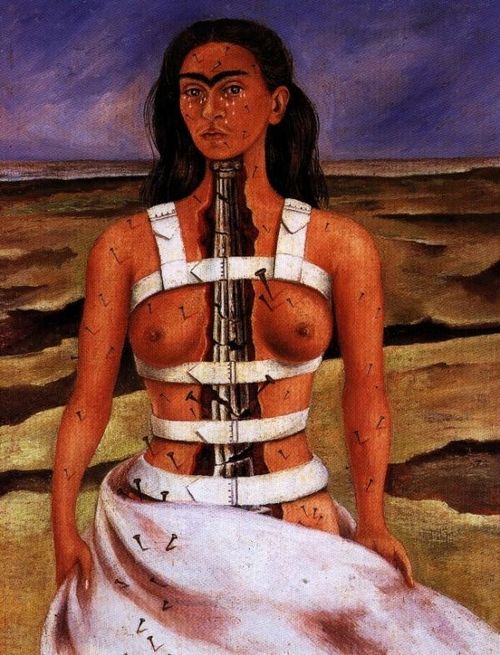
6a00d8341bfb1653ef0192aace21ed970d-500wiFrida Kahlo, The Broken Column, 1944

That [Kahlo] became a world legend is in part due to the fact that … under the new world order, the sharing of pain is one of the essential preconditions for a redefining of dignity and hope. John Berger

 Please don’t come back!

My forehead thumped down on my desk after a ten minute appointment that had stretched out to over half an hour, I felt completely exhausted and still I had another 17 patients to see and I was now running 25 minutes late. It wasn’t just that I felt exhausted, I felt useless and demoralized and more than that, I felt angry, really pissed off.

I had spent the last 30 minutes listening to Sharon describe her pains, which shifted from the somatic – how they feel, to despair – how she feels, and anger – how she feels about me. Why didn’t I know what was wrong with her? Why didn’t I refer her for more investigations? Why didn’t I send her to a [another] specialist? Why didn’t I listen? At some point I tried to introduce the idea that perhaps a pain-psychologist might help but this merely ignited the oil I’d been trying to pour on troubled waters. “You don’t even know what’s wrong with me and now you’re trying to tell me it’s all in my head, you’re not listening to me!” she all but screamed at me, tears welling up in her eyes. “No, no, no, not at all!” I actually held my hands up in front of me in self-defence, “but pain, whatever the cause, is always emotional and physical.” I believed what I was saying as I dug myself deeper into a hole I wasn’t going to dig myself out of. She was in fighting form and I was floundering. She took advantage, “You’ve done nothing for me, nothing! I want to see someone else.” I’ve been her doctor for almost 10 years and have seen her health deteriorate dramatically, her marriage take the strain and recover, her children in and out of illness and her husband through his redundancy and depression and more. I’d visited her at home and referred her to rheumatologists, physiotherapists and a pain clinic. I felt like I had nothing else left to offer. Her killer blow left me speechless. “I don’t know what to say,” I admitted, defeated, barely able to maintain eye-contact. She stood up and left.

The sufferer is in a state of high alertness and of anger looking for a cause. What strikes me is that (in my case anyway) anger comes before the pain: a wash of strong, predictive, irritation emotion that I don’t feel at any other time. Hilary Mantel

I’ve had this consultation in various forms too many times to count and I’ve discussed the problems with colleagues enough to know I’m not alone. Why then is it so hard for doctors and patients to cope with chronic pain?

Restitution and chaos

Yet most people who decide to become doctors respond to a deep intuition about life and their own lives. To become a doctor implicitly places us on the side of those who believe that the world can change – that the chains of pain and suffering in the world can be broken. For every medical act challenges the apparent inevitability of the world as it is, and the natural history of illness, disability, and death. Every antibiotic, every surgical intervention, every consultation and diagnosis becomes part of an effort to interfere with the “natural” course of events. Thus, at a profound, even instinctual level – because it precedes rational analysis – people become physicians to find a way to say “no” to disease and pain, and to hopelessness and despair – in short, to place themselves squarely on the side of those who intervene in the present to change the future. Jonathan Mann

This moving statement helps to explain why responding to our patients pain, especially chronic pain for which we emphatically cannot say “no”, is such a challenge. We are naturally solution-focused and the stories doctors like to tell about our work and our patients like to tell about their illnesses is a ‘restitution narrative’ in which illness is overcome and good health restored. We find it difficult to describe alternative narratives and this leaves us and our patients with chronic pain deeply frustrated. Doctors who cannot make their patients better, or even relieve their symptoms, suffer crises of identity and purpose and seek to avoid the situations that make us feel like this. In cancer care, barely 2% of spending is on palliative care and the proportion is even less for other diseases where suffering is at least as unpleasant and prolonged. Doctors have traditionally abdicated responsibility for the relief of suffering to nurses and now we’ve created specialist pain and palliative care services to do this difficult work for us. And yet our patients still come back to us. And then what happens? Instead of restitution we end up with chaos. In a chaos narrative, patients and doctors are stuck. According to medical sociologist Arthur Frank, “people live chaos, but chaos cannot in its purest form be told”, “if medical communications often fail people living in chaos, it is equally true that living in chaos makes it difficult to communicate”. Doctors and patients with chronic pain often find ourselves lost for words as I did with Sharon. This is one reason why we stop talking altogether and resort to questionnaires from which we choose words like burning, aching, sharp, dull, stabbing, gnawing, shooting, throbbing etc. instead of exploring narratives.

Another patient came in to see me, full of anger and frustration. Over and again she said how sick she was of explaining to other people why she couldn’t come out, help out or do the things she used to do. I hardly had a chance to speak, every now and again she challenged me to offer her an investigation or a treatment she hadn’t tried that would relieve her pain or chronic fatigue. I knew her well, but had failed her several times before and she no longer saw me as her usual GP. As gently as I could I asked her to describe why it was such a struggle to explain how she felt and she said that she had given up and how isolated she was. I said that in my experience this was all too common and asked if I could show her something that might help. When I showed her the Kahlo picture (above) she burst into tears.

Chronic pain extends to the limits of language and beyond. This was the first time I’ve tried showing a picture to a patient – and it felt very odd, it’s not in the NICE guidelines for chronic pain, but having researched this essay I was acutely aware of how words often fail. The tension in the room was relieved when words were no longer necessary.

Listening to accounts of pain

Patients’ accounts of pain are valued by doctors for the contribution they make to a diagnosis, to help, for example distinguish between the recurrent, severe, unilateral headaches lasting up to 3 days with nausea that typify migraines and the recurrent, severe, unilateral headaches with a watering eye that can last for a few weeks, that typify cluster headaches. I remember vividly a lecture from a distinguished neurologist who explained that we could diagnose headaches by watching him listen to a patient’s history.  Listening to a patient describe a ‘feature-full’ migraine, he would be alert and interested, but listening to a patient describe an equally disabling, but ‘feature-less’ chronic tension headache, the neurologist would look bored and distracted. Doctors often loose interest once they’ve got the information they want.

We are taught to take a clinical history by listening selectively to our patient’s stories to remove the particular, subjective features, which are deemed irrelevant to the diagnostic science of medicine.

I learned early in my life that a pain is almost never just a pain. The ripples spread from the nervous system into the sufferer’s whole life. If you stub your toe or burn your finger, it hurts but it’s quickly over. Anything more complicated – and especially the kind of pain that is recurring or chronic – impacts on the patient’s personality and relationship with the world. Pain does not happen in a laboratory. It happens to an individual, and there is a cultural context that informs the individual’s experience’. What a pain is, and whether it matters, is not just a medical question. Hilary Mantel

Philosopher Havi Carel uses the term “epistemic injustice” to explain the gap between what doctors want to know and what patients want them to know. Our refusal to pay due attention and respect to our patients’ account of suffering is a “wrong done to someone specifically in their capacity as knower”. At its core is the “denigrating or downgrading of [patients] testimonies and interpretations which are dismissed as irrelevant, confused, too emotional, unhelpful, or time-consuming”. All of which must (ought to be) be familiar to doctors who have struggled with patients in chronic pain.

Patients give their bodies over to doctors and hospitals only to encounter inattention and indifference, not because they cannot express their suffering, but because their language is unvalued and unrecognized in medical culture.

Doctors are taught to be sceptical of patients’ accounts, treating them as unreliable, insufficiently articulate, and subordinate to their own interpretation. But a degree of scepticism is necessary, not simply because accounts are sometimes inconsistent and inauthentic, but because accounts of suffering serve a multitude of context-dependent purposes and warrant a wide range of responses, for example, not everyone wants sympathy or action.

For patients in chronic pain questions such as, “Why me? Why now? Why does is hurt so much? Why can’t you tell me what’s wrong? Why can’t anyone help?” – and, just as important, their own, tentative answers to those questions – still need acknowledging even if they cannot be answered. When Sharon accused me of not listening to her, the problem was not simply that I was not listening, but that I was listening in the wrong way, I had failed to acknowledge her suffering and she didn’t believe that I believed her. In order to ask the right questions about pain we have to unlearn what we have learned about taking a clinical history; we cannot presume to know about suffering from a clinical history.

The pain with no name

The pain clinic, neurosurgeons and psychologists discharge patients when their course of treatment is over, relieving them of patients for whom “nothing more can be done”: “I am discharging this patient back to your care”, “surgery was not indicated”, “your patient wasn’t suited to the psychological milieu”, “no cause for your patient’s pain was found”, “serious pathology was excluded”. As medicine becomes more specialized and fragmented, it is increasingly common for patients to be discharged back to the GP with the specialist satisfied that their organ of special interest is not responsible for the patient’s symptoms: “non-cardiac chest pain”, “functional abdominal pain”, “referred knee pain”, “mechanical back pain”. Our patients are rarely ever satisfied with the lack of diagnosis and the GP remains to face the patient’s pain and frustration. GPs are the ones who have to care for patients for whom “nothing more can be done” or for whom, “no cause for their pain can be identified”.

On the psychological level recognition means support. As soon as we are ill we fear that our illness is unique. We argue with ourselves and rationalize, but a ghost of the fear remains. And it remains for a very good reason. The illness, as an undefined force, is a potential threat to our very being and we are bound to be highly conscious of the uniqueness of that being. The illness, in other words, shares in our own uniqueness. By fearing its threat, we embrace it and make it specially our own. That is why patients are inordinately relieved when doctors give their complaint a name. The name may mean very little to them; they may understand nothing of what it signifies; but because it has a name it has an independent existence from them. They can now struggle of complain against it. To have a complaint recognized, that is to say defined, limited and depersonalized is to be made stronger. John Berger

Brenda recently joined our practice. “Doctor, I have to tell you, I have cancer and a headache and I’m not worried about the cancer.” It was the first time we had met and I was the first doctor she had seen in years. “I have seen about the cancer on the telly, and I know that a woman of my age shouldn’t have no bleeding and that means it’s cancer and they’re going to do an operation and I’ll be ok.” This is exactly what she said and though it’s unusual that someone is so direct, it serves my point well. “It’s the headache I cannot stand doctor, what is the cause of it?”

Pain we cannot explain is frightening because of what it might be. Even though there is little or no relationship between what we can see from scans of your knees or back and the amount of pain in you’re suffering we make good use of the therapeutic value of explaining your pain in terms of arthritis or a slipped disc. Brain scans are of no use at all for the vast majority of headaches. The resulting anxiety is felt most acutely by patients, but for doctors dealing with headaches, a great deal of the variation in specialist referrals is due to our own inability to cope with uncertainty.

The uncomfortable truth is that most of the time we just don’t know why pain hurts so much.

[Pain is] … a Cartesian dualism by its subdivision into “sensory” and “psychological”. This is an intellectual artifice invented to preserve a concept of divided brain and mind. There is not a scrap of physiological or psychological data to support the dualism. (Wall see Diski / Jean Jackson essay)

In seizing upon simple explanations we contribute to the shame and stigma felt by people suffering chronic pain. Faced with chronic pain from undiagnosed endometriosis, author Hilary Mantel experienced this:

I was aware that my condition was exacerbated by stress, and I knew that if I confessed to this, stress would be blamed for everything … besides, every visit to every doctor would begin with a lecture about my weight.

The loneliness of pain

I think therefore I am in pain quickly becomes I think therefore I am alone. Jenny Diski

“I’ve had this since university, but none of my friends know about it.” Toby, a 27 year-old accountant looked fit, athletic and confident. He was asked to attend the surgery because everyone on our list with inflammatory arthritis has to be assessed for his or her cardiovascular risk factors. He has arthritis in his left knee. “Do you think I’ll ever be able to play tennis again?” he asked me. This was yet another ten-minute consultation that extended well beyond its brief and timeframe. The last time he played tennis was at university, six years ago. “There are weeks when I don’t see anyone except at work, I can’t stand in a bar, dance in a club, or even walk anywhere. I don’t want anyone to see me when I’m like that.” “So what do you do?” I asked, “Nothing”, “Nothing?” “I just stay at home watching TV, I don’t even answer the phone, I don’t want to have to explain or make excuses. After a while, people stop asking.”

“Since you ask, I do still get headaches, almost every day,” I interviewed my wife for this essay. “Rarely a day goes past without a headache. They’re horrendous, they’re from the back of my neck to the top of my head, they’re exhausting. If I work for a day, they’re twice as bad for the next three days. I love to swim, but twenty minutes of swimming brings on a migraine – once a week I can just about bear it, but I can hardly speak for most of the rest of the day. They make me feel irritable which I hate, so I avoid people until they settle down. They’ve been like this for years; I’ve seen GPs, neurologists, physiotherapists, massage therapists and a psychiatrist. I’ve had acupuncture and done yoga, but they’re no different now from how they were 15 years ago, and I expect they’ll be the same in another 15 years.”

People with chronic pain grow tired of telling the same story over again. There is none of the drama of cancer or an attack as in heart, gout or the runs. Chronic pain is dull and exhausting. Most of my patients with chronic pain are tired of making excuses, trying to explain why they cannot join in or help out. ‘No-one gets flowers for chronic pain’, most suffering goes on without witnesses.

(Pain) shows us, too, how those around us

do not, and cannot, share

our being: though men talk animatedly

and challenge silence with laughter

and women bring their engendering smiles

and eyes of famous mercy,

these kind things slide away

like rain beating on a filthy window

when pain interposes. John Updike (quoted in Leder)

Doctors are uneasy about spending time with the lonely. In an age of ever increasing demands for healthcare productivity, where the heavy hand of state surveillance scrutinizes the details of every clinical encounter, doctors feel increasingly anxious about consultations spent listing, bearing witness to suffering or providing comfort instead of diagnosing and treating, measuring vital statistics or giving lifestyle advice, all of which are recorded measured and paid for. How close I came to sticking to the cardiovascular risk-factor script when Toby came in, but how much more I learned by discovering about his isolation, his fears and his experience of chronic pain. It’s a tragedy of modern healthcare that we spend so much time with people who feel perfectly healthy, yet have risk-factors for disease such as raised blood pressure or cholesterol, and yet have so little time for people who are in pain all the time, but have nothing to show for it and nothing to measure.

Lonely patients are twice as likely to visit their GP, and yet the blogs and other testimonies of people with chronic pain are full of people who have given up going to their GP, often because their GP has given up on them. I know the feeling of despair when Sharon is on my appointment list, “Why does she keep coming back? What can I possibly do?” It is this despair that’s motivated this essay and driven others away.

It is little surprise that patients with chronic pain experience acutely the sense of being unwanted and unwelcome.

Chronic pain patients sufferers typically report experiences of isolation and alienation from their physicians and providers, from their care-givers, and even from their own bodies. … chronic pain sufferers rate the alienation they experience from their physicians as qualitatively worse than alienation from loved ones. Daniel Goldberg

Pain and the body

The healthy body is transparent, taken for granted. This transparency is the hallmark of health and normal function. We do not stop to consider any of its processes because as long as everything is going smoothly, it remains in the background.“The body tries to stay out of the way so that we can get on with our task; it tends to efface itself on its way to its intentional goal.” This does not mean that we have no experience of the body, but rather that the sensations it constantly provides are neutral and tacit. A good example is that of the sensation of clothes against out skin. This sensation is only noticed when we draw attention to it, or when we undress. Havi Carel

Chronic pain is a constant reminder of a broken body. In Kahlo’s self-portrait above, the white straps represent the metal corset she had to wear after she broke her spine in a coach crash as a young woman. They also represent being chained to a broken body – she cannot escape her shattered spine or the nails in her flesh. She is beautiful and sensual, but the biggest nails are over her heart because the pain of love is as real as any other, and her face is brave and stoical and yet tears roll down her cheeks. The land behind her, the context in which she stands is barren and forlorn.

Marian came in with her husband to ask if I could help with his impotence. He looked down at the floor and didn’t seem too keen to join in the consultation. I was prepared for this because we had discussed his problem when he last came in alone. It wasn’t that he was impotent, but that even when they made love as cautiously as possible, his back-pain afterwards was so severe that it was impossible for him to continue waiting tables for the next couple of days and his job, at one of London’s finest restaurants, was on the line. “Everyone who waits tables has back pain”, he explained, “so you don’t talk about it, you certainly don’t complain about it, you just get on with it. And you certainly don’t take time off for it.” Pain’s isolating tendencies have no respect for sexual intimacy.

Conclusions

My motivation for writing this essay came out of despair. My intention was to confront and examine why I felt like that and in my conclusion I will try to articulate what I might be able to do about it.

In her essay, The Art of Doing Nothing, Iona Heath explains that, “in medicine, the art of doing nothing is active, considered, and deliberate. It is an antidote to the pressure to DO and it takes many forms.” Too often when confronted by patients which chronic pain, we “do something” in order to get rid of them, we send them for another investigation or another opinion or we prescribe more drugs. I don’t doubt that this partly explains why the rates of deaths from prescription pain-killers are so high. Another reason for “doing something” is because chronic pain traps us in the present and destroys a sense of progress. “Doing something” sets us in motion again, even if we’re only going round in circles.

“Doing nothing” needs to be qualified, it is far from passive and far from easy.  Heath wrote her essay at the end of a long career distinguished by exceptionally deep and considered reflection. Instead of “doing something” we should learn again how to listen, think, acknowledge and bear witness.

Listening to stories about chronic pain makes doctors feel helpless, exhausted, anxious and at a loss for words. Paying close attention we might recognise that this is because the restitution narrative is inadequate and that we are trapped in chaos. I’ve explained how to listen for these different narratives in a recent essay about forgiveness: it’s both a warning and a ray of hope that we might be stuck in chaos for a long time (in the case I discuss, it’s 18 years). Recognising this is in itself a therapeutic opening. As a doctor I must resist the temptation to push toward this opening prematurely. The chaos narrative is already populated with others telling the ill person that “it can’t be that bad”, “there’s always someone worse off”, “don’t give up hope”; and other statements that ill people often hear as allowing those who have nothing to offer feel as if they have offered something.

To deny the living truth of the chaos narrative is to intensify the suffering of whoever lives this narrative. The problem is how to honor the telling of chaos while leaving open a possibility of change; to accept the reality of what is told without accepting its fatalism. Arthur Frank

When Frank wrote his classic book on medical narratives, The Wounded Storyteller in 1995, he wanted to help clinicians listen to their patients. He wanted to show that the stories patients tell make a moral case for doctors to be transformed by bearing witness.

Bearing witness is different from witnessing alone. Any doctor who has felt tired or forlorn after spending time with a patient in chronic pain, understands the burden that we feel when our patients share their suffering. We know that this is hard work, indeed, compassion means ‘to suffer together with’.

Chronic pain blogger Jessica Martin offers us a mantra,

I don’t want you to save me, I want you to stand by my side as I save myself.

The word mantra comes from manas (mind) and tra (liberate). The repetition of a mantra is transformative and this captures very well the transformation that doctors need to undergo to better serve our patients with chronic pain. Finding the right balance of proximity and distance is a challenge. Too close and we project too many of our own feelings on our patients, too far and we have abandoned them.

Proximity demands recognizing that yes, the monster is in the room and that the clinician take a stand with the patient in facing that monster. The first and crucial clinical move is to express the commitment to stay with the patient, to be there to do whatever can be done. It is an enormous defect of health-care organizations that professionals often cannot express this commitment because there are constant territorial disruptions over who stays how long and does what. This structured disruption of continuity of relational care is more than an organization problem; it is a moral failure of health care, deforming who patients and clinicians can be to and for each other. Arthur Frank

Writer Susan Sontag wrote about her experience of suffering as she endured two different types of cancer. She also wrote books about how we respond to images of suffering. She clearly wants her writing to give access to what is real, to create knowledge and the conditions for compassionate understanding and ethical action. Indeed, the project of many of Sontag’s best known, early essays is to protect reality from the distorting influence of representation. She wants her essays to affect and change minds and culture (see Ann Jurecic).

Frank’s final narrative is the quest. For the last two months while researching this essay I’ve been swimming in narratives of chronic pain. The chaos narrative is one that cannot be told and so it is perhaps little surprise that they are hard to find. When the story finally can be told, it is the quest. Jessica Martin’s excellent blog, ‘No-one gets flowers for chronic pain‘ is a great example.

Quest stories carry the unavoidable message that the restitution narrative will, one day, prove inadequate. Quest stories are about being forced to accept life unconditionally; finding a grateful life in conditions that the previously healthy self would have considered unacceptable.

Lastly, taking care of patients suffering chronic pain is one of the hardest things I do as a GP. It’s been my experience that patients quite frequently realise this too.

My other concern is with the doctors and nurses who have to deal with patients who are in pain. I think it must be a depressing and unsettling business, unless you are well-trained and supported. Sometimes medics seem callous, and I often wonder if they are frozen because they are afraid. People who are suffering often have an aura of unapproachability. They are cut off, turned inward, preoccupied with their inner experience. Pain requires a kind of concentration, and it’s easy to feel helpless and useless in the face of the patient’s otherness. What healers need to do is muster their own resources of personality and professional knowledge and address the fear as well as the pain: to provide reasoned reassurance, information, and above all, hope. Hilary Mantel

Hilary Mantel quotes © Copyright 2013 International Association for the Study of Pain. Reproduced with permission. All rights reserved.

References and further reading

Pain is weird. Fantastic overview from Paul Ingraham – Painscience.com

The Buddhist practice of Tonglen uses things we find difficult to “wake up” instead of being a big obstacle. We learn patience, compassion etc. from people who push our buttons. “The job of the spiritual friend is to insult you … you need people around to provoke you so you know what you need to do.” It has been very useful in thinking about how I manage patients with chronic pain. The key is to engage with the difficult emotions and find better ways to cope rather than avoiding them.

No-one gets flowers for chronic pain. Great chronic pain blog demonstrating narrative as quest.

How to understand someone with chronic pain. Good advice via Wikihow

Spoon theory: A simple way to explain chronic pain to others

Body of work. An author, Barbara Gowdy – who lives and writes with, but not about, chronic pain

The Lived Experiences of Chronic Pain. Daniel Goldberg 2012

Asking the right question about pain: Narrative and Phronesis. Arthur Frank 2004

Illness as Narrative. Ann Jurecic 2012

Stigma, Liminality and chronic pain: Mind-body borderlands. Jean Jackson American Ethnologist 2005

Mantel_IASPInsightJune2013 copy © Copyright 2013 International Association for the Study of Pain. Reproduced with permission. All rights reserved.

How doctors respond to patients’ shame.

Do Doctors need to be kind?

Love, Hate and Comittment.

Medical advocacy.

The Compassionate Brain: Humans Detect Intensity of Pain from Another’s Face http://cercor.oxfordjournals.org/content/17/1/230.full

Pain: Science, Medicine, History, Culture. Wellcome Collection.

Why is is so difficult to find better methods of chronic pain management? This ain’t livin’ blog

Living with Chronic Pain. Indepenedent 2013

To just be a person and not a patient any more. Heart Sisters blog

Pain really is in the mind, but not the way you think. The Conversation

How Chronic Pain has made me happier. Robert Heaton

Agency without mastery, Chronic Pain and Posthuman writing

Chronic low back pain, self management from Saveyourself

http://www.scoop.it/t/chronic-pain-and-occupational-therapy

Chronic regional pain syndrome

Psychological therapies for chronic pain: very modest benefits

Psychological therapy for adults with longstanding distressing pain and disability – See more at: http://summaries.cochrane.org/CD007407/psychological-therapy-for-adults-with-longstanding-distressing-pain-and-disability#sthash.Se27mPZK.dpuf

The best evidence strongly indicates that these stuctural findings on X-Ray and MRI are not clearly related to the onset, severity, duration or prognosis of low back pain http://www.bodyinmind.org/spinal-mri-and-back-pain/

Healthtalk online: Videos of patients discussing life with chronic pain: http://www.healthtalkonline.org/chronichealthissues/Chronic_Pain

Havi Carel epistemic injustice: via Kings Fund

“The placebo effect is the effect of everything surrounding the fake pill, or the real pill,” he says. “It’s the compassion, trust, and care. It’s the ritual and symbols. It’s the doctor-patient interaction.” http://www.fastcoexist.com/3016012/the-placebo-effect-is-real-now-doctors-just-have-to-work-out-how-to-use-it

Jenny Diski: Feel the burn. LRB

Roy Porter: Pain, Rey observes, remains poorly understood because it ‘has no clearly defined status’; all divisions between ‘real’ and ‘subjective’ pain, having been founded on archaic metaphysical body/mind dualisms, are plainly problematic, not to say question-begging. LRB

The body in pain LRB

Pain Toolkit. Resources for living with chronic pain. Excellent UK website

Living With Arthritis


Pain. Is it all in your mind?

Understanding pain in 5 minutes

Doctors and death

“I wish she were dead”

Joy had spent most of her life trying to avoid thinking about death or dying, or anything to do with it, so wishing her own mother was dead was even more unwelcome and intrusive a line of thought than it ought to be. Repelled by anything to do with death, she had tried for the last 40 years to focus her efforts and attention on the living.

Her mother, like her grandmother, her aunt and, she increasingly suspected, her sister, had Alzheimer’s dementia. A few years ago her mother had been found hanging happily upside down from her seat-belt in her upturned mini in the middle of Peterborough. She had written off several cars and smashed the front of Top Shop. It was a wonder no-one, including her, had been killed, but at 4.30am on a Wednesday morning there fortunately weren’t many people about. Her family knew she was getting forgetful, but she seemed cheerful enough and was fiercely and doggedly determined to hang on to her independence. In the months before ‘the crash’ her car had become progressively dented as her driving became more and more erratic. A few family arguments had been simmering in that time. Joy had defended her mother’s right to independence and quality of life, whilst her sister pleaded for the safety of other road users, street furniture and pavement dwellers. Joy fought for her mother’s right to drive to the end, on the grounds that no-one had actually been hurt, whilst her sister pointed out that it was absurd to wait for a calamity. After ‘the crash’, their mother was taken to hospital where she was judged to be suffering from dementia and her car, to the family’s relief, was judged to be a write-off. Their mother never fully understood why she shouldn’t be allowed to drive again and became isolated and depressed in spite, or perhaps because of her family rallying around. The car had been her means of escape.

This afternoon, 4 years after ‘the crash’, Joy had been to visit her mother for lunch. It wasn’t one of the better days for either of them. Usually, at this time of day, Joy is less stressed, and her mother less agitated than in the mornings. In the evenings Joy is frequently as exhausted as her mother is psychotically paranoid; a little, but more than enough.

Her mother was sitting in her rocking chair looking out of the window into the garden. The sandwiches left by her carer had been pushed around on the table in front of her but not eaten. “Come on mother, you’ve got to eat something”, Joy pleaded. “Don’t tell me what to do!” her mother hissed back at her.

“Don’t fucking start.” The words came out of Joy’s mouth before she had time to hold the thought back and compose herself. Her mother grabbed the sandwiches and clenched them in her fists, she was still easily strong enough to squeeze the cheese and cucumber and white bread through her fingers. She scowled at Joy when she finished.

“What on earth is wrong with you?!” Joy protested.

“Oh go away!”

After ‘the crash’ Joy thought it best for her mother to move in with her, she was working part-time and selling her mother’s house raised enough money to pay for extra care when she wasn’t around. She was increasingly regretting the decision. It wasn’t that her mother actually needed all that much care, it was worse than that. The bouts of confusion, paranoia and rage – the rage that all seemed to be directed at her – were increasingly difficult to cope with. Physically, at least, her mother had the constitution of an ox, and whilst her dementia was slowly and steadily progressing, her fearsome determination was beating Joy down. Joy spent her evenings alone tearfully with a bottle of wine, increasingly hopeless for her future. Her mother was 80 and looked like she could keep this up for another 20 years or more, far longer than Joy could cope with.

Forty years ago in the same room in which they argued, Joy’s son Tom had died. Barely 7 months old, he had been born with severe congenital heart disease and had spent his life in hospital. When he was finally discharged, painfully thin, breathless and wheezy, all he could do was lie back and pant. His arms and legs were scarred from all the needles, his lips were tinged blue from lack of oxygen and his eyes, when they were open, looked anxious and distant. Joy and Roger, her husband, had brought Tom home in the morning. Neither of them felt prepared to be alone with him without the support of the hospital medical staff. They knew they could call for advice at any time, but were ashamed to admit they were scared and couldn’t cope. Neither of them had slept properly since Tom’s birth and on the night after his discharge they took turns to sit with him while the other lay fitfully in bed. It was a sweltering hot night, Joy remembered clearly lying on top of her bed, holding her breath so that she could hear the little squeaks and wheezes from Tom’s room.

Eventually she fell asleep. She awoke with a start, it was a shock to find herself asleep after such a long time. She sat up and held her breath … silence. She walked into Tom’s room hardly daring to breathe, and saw Roger sitting by the window, staring outside, lit by moonlight, holding Tom in his lap. For the first time in his life, Tom looked relaxed, head tilted back against his father’s shoulder, arms and legs flopped over him. For a few moments she stood in the doorway, at peace for the first time since his birth. What happened next she cannot clearly recollect. They fought, she knows that, even though the memories are of pain and fury, grief and loss, and not physical violence. The doctor who examined Tom’s body – the doctor who had never met them, never spoken to them and knew nothing of what they had been through – insisted on a post-mortem because somehow, in their – her – distress, his body, for God’s sake, he wasn’t even alive, had been bruised, and they, Tom’s parents, were under suspicion.

She had a breakdown of sorts after that. She had always considered a ‘breakdown’ to be hopelessly vague as a term, but much like ‘being beside herself’ it was an apposite term for what she went through. To the present day she bitterly resented the hospital for sending Tom home; why didn’t they tell her he was going to die? Obviously he was sick, but if they expected him to die, why did they send him home? Why? Because they didn’t want another death on their unit? Because they couldn’t cope with it? What about us, or me? Roger left soon after, we couldn’t bear to be together after that. Is it like that for hospital doctors too? Is it too much to bear to face death and bereavement? Is that driving the pressure for patients to die at home today? She couldn’t see the point of it herself.

From that day on her left breast had ached terribly. She put it down to grief for the first few weeks, but when it refused to settle, she visited her GP who arranged some tests to check her heart and a mammogram to check her breast for cancer. The tests came back fine and she accepted it from then on as a stigmata, the physical manifestation of her mental grief.

Joy sat in her car outside her office after visiting her mother, wiping tears from her cheeks and checking her make-up in the rear-view mirror. Her breast ached more than ever, punishment she believed, for wishing her mother dead.

She slipped her hand inside her bra to rub the pain away … oh Christ, no! She cursed her mother, the witch, it was her fault. It wasn’t the first time she had felt the lump, it was there last week, and the week before and she was sure it would go, but if it didn’t she would deal with it, make an appointment to see her GP, but not now, not today, not this week. She had too much to deal with already this week.

Joy got out of her car and let herself through the back door into her office, switched on her computer, straightened her jacket and checked her appearance one last time in the office mirror. Taking a deep breath, she walked into the waiting room and called in her first patient.

Further reading and inspiration:

Dr Kate Granger Extraordinary blog by doctor & terminally ill cancer patient musing about life & death

Our unrealistic attitudes about death, through a doctor’s eyes. Excellent essay via the Washington Post. Dec. 2013

Why are newly qualified doctors unprepared to care for patients at the end of life?

“Newly qualified doctors perceive that they receive little formal teaching about palliative or end-of-life care in their new role and the culture within the hospital setting does not encourage learning about this subject”

Junior doctors experience of death. Personal accounts of being with patients who die. Excellent narratives from Student BMJ

On Death and Fear: A Personal Reflection on the Value of Social Psychology Research to the Practice of Oncologists. J. Clinical Oncology. Sept. 3rd 2013

5 days: a tale of escalation creep. A tale of a hospital death, explaining why it is is so hard to die well in hospital.

Dying Matters. Blog by hospital doctor, Elin Roddy explaining how she is affected by the death of her patients.

Caring for a dying patient in hospital. BMJ article written by clinical lecturer in palliative care, Katherine Sleeman

Dying Matters. Website with award-winning films, support and end of life education for everyone

This is how you healthcare. An American death in London. Extraordinary writing, worth the subscription cost.

How Doctors Die: It’s Not Like the Rest of Us, But It Should Be

Doctors Really Do Die Differently: Research Says That More Physicians Plan Ahead, Reject CPR, and Die In Peace

Doctors’ Secret For How to Die Right. Oct 2013

How Doctors Die: Showing Others the Way NY Times 19/11/2013

Discussing and Planning for How to Die. British Social Attitudes Survey.

Shared Decision Making: Place of Death. SDM NHS Right Care

The Facts of Death. Presented by Dr John Launer

A Good Death. Richard Smith British Medical Journal

Waking the dead? Some things you should know about dying

Mortality and the imagination, talk by Iona Heath at the North West Arts and Health Network, July 7th 2013

How doctors choose to die (infographic via Passare.com)

How-Doctors-Choose-To-Die-SM

Competition, choice and quality in general practice

The evidence in favour of using competition between GP surgeries to improve the quality of patient care rests almost entirely on a 2010 report by the Competition and Cooperation Panel, a so-called: Empirical analysis of the effects of GP competition. This showed that GPs with neighbouring practices less than 500m away made fewer referrals for certain conditions and had patients who were 0.1 percent more satisfied than patients from practices without such close neighbours.

I have lived and worked as a GP in densely populated urban areas with many close, neighbouring practices for the last 12 years and so I read with interest and dismay a blog written by entrepreneurial doctor Neil Bacon on the website of one of the most respected health think tanks, The Nuffield Trust.

Bacon concluded, much like the authors of the paper, unambiguously and without criticism that, ‘everyone who truly believes in improving patient care should be arguing for increased and fully regulated competition in primary care. Fact.’

There are many problems with the CCP report, not least are the difficulties in defining quality in care, explored in detail at a recent conference I attended at Cumberland Lodge, and in brief in the British Journal of General Practice. My own practice has roughly a 30% turnover of patients a year with a list size of 12 000 patients, so over 3000 patients leave and join our practice every year. This is not unusual in inner city practices. I ask new patients why they join us. Quality, whatever that means, is not the same as ‘what matters’. What matters to a family with young children, is very different to that of a housebound elderly man with a complex neurological disorder, a busy businesswoman with an endocrine disease requiring regular monitoring or a patient preparing to undergo gender reassignment.

In my experience neither the patients I speak to, not the GPs I know behave in the way that the authors of the paper, or Bacon, assume. Nowhere in the 51 pages of the CCP paper do the authors study how, or even whether patients are choosing, or GPs are competing in the manner they imagine.

There is a contrast between the traditional model of medicine as a vocation, health care as a public good and the sick patient as a vulnerable citizen who has a right to care (and for whom the clinician has a duty of care) and a new era of market values where medicine is a business, health care a transaction and the sick patient a customer.

The formulation of the patient as a ‘rational chooser’ underpins contemporary political policy, but is contradicted by studies about the experience of illness, the nature of suffering, the practice of care and the wishes of patients.

Most of my time as a GP is bound up in therapeutic relationships with patients who have multiple, long-term conditions and/ or mental health problems. That this is the case for my practice which has a younger than average patient population, suggests that for the majority of GPs with a greater proportion of older patients this is typical of even more of their work. One of the commonest questions new patients ask is, ‘will you be my doctor?’

Relationships between doctors and patients are built up over time and involve trust and commitment on behalf of both parties. Because of the investment in time that this takes, patients are loathe to leave a doctor that they trust, even if they suspect he might not be the best doctor around. Counter to the claims of competition and choice advocates, the importance of continuity of care is being recognized as being fundamental to the safe and effective management of patients with complex multiple conditions and even in our practice, where we have 14 doctors, none of whom work more than 7 clinical sessions a week, we have made continuity of care a priority and are succeeding in making sure that every patient has their own doctor.

From the perspective of most patients, a doctor who they have gotten to trust and that knows them is more tangible and therefore valuable than some abstract notion of ‘quality’.

Fortunately for patients, doctors are motivated by a wide range of factors of which a deep understanding of what needs to be done to deliver high quality care, a culture of commitment, supporting colleagues, and education are the most important.

The introduction of clinical commissioning groups (CCGs), although greeted with great scepticism because GPs are being scapegoated for the failings of the NHS reforms, is resulting in renewed enthusiasm for these intrinsically collaborative activities. Unfortunately the funding for our CCG is only 40% of the funding that was given to the PCT (the Primary Care Trust that it replaced on April 1st 2013). My own experience is that commitments to my patients and medical students doesn’t permit me sufficient time to devote to the CCG. The future of many, if not most CCGs hangs precariously in the balance.

I believe that patient choice demonstrates that we as doctors treat our patients with dignity and respect for their values and opinions, as partners, willing and able to share decisions about their medical care. As conceived by the proponents of competition, patient choice has nothing to do with this, but instead it is to be used as a tool to promote a medical market using patient feedback websites, the like of which Neil Bacon promotes. Competition and choice risk increasing inequalities because GPs seeking to maximise their income may design services to satisfy those patients most capable and likely to exercise choice by changing practice – the young and healthy rather than the housebound, seriously ill or impoverished who need most care. Providing a minimal service to a large patient list remains one of the most profitable tactics of unscrupulous GPs.

It is both futile and inappropriate to make patient choice the servant of a medical market place and a tool for quality improvement, especially on the basis of such poor understanding of the complexities of patient choice and the quality and nature of patient care.

A shorter version of this blog is due for publication on the Nuffield Trust website today.

See also:

Primary care competition and the effect of new providers on quality of care in England: Performance of new private providers is worse than traditional incumbents. Lancet November 2014

Berwick review: it is counterproductive to use staff survey and attitude data as a performance management tool or to compare organisations.

Competition in the NHS: Is the toothpaste out of the tube? Blog by the founding director of the Competition and Cooperation Panel

Competition in Healthcare: The Risks Blog on abetternhs

Betrayal of the NHS must end, it’s time for doctors to fight back

Reblogged from the Guardian: Written by Jacky Davis: http://www.guardian.co.uk/commentisfree/2013/jun/23/betrayals-nhs-doctors-fight-back-bma

This week hundreds of doctors meeting for the annual BMA conference in Edinburgh will debate the wreckage left by Lansley’s Health and Social Care Act. When first proposed in 2010 hopes ran high after the government promised that spending decisions would go to GPs and power to patients. But the profession is now contemplating the betrayal of those promises, as cuts lead to rationing and GPs are forced to tender out all services to the private sector. As one GP grimly remarked: “We’ve got less money, more complexity and all of the blame.”

But it is not only the politicians who have betrayed the NHS. The media, who should have asked hard questions as the Act passed through parliament, and the medical establishment, who should have stood up to the government, share the blame. It is no surprise that the Tories betrayed the NHS. In his book Never Again, Nick Timmins describes how Lansley’s initial plans for the NHS were redrafted by Oliver Letwin and Danny Alexander. Letwin, at the heart of Tory policy-making for 25 years and author of Privatising the World, reportedly told a meeting that the “NHS will not exist” within five years of a Conservative election victory, and he is close to being proved right. That the Lib Dems went along with this against the wishes of their supporters was a shocking violation of their party’s democratic processes. Without Lib Dem support, a minority Conservative government could not have passed this legislation.

It is not the responsibility of the media to blindly defend the NHS but it is their job, as Lord Justice Leveson said, to provide an “essential check on all aspects of public life” – and with a few exceptions they failed in their duty. The BBC, trusted and relied on for in-depth political coverage, frequently acted like a mouthpiece for the government, regurgitating the official mantra that the bill was about “putting patients at the heart of the NHS” and “empowering GPs”. This was still the line on the day the bill, by then the subject of a long bitter battle, was passed. Important stories, including the web of financial interests behind the bill, were ignored.

The failure of the medical establishment to recognise the dangers and oppose the “reforms” is the most difficult thing to explain. The medical royal colleges, with the notable exception of the RCGP led by Clare Gerada, were myopic and supine. They focused on details while ignoring the real threat – that it would be impossible to deliver their remit of high standards of medical training and patient care within an NHS that was being broken up and tendered out to the private sector. The BMA’s response was led by influential GPs, many of whom were naturally attracted by the prospect of holding the majority of the NHS budget. Their initial policy of “critical engagement” was pursued long after it became clear that the government had no intention of engaging. Surveys conducted by other organisations showed the profession overwhelmingly rejected Lansley’s proposals but the BMA never consulted its 150,000 members about the possibility of opposing the reforms or of a boycott of the increasingly discredited GP commissioning. If the medical establishment had been united it could have brought down bill which purported to put clinicians in charge, but the leaders of the profession vacillated, prevaricated and ultimately failed the test.

What might the BMA do to redeem its failure to fight the Act? It could begin by spending some of its considerable resources on a high-profile campaign to tell the public why the NHS is in danger and what we stand to lose if we don’t defend it. It should ensure that the NHS becomes an election issue in 2015, hold Labour to its promise to repeal the Act and back Lord Owen’s bill to restore the secretary of state’s responsibility for the NHS. It should produce evidence to counter the self-serving attacks by politicians on the service, including closures masquerading as “reconfigurations”, and it should defend its staff when they are blamed for the chaos that is a result of “reforms”. And since the holy grail of GP commissioning is turning to base metal before our eyes it should “critically engage” its members on whether they think it’s time to withdraw from the process. It should rediscover its voice as a trade union, abandon appeasement and come out fighting.

See also, the book: “NHS SOS” edited by Raymond Tallis and Jacky Davis

The Rules (for GPs)

With respect to Dr Moderate who was forced to moderate his own rules.

With respect also to the Velominati Rules for cyclists, which Dr Moderate and I fully endorse. On reflecting upon The Rules, I realised that they were for the cognoscenti by the cognoscenti. Rule #5 is essential if you are to respect Rule #70, important in cycling, but they have no place in general practice, where cooperation, not competition is ‘The Rule’. I taught myself to use a cut-throat razor in order to adhere to Rule #33.

As a GP I aspire to the rules below:

Rule #1. Do not consult in a bow tie. Ever. You are a GP.

Rule #2. Do not consult in lycra.

As a GP trainee back in 2000 I arrived at work in my lycra after a brisk cycle-ride into work and opened my bag and took out a freshly ironed shirt and realised to my horror that I had forgotten to bring any trousers. My surgery was starting in 10 minutes and it was about 25minutes ride home. I wore my shirt, black lycra tights and brown ankle boots for the entire surgery. To make matters worse, my consulting room was upstairs and my patients had to follow me up them. Unsurprisingly several of them said that whatever it was that was wrong with them when they made the appointment had got better while they were waiting.

Rule #3. Tidy your desk.

Do not consult from behind a mountain of paperwork. If you are a real GP, you will obviously have a mountain of paperwork, but don’t have it all over your desk. It makes it very hard to blame the hospital for the missing letter or x-ray result when your own filing is obviously in disarray.  It makes you look disorganised and unprofessional. Hide it behind the printer instead.

Rule #4. Clean your kit. Do not perform earwax transplants.

The little plastic funnels that fit on the end of otoscopes (the torch for looking in patients’ ears) are disposable. You might be doing your bit for the environment by reusing them, but in the grand scheme of resource-depletion and climate change, it’s simply not worth peering through Mr Smith’s waxy deposits when you’re trying to look at Mrs Jones’ ear drums. And it’s disgusting.

Rule #5. Tool yourself up. Do not use a ruler as a tendon hammer or a bike-light as an otoscope.

Not so long ago my practice invested in wall mounted otoscopes and opthalmoscopes (for looking in ears and eyes). The difference between these and my old battery-powered kit was vast. For a few months before this I had taken to using my bike light to look at my patients tonsils, which was bright enough to light up heads like pumpkins, but far better than my battery-powered otoscope which was no better than peering in with a match. Rulers and the edge of the bell of your stethoscope are unacceptable alternatives for a tendon hammer. Both hurt and on occasion break. Furthermore time spent looking for kit while your patients are waiting is unprofessional and wasted.

Rule #6. Dr. is enough. The long list of letters after your name doesn’t impress your peers or make sense to your patients.

A diploma in contraception you picked up in 1984 is of no relevance to anyone. If you are a professor or have won a gong, good for you, but it doesn’t make you a better GP. A four-foot name plate with a dozen or more letters after your name  makes you look vain and insecure.

Rule #7. Don’t refuse anything, even homeopathy until you have heard the patient’s story.

If the patient’s opening line is a request and your response is a refusal, you’ve ruined the consultation. The correct response to a request for a referral for chiropractic is a look of interested concern followed by, “tell me all about it”

Rule #8. Your consulting room is not your den. It should be filled with neither religious paraphernalia nor boastful evidence of your fecundity.

Patients may not share your religious convictions and they may be struggling with infertility. If you must have pictures of your family, they are so that you don’t forget what they look like, because you are always at work. I know one GP who keeps a picture in a draw and for patients who ask, she shows them. I keep a couple of pictures on my computer.

Rule #9. Do not fear dependency.

Patients sometimes need someone to lean on. It’s your job to be strong when they are weak. Fear of dependency has de-humanised the profession. Related to this is continuity of care. Take responsibility for your own patients, get to know them, build up a therapeutic relationship. Ever jot of evidence shows that healthcare is safer, more efficient and more compassionate when you are looking after your own patients.

Rule #10. Do not bullshit your patients.

There is no excuse for guessing. If you don’t know, patients can look it up, on their smartphone. Very quickly. Admit you don’t know everything. Up to 40% of symptoms that present to doctors defy medical explanation.

This is a somewhat ‘off the cuff’ list, compiled on a cycle ride home from work. I expect to edit it on the basis of your wonderful contributions.

The True History of GP Out of Hours Services

The True History of GP Out of Hours Services

Dr Eric Rose

OOH

The early days of the NHS

Before 1948 general practice was a cottage industry. Most GPs worked independently usually from a consulting room in their own house. There were few if any staff with the duties of answering the phone usually falling to the GP’s wife (most doctors were at that time male) or in some cases a housekeeper like the indomitable Janet of Dr Finlay’s casebook.

When the NHS was created General Practitioners feared the idea of becoming salaried employees of the state and held out against it … Eventually a compromise deal was reached in which GPs would work for the NHS but as Independent Contractors rather than employees.

Much of that independence was however illusory. Whilst GPs remained free in some ways to organise their own practices the work they did for the NHS was controlled by a very tightly defined contract.

A framework already existed; Lloyd George’s National Insurance Act of 1911 provided for limited health cover for working men (but not their families).   The scheme was administered by Local Insurance Committees covering counties and large conurbations which held a list or panel of doctors prepared to work under the scheme. The panel doctors were subject to “Terms of Service” which were later lifted directly into the NHS GP contract.

The NHS also adopted the medical cards issued by Local Insurance Committees. and the record system consisting of cards contained in a card “Lloyd George envelope” which were still in use up till a few years ago.

1948-2004 24 hour responsibility

Over the years the name and form of the local body responsible for administering family doctor services changed a number of times and the Terms of Service were embellished. The main clauses however remained unaltered, two of which are most significant:

Firstly the contract was an individual one, that is to say that virtually every doctor working in general practice had a personal contract with the local NHS Body and patients were registered with a named doctor. Secondly there was a clause which stated   a doctor is responsible for ensuring the provision for his patients of the services referred to … throughout each day during which his name is included in the … medical list.”

This meant that each GP was personally responsible for the care of his or her patients 24 hours a day 7 days a week and 365 days a year. Any failure in that provision could result in being hauled before the dreaded Medical Service Committee and “withholding of remuneration” or fines.

For single handed doctors this meant being on call to patients literally round the clock with no respite unless they could find a locum which was not easy. Even for those in partnership it meant a gruelling on duty rota. As well as the doctor himself the family were involved as at nights and weekends GPs were on call from home with no other provision for answering the telephone.

1966 Doctors Charter

By the early 1960s working conditions were such that there was a major recruitment crisis in general practice with newly qualified doctors preferring to work in Australia or Canada to the NHS. The then Health Secretary agreed to the 1966 Doctor’s Charter which provided amongst other things access to funding for new surgery buildings and  partial reimbursement of the wages of ancillary staff. It also included a “Group Practice Allowance” to encourage GPs to work together in practices. Despite this individual contracts and personal round the clock responsibility remained.

Group Practices provided some respite as it was possible for the doctors to take it in turns to cover the Out of Hours period when the surgery was closed.  However since the average partnership size was only 4 or 5 doctors  this still meant around one night a week and one weekend a month and more if a partner was away on holiday This was in addition to daytime work in the surgery.

In some large cities commercial deputising services were set up employing doctors to cover the out of hour’s period but these just weren’t viable in much of the country. Their use was also often limited by the local Family Practitioner Committee and frowned on by politicians who felt that some GPs were being paid for staying in bed. The fact that these doctors in had to give up part of their own income to pay the deputising company was either not understood or glossed over.

Personal Experience

My own experience was that I entered General Practice in 1972 choosing deliberately to go to an area which wasn’t covered by a deputising service as I felt I wanted to give complete care to the patients in my practice. At first as I was only 28 and came from working a hospital rota of 1 in 2 the work seemed manageable. Sometimes if I had been up in the night there was even an hour between morning and evening surgeries to take a nap.  I even enjoyed some night calls especially in the summer. Going out and being able to relieve pain or help someone with breathing problems could be a pleasure although it didn’t stop one from being tired the next day.

Over the next few years however things began to change. Daytime surgeries got busier and the gap in the middle of the day disappeared. Although most patients were reasonable, an increasing minority regarded it as their right to call the doctor to visit in the evening regardless of whether it was an emergency; some names cropped up so regularly that they were suspected of deliberately waiting till the surgery was closed. Some even thought they were calling a special night service instead of their own doctor who had already been working all day.

Family life had to be planned around the on call rota; my wife who by now had her own job had to be home by 6pm to answer the phone and during weekends couldn’t leave the house at all. The children were also restricted; it was only recently that my son, now in his 40s, told me how upset he was by my weekends on call.  I was on call and unable to visit my wife in hospital after our second child was born and was also on call when my older son had a serious accident at home. My memory is kneeling beside him trying to staunch bleeding with one hand whilst holding the phone in the other trying to find someone to cover my duty.

Social life also suffered as non-medical friends just couldn’t understand why we couldn’t join in all of their activities. Even when it was possible to go, I soon established a reputation for going to sleep at the dinner table due to having been up all night before.

In my practice weekends on duty began at 9 am on Friday and lasted until Monday evening. During the week before I would become increasingly tense and on the Monday night relaxation came only from a bottle.

One small additional factor that no one seemed to consider is that GPs answering night calls to patient’s homes had to drive themselves often whilst in an exhausted state. As I turned 40 the thought of continuing to work like this for the next 25 years filled me with horror but there seemed little likelihood of change and I remember being treated as an oddity by some senior colleagues at a local Royal College of GPs meeting when I said that I thought we should work to change the contract.

The 1990s GP opinion changes

Gradually it became apparent that I was not alone amongst doctors and there were also other forces at work.  There were an increasing number of women entering general practice who often needed to juggle family commitments around on call duties. What childcare facilities there were in the NHS ceased to operate outside “normal” working hours. Spouses of both male and female GPs had careers of their own and couldn’t be at home as an unpaid telephone answerer.

Workload continued to rise and Kenneth Clarkes’ imposition of a new and more demanding contract in 1990 made many doctors feel that the trade-off of 24 hour responsibility for independence was increasingly unattractive. A BMA survey showed that an overwhelming majority of GPs would now like to be relieved of the 24 hour contract and in 1992 the BMA began a campaign to get rid of the contractual obligation which made GPs themselves responsible for organising & providing a round the clock service.

We adopted the slogan “tired doctors are not good doctors”  Surprisingly considering their recent handling of the issue the Press were largely sympathetic and understood that GPs couldn’t go on working all hours.  As so often happens, politicians refused to listen to the arguments with ministers claiming that most of the time GPs were on call they were comfortably at home with their families. “They were in any case” it was stated “paid a generous fee for night visits after 10pm which amounted to  only a handful each month”. This ignored the fact that the greatest burden of out of hours work was in the evenings and weekends.  On a single Sunday at around this time I was called out 37 times only 2 of which qualified for these  payments which were in any case only payable to GPs working in small rotas of less than 10 doctors. The GP payment system was and still is complex but the total amount earmarked for Out of Hours duties including Night Visit Fees was an average of just under £6000 per GP per year.

1996 GP Out of Hours Cooperatives

Around 1994 the Department of Health organised a meeting of Family Health Service Managers from around the country which was intended to brief them on the government line on maintaining the 24 hour contract. But they were in for a shock as instead many of the managers reported that their local GPs were on their knees and the system was unsustainable. When Stephen Dorrell became Secretary of State for Health he vowed to resolve the dispute. What he produced were some small changes in the wording of the contract which made it clear that GPs did not have to respond to every request for a home visit and that the full night visit fee would be paid to doctors working in larger rotas. In addition there was an Out of Hours Development Fund which would pay out an average of £3000 per GP to support and encourage new ways of working.

The response of GPs was immediate and massive; all over the country groups got together and formed cooperative organisations sharing the out of hours calls  between a large number of  local GPs. Within months premises were found and staff such as receptionists and drivers employed some employed nurses with enhanced training to triage calls but the medical work still had to be done by local doctors themselves. In some cases this was on a compulsory rota in others it was possible for the doctor to buy out of his or her shifts and pay others to do the work. But the bottom line remained GPs still had individual responsibility for the provision of a service to their patients round the clock. If the cooperative collapsed or not enough doctors were willing to do their shifts then it was back to GPs covering their own out of hours.

Experience was that it needed a minimum of around 40 GPs to set up a successful cooperative which was relatively easy when based on a large town. But against all the odds they also were made to work in more rural areas such as Cornwall.

But not every GP was part of these groups; in remote areas where a cooperative was not possible they continued to be responsible for providing round the clock cover them. And the commercial deputising companies continued to operate in large conurbations.

The Carson Report 2000

Patients largely took to the new system where instead of getting a home visit from their own doctor or a partner they would unless bedbound go to be seen at a special out of hour surgery is. In some cases this meant travelling to a nearby town and inevitably there were complaint s about the delay involved which was taken up vociferously by local MPs. At the same time there were some reports by the Health Service Ombudsman of problems mainly involving commercial deputising services in one complaint in which I advised the Ombudsman there were insufficient doctors employed and a 7 hour delay in seeing a seriously ill patient who died.

As a result of these concerns the DH commissioned a team under Dr David Carson to investigate  GP out of Hours Services.   The Carson Report published in 2000  proposed some stringent quality standards and made it clear that these should apply not only to organisations such as deputising services and OOH cooperatives  but equally to individual GPs & practices providing their own cover.

Carson also proposed  “A new model of integrated out-of-hours provision should be accessed by patients via a single telephone call, routed in the first place through NHS Direct and  passed, where necessary, to the appropriate provider of out-of-hours services in that locality.”

One of the basic premises stated by Carson was  “The provision of family doctor services will continue to be based on the patient list system, with GPs retaining 24 hour responsibility for their list.”

Paradoxically it also stated ” the Primary Care Trust will have overall responsibility for the planning of out of hours services in its locality”  and stated,

“all out-of-hours services in a given locality (including GP Out of Hours Service A & E  Ambulance  and NHS direct) should be planned as a single integrated service”

It is clear that Minsters of the time and the Department of Health were enamoured of this idea as a subsequent report of the Health Select committee was to reveal.


The 2004 GP Contract

By the start of the 2000s  for a number of reasons General Practitoners’ morale was at an all time low.   Recruitment was increasingly difficult; whereas in the 1980s an advertisement for a partner might bring in as many as 80 applicants by 2000 there were rarely more than a handful. Some practices got none at all leaving the existing partners to cope with an ever increasing workload.  As stated at the outset the GP Contract had its foundations in a document produced in 1911 and the payment system was arcane.to the point that many GPs themselves couldn’t understand it.

As Independent Contractors GPs have never received a salary from the NHS instead there was a complex system of fees and allowances detailed in an increasingly thick volume known as the Red Book which made up the total practice income.  The doctors’ personal income derived from what was left after paying all the running costs of the surgery including equipment and the staff.

In a national ballot GPs called overwhelmingly for a new contract. At the same time under the influence of Downing Street advisors the government had its own agenda including opening up primary care to a wider variety of providers and introducing a form of performance related pay.

The mythology about the 2004 GP contract is that the BMA dictated the terms and the NHS Employers team who represented the government were a soft touch resulting in a contract which paid GPs a lot more for doing less work.  The reality is that negotiations were very detailed and there were many long meetings over nearly two years. Department of Health, Treasury and Downing St advisers were present every step of the way and reported back to their ministers. The final Contract was signed off by Health Secretary John Reid who was never a pushover. Indeed when some GPs expressed anxieties about agreeing to the New GMS contract the attitude of Reid was “no renegotiation”

2004 Responsibility for organising OOH passes to PCTs

 With regard to the Out of Hours part of the contract the BMA was clear that the current model of individual GPs having total responsibility both for organising and providing round the clock cover was unsustainable. The Department of Health was attracted to the idea of Integration of Out of Hours care which they thought would not only be better for patients but would give an opportunity to reduce costs. As a subsequent report of the Health Select committee stated:

“Although there were differences of opinion on many issues relating to GP out-of-hours services, our witnesses gave a clear and unanimous message that the handover of responsibility for GP out-of-hours services from GPs to PCTs represented an excellent opportunity to redesign out-of-hours provision for the better, designing services around patients and developing a new model of primary out-of-hours care that dovetailed with the wider economy of unscheduled care provision, including A&E departments, ambulance services, GP emergency clinics, Walk-In Centres, NHS Direct, and local authority social services provision.”

So the clause in the new contract which allowed GPs to opt out of their total 24/7/365 responsibility clearly suited both sides.  It must be stressed that this did not abolish the out of hours GP service it merely passed the responsibility for organising it from individual doctors to the Primary Care Trusts As for the cost: much has been made of a subsequent television programme in which 1 of the 8 BMA GP negotiators expressed surprise that it was only £6000.But this figure wasn’t plucked out of the air; it equates exactly to that part of GPs’ pre 2004 income which was earmarked for out of hours work.

As well as this £6000 per GP Primary care trusts would have access to the £3000 per GP in Out of Hours Development fund. In other word s they had exactly the same amount of money that GPs had used to fund the very successful Out of Hours cooperatives.

In less than 10 years with GP cooperatives had built up a great deal of expertise in organising out of hours cover and their management boards comprised local GPs. It might be supposed that PCTs would automatically want to use this expertise.

But this was not the case. The NHS Confederation (the managers own organisation) told the Health Select Committee that few PCTs were working positively with GP co-operatives, often instead being adversarial and generating conflict. In Buckinghamshire the GP cooperative was forced out of business literally overnight when the PCTs awarded the contract to a large company called Harmoni.  In Cornwall the exemplary Kernowdoc was passed over in favour of Serco. Both Harmoni and Serco has since been the subject of major complaints and in particular have been accused of failing to employ sufficient doctors. Ironically these cases mirror the very situation which led to the Carson Report. Despite these experiences a recent bid by a group of East London GPs to take back organisation of Out of Hours care for their patients was passed over in favour of a private company.

It is clear that  the blame for any failings and shortcomings in Out of hours GP Services  should rest with not with GPs but The  Primary Care Trusts which were until April 1st 2013 responsible for arranging the service  As long ago as 2004 the  Health Select committee recognised the risks and warned that many PCTs had failed to consider fully the risks and the responsibility for organising Out of Hours services was often being handled at  a junior level .It is clear that in many cases this warning was not heeded.

Are GPs working less?

With regard to the rest of GPs work there is no doubt that the 2004 Contract delivered a very welcome funding increase to practices and therefore an increase in GPs personal income but in the intervening 9 years this has been steadily eroded as funding levels have been frozen whilst the running costs of surgeries and staff pay have increased.   In addition the Department of Health has year on year increased the work that has to be done in order to qualify for payments. Despite being relieved of the round the clock responsibility most full time GPs are working hours well above the national average.

What is clear is that there has been a steady increase in the number of GPs working part time which is not surprising considering that over 50%  of entrants are now women  who as in other walks of life are likely to want to work part time for at least part of their careers

Summary

1 Prior to 2004 GPs were working to a 90 year old contract clause which made them personally responsible for providing round the clock services

2 For many reasons by the turn of the century this had become unsustainable

3 The Department of Health also had an agenda to integrate out of hours services

4 The 2004 passed the responsibility for organising out of hours GP services from individual GPs to Primary Care Trusts

5 The amount of money given up by GPs equated to what they were paid for out of hours work prior to 2004

7 Full -Time GPs continue to work hours above the national average but there has been an increase in the number of GPs working part time

8 Any perceived inadequacies in the current Out of Hours GP services are the responsibility of the Primary Care Trusts not of GPs

Dr Eric Rose  MB BS  FRCGP    Was an NHS GP for 36years . From 1989 until 2008 He was   a member of the General Practitioners Committee of the BMA and played a leading role in the campaign to reform GP Out of Hours

See also another detailed account by Dr Peter Holden: http://egplearning.co.uk/ramblings/general-practice-to-blame/

Loneliness

“The biggest disease today is not leprosy or tuberculosis, but rather the feeling of being unwanted, uncared for and deserted by everybody” Mother Theresa

I am always early for my doctors appointment. I cannot imagine how anyone could be late for a doctors appointment, even though I know that lots of doctors, including mine, often run late. I hate to waste his time. I often worry that I am wasting his time though. It’s not a nice feeling. Sometimes, like when I’m feeling really down, I worry about it a lot. Quite often I say, “you don’t think I’m wasting your time do you?” and I always apologise, even though he’s always very nice and says I’m not, but you can tell sometimes, like when he’s looking stressed and tired, and you know there are patients still waiting and he’s running late, and he says I mustn’t ever worry about wasting his time, and I think, well what else could he say? And maybe he can’t tell me what he really thinks … and actually he’s thinking, “oh no, not her again!” I said that as well, the last few times I came in, actually, quite often it’s the first thing I say, in case that’s what he’s thinking, “Oh no, not her again!” I usually make a list of things so that he knows I’m not wasting his time. Sometimes I write the list when I’m waiting because I get quite forgetful these days. I think it helps. Once I couldn’t find my list and I just sat there not knowing what to say, and he said, “How can I help you today?” and I said I couldn’t remember and I was afraid … afraid that it would be over and I’d have to go and make another appointment and it might be another two weeks or more and it would all be over, but he looked at the computer and checked my blood pressure and my weight and while he did this we talked … I remember he said his little boys were playing a lot with each-other and were riding bikes … I don’t remember what I told him, I hardly ever do … Even so, I don’t think there’s anybody in the world who knows me like my doctor. Not any more. I remember one time I came in and one of the things on my list was a lump on my breast and it was quite a way down the list and I hoped that we wouldn’t get that far because I was so scared. There are some doctors you know, who only let you discuss one problem at a time. I don’t know how I would cope with that … I don’t even know how doctors cope with that … When I showed him my list with ‘breast lump’ at the bottom he asked where I wanted to start and I said I didn’t know, and he said we should start with the lump. I don’t really like getting undressed, even in the doctor’s. I think part of it is that when you’re undressed you cannot hide what you’re feeling, you feel vulnerable when you’re behind the curtains and he’s examining you – it is a bit like that, an examination, and you just blurt something out without thinking because you’re so nervous. It seems odd when you come to think of it, because he knows me and I trust him, more than anyone in the world, but I don’t want him to know everything about me. That’s just how I am, I don’t think anyone really knows you but yourself, and it’s not really anyone’s business but your own. I don’t like to bother other people, around here they’ve got enough problems of their own. That’s why I don’t like to bother my doctor – I bet he spends all day listening to people’s problems, far worse than mine. The lump though, it wasn’t cancer. He sent me to the hospital, just to be on the safe side he said. I was terrified, they had to do a biopsy and I couldn’t sleep for weeks and I wished I had never mentioned it in the first place. Nowadays I try to remember the list before I go in so I don’t have to show it to him.

I had caught sight of Joan as I carried a pile of paperwork, prescriptions and a cup of tepid coffee into my consulting room. My afternoon surgery wasn’t due to start for another half an hour and as usual she was early. I wondered why she didn’t bring a book or some knitting or something else to keep her occupied. Not long ago, for for the first time, to my embarrassment, I’d tested her eyesight and checked she could read – I’m constantly surprised by how many of my patients cannot read, but she had no problems. I even asked her why she didn’t bring a book or have a look at our practice newsletter. “I didn’t know you had a practice newsletter,” she said in a surprised tone. I wondered how it was she hadn’t noticed them when they were so clearly on display. As I walked through the waiting room she stood up to help me with the door, asking as she did so how I was, “You’re very busy as usual doctor,” I smiled back, heartfelt appreciation that my stress had been noticed. I wondered briefly before forcing some coffee down and looking at the first hospital letter in my pile why she always came so early to her appointments. Today she was my first appointment of the afternoon. Because I felt guilty about how long I usually kept her waiting, I booked her in first. I knew Joan so well I didn’t have to read her records before I called her in. She was anxious and a little depressed, worried about her declining physical health and forgetful with her medications. I was fond of her. We had been through a lot together, from her diagnosis with diabetes to her breast-cancer scare. She was kind and sensitive, gently curious about my own life and I didn’t mind sharing occasional details with her. In some ways I think of her as one of my favourite patients. All doctors have our favourites although we rarely admit it in public. We are, of course supposed to be professionally removed from having any actual feelings about our patients, as if professionalism can do such a thing. I wonder to myself if I ought to treat her differently, consciously avoid any special friendliness, concentrate more on her diabetes, cut the small-talk, refer her (again) to the specialist diabetic nurse … arrange a follow up appointment in six months time instead of leaving it up to her to fix the next appointment as she invariably does every three or four weeks. It can take two or three weeks for my patients to get a routine appointment with me so I phone several patients every day who need to speak to me sooner and I am always squeezing in extra patients before and after every surgery so that my working day seems to get ever longer. I worry that I’m depriving more patients with more pressing needs of appointments by seeing Joan so frequently. Her appointments, almost double the average six per patient per year, feel like an indulgence. What else do favourite patients get from me? Barely a handful email me from time to time, appropriately, about their health, but it’s not a service I feel I can offer to everyone as there’s no extra time to read emails and I’m rarely at work for less than thirteen hours at a stretch. Perhaps in the interest of fairness, access to my email address should be for everyone or no one? I worry that it’s privileged access given to busy, articulate patients rather than the chronically anxious, IT illiterate, elderly whose health needs are more serious or complex. What else do my favourite patients get? Nothing that I can think of other than a more relaxed manner, and an occasional insight into my own life. I also worry about missing something important when Joan comes in. It seems, in spite or perhaps because of our easy familiarity that we’re not achieving much. The NHS is increasingly scrutinised for productivity and efficiency, and as a practice our income is increasingly dependent on how well we control our patients diabetes or stop them smoking, both things I’ve failed to achieve with Joan. I wonder how I would justify the time I spend with her to an investigating health economist … would he suggest, as health economists always seem to do, that a nurse, a receptionist or a call centre operative could do the same job? Should I spending more of my time with those for whom ‘things can be done’?

I remind myself about her breast lump. Perhaps this is the nature of General Practice; we deal in the seemingly mundane, building up relationships of mutual trust, waiting for something life-changing to come along. But it’s more than that. We are constantly sifting through conversations, lists, symptoms and signs looking for something significant; a diagnosis perhaps, but also an event from their past, a deeply held belief, or a relationship, something perhaps from their subconscious. GPs are judged according to how many times we see a patient with symptoms suggestive of cancer before making a diagnosis – typically two or three, but what if the thing we are searching for is an explanation not for a breast lump or unexpected weight loss, but an explanation for something far more nebulous like frequent consultations …

He calls me in, it’s exactly two thirty, he looks stressed even though he’s on time. His hair is standing up – I know it’s his bicycle helmet that does that because I’ve seen him riding to work. Sometimes it stands up in three peaks all day. He should pay more attention to how he looks because on a good day he looks lovely. I’ve bought him a present today, it’s a bottle of wine. I think it’s quite good, but I don’t really know anything about wine. It’s difficult to know what to give your doctor as a present. The first time I gave him a bottle of wine I suddenly got really nervous because I thought that maybe he didn’t drink alcohol and I apologised in case he was offended, but he laughed, in a nice way, and I usually give him wine now if I can afford it, which is only sometimes. I think there must be some rules about doctors not accepting presents because he always says that I shouldn’t give him anything and he’s not really allowed to accept presents from patients. Once I asked the receptionists to give it to him, so that he couldn’t say no, but that’s not the same. I’ve never done that again. One time he said that if I wanted to say thank you a card would be better. I thought that was a bit unfair, for one thing I’m not really any good with words and for another, it should be up to me what I do. How are you supposed to show your appreciation if you’re not allowed to give them anything? It’s not fair. I’ll keep it hidden this time and give it to him just as I’m leaving so he hasn’t got time to say no.

I called Joan in from the waiting room. She stood up with greater ease and more obvious sprightliness than most of my elderly patients, prompting the questions, “Why is she here again? What’s going on? Am I missing something?”
“You’ve been cycling again doctor,” she said cheerily as she walked past me and I tried to flatten my hair. I was making a mental note not to be distracted by her list of minor complaints again today, but to try to find out what was behind them, to get to the bottom of these frequent appointments. Doctors are afraid of dependent patients. We are afraid that we create dependency or become magnets for so-called, dependent patients. Dependency is a dirty word in medicine. I like to think I am above that. I’ve spent time with many patients going through such awful experiences that they had no choice but to be dependent until they were able to take back control of their lives again. I’ve been meaning to write a blog about the importance and value of dependency for some time. My father-in-law, a retired vicar, was going to help me. But the zeitgeist is independence. Inter-dependence is making a bit of a comeback, but trying to mount a defence of dependence is to invite ridicule and scorn – it smacks of medical paternalism and worse. When I think of Joan, I imagine my critics and I struggle to defend myself. I start to blame myself for her frequent appointments, in all ten last year and already six this year and it’s barely even May. Why am I colluding with her lists? There is always a list, just enough potentially serious or important clinical issues to fill the appointment so we never have time to get to the bottom of what’s really going on, and then when it’s nearly over she asks about my children or gives me a bottle of wine and it doesn’t seem fair and there isn’t time to ask an awkward question or get stuck into a difficult conversation. So we arrange another appointment and I think next time, I’ll shoot through the list and get to the bottom of whatever it is. Am I avoiding difficult conversations because, if we carry on as we are, she is a friendly, familiar face and an ‘easy consultation?’ Am I afraid of opening a can of worms, raising some awful event from her past that was buried there that I’m completely unable to do anything about? Often, when my surgeries are running late, I’m relieved to see Joan, because she’s usually a quick appointment, but whose fault is that, aren’t we both sticking to superficial issues to avoid mutual discomfort? Perhaps there is no hidden agenda, and I’m just using it to justify all these appointments? If so, shouldn’t I tell her to see the nurse instead or arrange for her to phone me instead of booking an appointment? I start worrying that I am wasting my time and hers, both of us a drain on the vanishing NHS resources, achieving nothing.

He looks sad. I wonder why. He’s usually pleased to see me. I try to cheer him up, “I bet you’re thinking, Oh no, not her again!”, but he barely smiles. I’m afraid. Maybe it’s true, that is what he’s thinking and he doesn’t want to see me any more. I wouldn’t blame him. I’m only half joking after all, there are very few people I talk to these days. I haven’t got anything left to say, I even get fed up with my own company these days. It’s his job I know, but I don’t want him to put up with me just because it’s his job. That’s why I try to cheer him up, I think of all the other people he must listen to moaning all day. I don’t want to be like them. I want him to like me. “I’m sorry, doctor, I won’t take much of your time … it’s only a short list …” He interrupts, and asks if he can have a look, I try to find it but I can’t, I’m beginning to panic a bit now. “It’s just my medication and, if you don’t mind, could you have a quick look in my ear”. I don’t know why I said that, it just came out. “of course” he says, and quick as anything he’s looked in my ears and done something with his computer and there’s a prescription on the desk and he’s looking at me, really seriously but gently, like he’s going to tell me I’ve got cancer …

She looks really worried. I start to regret my brusqueness. What am I doing, taking out my frustrations on this poor woman? She has no idea what’s been going through my head, this is a problem of my own making. Actually … and now I can feel my blood boil, this is neither her fault nor mine; it’s the absurd reductionism of general practice, this stupid belief that a doctor-patient interaction is little more than making a diagnosis, prescribing a treatment or referring on to a specialist. The obsession with efficiency and productivity. No wonder they’re trying to replace us with smartphones and call-centres. What do politicians, policy wonks, management consultants or journalists know of trust or continuity or the relationships between doctors and patients? I curse my obsession with monitoring the health-policy chatter on twitter and in the media – a constant stream that denigrates and mis-represents the job I love, but I still struggle to understand it myself, even after a dozen years of full-time practice. How dare they assume to know?
I snap out of my dark thoughts and recompose,

“Joan … who do you have in your life?”

Why is he asking me that, is there something he wants to tell me but won’t say because I’m on my own. “There’s nobody else but … me …” As the words come out I hear them for the first time … I’ve admitted it, I’m on my own. There are weeks when I don’t go out of my flat. Sometimes I can go for a month without speaking to anyone at all. Sometimes when I’m really low and there’s nothing left, I’ll just eat spaghetti from the tin and drink a bottle of wine and then I’ll feel awful the next day and I won’t even get out of bed. Before I came here today I hadn’t had a bath for nearly a week. I wouldn’t ever want him to see me like that. I wouldn’t ever want him to see my flat, I’d be too embarrassed. Suddenly I realise I’ve been speaking my thoughts aloud, and he knows.

“Are you lonely?” he asks

“No, no, of course not!”, but of course I am, desperately lonely, but there’s nothing in the world that he or anyone else can do about it, so why is he asking? Tears start rolling down my cheeks. I can’t tell if I feel betrayed or relieved. He hands me tissues. I tell him how awful I feel, how sorry I am for crying and wasting his time. He’s not trained all these years to listen to me crying about being on my own and feeling sorry for myself, there are sick people waiting to see him, babies some of them. That’s who he ought to be seeing, I’m wasting his time. As if he can read my mind he tells me that I’m not wasting his time at all and that he’s sorry he never asked before. But I didn’t want him to know! I don’t believe him. What if he thinks that’s why I’m here, because I’m lonely? What will happen then? He’ll stop me coming, tell me to find a friend, join a club, take up a hobby … does he think I haven’t thought of that? You can’t treat loneliness, there isn’t a pill for it, not yet anyway.

I’m trying to imagine what life is like to be so lonely that you don’t go outside or speak to people for weeks at a time, wondering at how someone like Joan could be so isolated in such a big city. Wondering how she keeps herself going and what she keeps herself going for. I realise that I’ve got nothing to offer, the local club for elderly people was closed down last year, the befriending service seems to have folded, with more cuts to come, what will be left? I wonder how many of my patients are lonely and how many come to see me because they are lonely. I was trained to look for medical diagnoses, to interpret the world through a diagnostic lens in which the unique story and experience of my patients is lost. And so we beat about the bush, making small talk about aches and pains, unexplained tiredness, trouble sleeping, but never get around to talking about loneliness. When I worked in Afghanistan in 2004, the clinic was always full of women. It was a buzz of socialising and chatter. Few of them were ill, but all insisted on leaving with a prescription, some vitamins or some paracetamol would suffice, they needed something to prove to their husbands that their trip to the clinic was not merely a social occasion. And for our part we would write down a diagnosis to fit the prescription and the deception was complete. I look through Joan’s medical record and see carefully and concisely documented medication adjustments, blood pressure checks, smoking cessation advice, diabetic foot checks and urine analyses. But no mention of what we were really up to. We’ve been colluding for years. Or have we? There is no way of knowing which consultation will reveal a symptom of serious disease or help her take control of her diabetes, or give up smoking. Consultations are too complex and dynamic, unpredictable and creative to be separated into those that are for comfort and company and those that are about so-called ‘serious matters’. Loneliness has been linked to heart disease, strokes and depression, doesn’t that make it serious? Perhaps our appointments are some form of ‘treatment’ for Joan’s loneliness, reducing the risks slightly. If she wasn’t seeing me perhaps she would go to A&E where, not knowing her, they would find some reason to admit her to hospital. I recall an essay about a lonely woman who repeatedly presented new symptoms to the hospital doctors, so they kept her in for weeks doing more and more tests, up to and through the Christmas period, all because she didn’t want to go home.

So now he knows. He keeps telling me not to worry, that it’s ok, that lots of his patients are lonely, afraid to go out, isolated. I know he means it, because it’s true. I’ve been mugged, lots of us older people have. I won’t even come to the doctors after dark. But I don’t know what to say. It’s easier to talk about being depressed or feeling tired, or your aches and pains, anything really apart from the fact that you’ve got nobody and you’re on your own. I want to leave now. I get up to go, I say sorry for wasting his time, and then I feel silly saying it again, and I’m embarrassed so I leave. When I get into the waiting room there is a queue for the receptionists so I think I won’t wait to make another appointment, I just want to go home. Just then I realise I’ve still got the bottle of wine I meant to give him. For a moment I think I might go home and drink it, and then he comes out to call his next patient and so quickly I go up and give it to him, I say, “I forgot to give you this, to say thank you,” and I’m thinking, “Please don’t say you can’t take it, not this time …”

Key facts about loneliness and isolation:

Lonely people are almost twice as likely to visit their GP as patients who are not lonely (LPIGP) and are more likely to visit A&E departments (LTSWI)
A number of research studies conducted at different times in different parts of the UK, suggest that 5–16 per cent of the older population is lonely. Using these studies, it is possible to estimate that overall about 10 per cent of the general population aged over 65 in the UK is lonely all or most of the time. This equates to over 900,000 older people (LTSWI)

There is a steep rise in reported loneliness among the oldest old (80+), where roughly half the respondents report feeling a lack of companionship. (Age UK)

Twelve per cent of older people say that they feel trapped in their own home and 9 per cent they feel cut off from society. Six per cent report that they leave their house once a week or less. (LTSWI)

Women, responders in lower social class groups, those who rented their homes, those who lived in more deprived neighbourhoods, those with no car access, those with poorer self-assessed health, those who lived alone, and those who felt more unhappy about their current marital/partner status, reported higher levels of loneliness. Mean HADS (anxiety and depression) scores and number of symptoms were also significantly higher among responders who reported feeling lonely more frequently. (Someone to talk to? the role of loneliness as a factor in the frequency of GP consultations)

Certain groups are disproportionately affected by loneliness: the poor, the widowed, the physically isolated, people who have recently stopped driving, those with sensory impairment and the very old. (AgeUK)

Older people are more likely to be lonely if they live in a deprived urban area or an area in which crime is an issue. (LTSWI)

Levels of loneliness among ethnic minority elders are generally higher than for the rest of the population – 15 per cent reporting that they always or often feel lonely. 55 per cent of ethnic minority respondents say that they have someone who gives them love and affection, while the figure is 88 per cent for the general population. (LTSWI)

People who have enjoyed friendship and companionship are more likely to be lonely than those who have never had close ties. (Age UK)

The loss of a service which has had success at alleviating loneliness is worse than never having had the service at all. This also applies to patchy and unreliable services. (Age UK)

A report by the NSPCC published in March 2010 found that in 2008/09 almost ten thousand children were counselled by ChildLine about loneliness. Half this number telephoned about loneliness as their main problem, and this has tripled in five years, from 1,852 to 5,525. Children cited reasons for their increased feelings of loneliness, the most common being family relationship problems, issues linked to school, and bullying. (TLS)

Loneliness, social isolation and ill health.

Loneliness can affect our mental health, with 42% of us saying that we have felt depressed because we felt alone. Despite this, a relatively small percentage of us have sought help for loneliness (11%), which might reflect the apparent stigma attached to loneliness – almost a quarter of us (23%) would be embarrassed to admit to feeling lonely. (TLS)

Data across 308,849 individuals, followed for an average of 7.5 years, indicate that individuals with adequate social relationships have a 50% greater likelihood of survival compared to those with poor or insufficient social relationships. The magnitude of this effect is comparable with quitting smoking and it exceeds many well-known risk factors for mortality (e.g., obesity, physical inactivity). (Holt-Lunstad J, Smith TB et al. (2010) Social Relationships and Mortality Risk: A Meta-analytic Review. PLoS Med 7(7): e1000316

Lonely people are more likely to seek comfort in unhealthy food, avoid exercise, drink excessively and sleep badly all of which increase the risk of serious illnesses (The Lonely Society)

In 2006 a study of almost 3,000 nurses with breast cancer found that women without close friends were four times more likely to die than women with 10 or more friends. (The Lonely Society)

Loneliness is more easily felt than defined. It has been described as “a debilitating psychological condition characterised by a deep sense of emptiness, worthlessness, lack of control and personal threat”. But definitions fail to capture the intensely subjective experience of loneliness. My personal sense of loneliness which stems from a sense that my hopes and fears are too marginal or esoteric to be of interest to others, is of little relevance to someone else whose loneliness in old age crept up gradually after his wife and brother died and his hearing and eyesight gradually failed. The science of loneliness will perhaps always fall short of the art of loneliness in descriptive powers, much like the art and science of other kinds of suffering. Loneliness is not as simple as being isolated or alone and nor is it cured by being with others. In one study, among those who reported feeling lonely ‘mostly or often’, it was those who lived with other people who had significantly more consultations with their GP. Attempts to define loneliness have proposed social and emotional loneliness. Social loneliness happens when you are no longer part of a group, for example after disabling illness stops you going out or a day centre you attended is closed down due to local authority cuts. Emotional loneliness is when you are separated from someone significant, for example after bereavement or divorce. Situational loneliness is when circumstances, such as illness or stigma, stop you feeling connected to others. Chronic loneliness has been described as occurring when feelings of loneliness “become uncoupled from the situations that aroused them”. There is a vicious cycle of loneliness in which the lonely feel ashamed, blame themselves, and project negative feelings on social relationships, further alienating themselves from others.

References and further reading:

General articles

Interview with John Cacioppo, Professor of Loneliness. Guardian Feb 2016

In Solitude, what happiness? Economist Feb. 2018

Lonely Britain: 10% of population does not have a close friend. Independent August 12th 2014

Loneliness is not a bug with a technological solution. Helping elderly people to use the internet is a good idea. But let’s not mistake broadband connections for social ones. Guardian May 28th 2014

Loneliness can be deadly for elders. NY Times Jan 4th 2017

Loneliness, beating the curse of old age. BBC May 22nd 2014 Excellent feature.

Britain’s elderly, lonelier than ever, where do they all belong? Independent May 3rd 2013

Loneliness, the state we’re in. Report from Campaign to end loneliness. Excellent UK charity

The Lonely Society. Report from The Mental Health Foundation.

 Loneliness Is Deadly: Social isolation kills more people than obesity does—and it’s just as stigmatized. Slate August 23rd 2013

Loneliness and Isolation: Evidence review for professionals Age UK

Loneliness, conflation and ideology Loneliness encompasses ideology and the relationship between individualism and society.

Britian’s loneliness epidemic. Guardian. Jan 2013

Toll of loneliness: isolation increases risk of death, study finds Telegraph March 2013

Loneliness ‘time bomb’ warning fuelled by baby-boomer divorces. Telegraph April 2013

The High Price of Loneliness NYTimes

The Grim Impact of Loneliness and Living Alone Forbes 18/06/2012

Shaking off Loneliness. NYTimes May 2013 Feeling lonely was associated with a 64% increased risk of dementia.

Doctors and Lonely Patients:

GPs attitudes to lonely patients. ComRes poll for the Campaign to End Loneliness. Nov. 2013

GPs experience with lonely patients Australian Family Phyisican 2008

Lonely patients in general practice: a call for revealing GPs’ emotions? A qualitative study Fam Pract. 2009 Dec;26(6)

Someone to talk to? The role of loneliness as a factor in the frequency of GP consultations British Journal of General Practice 1999

An epidemic of loneliness. Lancet. A Lonely, elderly woman doesn’t want to leave hospital before Christmas and fools medical staff into believing she is too sick to be discharged. Extraordinary, prize-winning essay.

The Old Duffers Club. One GPs solution for lonely patients

The Lonely Patient. Book by Dr Michael Stein

Lonely, isolated doctors:

Professional Isolation is a major risk factor for poor medical practice BMJ

Introduction to Balint work. International Balint Society

Loneliness, Isolation and ill health:

Social isolation, loneliness, and all-cause mortality in older men and women PNAS Feb 2013

Loneliness in Older Persons: A Predictor of Functional Decline and Death Archives of Internal medicine 2012

Social Relationships and Mortality Risk: A Meta-analytic Review PLOS Medicine

Loneliness A scientific study Cacioppo J, Hawkley L, 2002.

Loneliness Matters: A Theoretical and Empirical Review
of Consequences and Mechanisms 2010

How people and animals in isolation die sooner. The Atlantic

A report says loneliness is more deadly than obesity – the challenge now is to help lonely people connect. Guardian 17th Feb 2014

How to cope and what can be done

Preventing loneliness and social isolation: interventions and outcomes 2011 Social Care Institute for Excellence October 2010

How to cope with loneliness. Excellent advice from MIND the mental health charity

In a Lonely Place. Thoughtful, helpful piece from Mark Brown: One In Four Magazine

Friendship

Friendship. Stamford Encyclopedia of Philosophy

Patients, Friends and Relationship Boundaries. Canadian Family Physician Vol. 39 December 1993 Excellent analysis of the issues from a rural practice perspective.

Should doctors and patients be friends? Can this lead to an ethical dilemma? Journal of Pakistan Medical Association

The friendship model of physician/patient relationship and patient autonomy. Illingworth Bioethics 1998

Re-thinking the physician-patient relationship: A Physician’s Philosophical Perspective. Paul Qualtere Burcher Dissertation 2011

Why I’m stepping down as a GP over NHS ‘reforms’

Published by the Guardian today, written by Dr Paul Hobday.

One of the first articles I put on this blog, under ‘comprehensive guides to the NHS proposals’, was Dr Hobday’s comment on the BBC website here. You can see he has been watching this coming for a long time …

It’s been an amazing privilege working as a family doctor. I am trusted with the long-term care and health of sometimes four generations, and I have tried to help with their most intimate and complex problems, sometimes shared only with me. It’s the best job in medicine, and the NHS was the best place to practice.

So why am I retiring early? Because for several years I’ve fought the dismantling of the founding principles of Bevan’s NHS and on 1 April I lost. That was the day the main provisions of the Health and Social Care Act 2012 came into effect. On Wednesday night, a last-gasp attempt in the House of Lords to annul the part pushing competitive tendering sadly failed.

The democratic and legal basis of the English NHS and the secretary of state’s duty to provide comprehensive health services have now gone, and the framework that allows for wholesale privatisation of the planning, organisation, supply, finance and distribution of our health care is now in place. Since 1948, we GPs have been our patient’s advocate, championing the care we judge is needed clinically.

Everyone necessary for that care co-operated for the good of the patient – they didn’t compete for the benefit of shareholders. Sadly, patients are now right to be suspicious of motives concerning decisions made about them, which until recently, almost uniquely in the world, have been purely in their best clinical interest. Most politicians understand little about general practice, have no idea about the importance of continuity of care and blame GPs for a rise in hospital work, even though this is a direct result of their policies.

I believe patient choice is an illusion as I am restricted in terms of where I can refer and what treatments I can use. GPs are now expected tocollude with rationing, are sent incomprehensible financial spreadsheets telling us our “activity levels” are too high and in some areas areprevented from speaking out about this, despite the government’s weasel words about duty of candour after Mid Staffs. Practices are already being solicited by private companies touting for business, often connected to members of my own profession. But the lie that GPs are now in control of the money will soon be exposed. Most services are to go out to tender, which will paralyse decision-making.

Now your doctor, the hospital, your specialist or the employing company has a financial incentive built into the clinical decision-making – even whether or not you are seen at all. Your referral may be to a related company, with both profiting from your care – so was that operation, procedure or investigation really in your best clinical interest? Or you may be told a service is now no longer available. The jargon used is that “we are not commissioned for that”. But you can pay. The elephant in the consulting room is the ethical implication of private medicine. In my 30 years as an NHS GP, some of the most disastrously treated patients are those who elected for private care. Decisions were made about them for the wrong reasons, namely profit. Patients are rarely aware of this.

The politicians who drive this unnecessary revolution claim the NHS is not being privatised because it is still free at the point of use. This is duplicitous as the two are not connected. They are ignorant or dismissive of the founding principles of the NHS which include it being universal and comprehensive – both of which have gone. The NHS logo appears on all sorts of private company buildings and notepaper which is one reason patients haven’t noticed the change yet. Just leaving “free at the point of use” under an NHS kitemark doesn’t constitute a national health service. It’s now one small step to insurance companies picking up the bill (but obviously profiting from it) rather than the state. An Americanised system run by many US companies. The end of a “60-year-old mistake”, asJeremy Hunt once co-authored.

I am proud to have been an NHS GP. I believe the way a society delivers its healthcare defines the values and nature of that society. In the US, healthcare is not primarily about looking after the nation’s health but a huge multi-company, money-making machine which makes some people extremely rich but neglects millions of its citizens. We are being dragged into that machine and I want no part in it.

The politicians responsible for this must live with their consciences, as it is the greatest failure of democracy in my lifetime.

Section 75

Here are links to some of the best pieces about section 75 being debated today in the Lords.

To quote Don Berwick, head of the Institute for Healthcare Improvement and the new NHS safety tsar:

please don’t put your faith in market forces. It’s a popular idea: that Adam Smith’s invisible hand would do a better job of designing care than leaders with plans can. I do not agree. I find little evidence anywhere that market forces, bluntly used, that is, consumer choice among an array of products with competitors’ fighting it out, leads to the health care system you want and need. In the US, competition has become toxic; it is a major reason for our duplicative, supply-driven, fragmented care system.

House of Lords protest today 12 midday to 5pm College Green (opposite parliament)

Section 75 of the health act is the engine for its destruction. Kailash Chand. Guardian. April 22nd

In the new NHS lawyers, not GPs, will be in the driving seat: GP commissioning groups will soon take over much of our healthcare, but they can’t compete with corporate legal firepower Colin Leys Guardian March 19th

Amended section 75 regulations still break promises on NHS regulation. Caroline Molloy, Open Democracy March 20th

Fatal attraction: The public will never forgive the government for undermining one of the nation’s most popular services. That’s why it is essential that Peers support my motion to kill off these regulations. Lord Hunt

Section 75: Healthcare commercialised at a stroke? NHS Alliance, April 18th

Private company preferred to local GPs, the reality of our new health market. Open Democracy

‘Charities are likely to be forced to walk away in light of the intolerable burdens of perpetual commissioning rounds’ Health Service Journal April 22nd

Why we are concerned about the section 75 regulations. Marie Curie Cancer Care April 23rd

Can the Lords, with their vested interests be trusted to overturn section 75? Social Investigations.

The NHS reforms have introduced an unhealthy level of competition. Randeep Ramesh, Guardian. April 23rd

NHS Section 75 revised regulations a charter for privatisation. UNISON

Section 75 The privatisation agenda, ie. what the college survey warned about. Royal College of Physicians.

GPs ar e’agents of state privatisation’ says GPC (British Medical Association General Practitioner’s Committee)

Live blog from the Health Service Journal: http://www.hsj.co.uk/news/hsj-live/hsj-live-24042013-lords-debate-move-to-kill-competition-rules/5057811.article?blocktitle=HSJ-Live&contentID=9221

Update 7.47pm Section 75 is being debated late into the evening.

Instead of weeping (or rejoicing should your Virgin shares have just increased in value) watch this video of Chunky Mark, The Artist Taxi Driver who pushed a pig nearly five miles with his nose to 10 Downing Street in protest at the privatisation of the NHS

How I Learned to Be Cancer Caregiver (Guest Post)

Guest post from Cameron Von St James about his experience of caring for his wife.


After my wife’s mesothelioma diagnosis, she often commented that she couldn’t imagine what I went through as her husband and caregiver.  I realize now that my story can be of some benefit to those currently fighting cancer, and I wanted to share more of my perspective with them.

Our daughter, Lily, was born just three months before Heather’s diagnosis.  Our lives were full of joy and excitement at the thought of what the future held for our new family. However, all of that happiness would be ripped away from us in an instant just three short months later.  I remember how I felt after her diagnosis, filled with uncertainty and fear. Heather was crying, and I could not imagine how we would get through this.

I remember feeling so overwhelmed in the next few moments.  I wanted to break down and cry. The only thing that brought me back to reality was the physician’s questions. Though I was overwhelmed, I realized that I still had to make life or death decisions with my wife.

Immediately after the diagnosis, I had a range of emotions including fear, anger and rage. Because I didn’t know how to manage my anger, I often used profanity and lashed out at others in an effort to vent my emotions.  However, I quickly realized that my wife needed me to be strong, and that lashing out at others could only cause more harm.  Eventually, I learned to control my emotions better and keep them in check. It was important for Heather to view me as a source of optimism and stability, and from that moment on that is all I tried to be.

After the diagnosis, there were many days when I had a long list of tasks to complete, and I was overwhelmed. I had to work, make travel arrangements for medical appointments, care for our daughter and pets, take care of the house – the list went on and on.  I couldn’t see how I would ever get everything done.  I had to learn to prioritize and create a routine.  Most important, however, was learning to ask for help.   We were so blessed to have a community of friends and family all willing and eager to help in any way that they could, but it took me a long time to accept their generous offers, thinking that I could do everything on my own.  However, once I finally did accept their help, a weight was lifted off my shoulders.  I will be forever grateful to each and every person who offered us a helping hand during this difficult time.

The hardest part by far, for me, was the two months following Heather’s surgery in Boston.  Heather underwent a major surgery called an extrapleural pneumonectomy, and during the operation we sent Lily to South Dakota to stay with Heather’s parents.  As soon as she was well enough to travel, Heather left Boston to join Lily at her parent’s house, while I returned home to continue working.  Heather needed constant care during her recovery, and we both knew that I would be unable to care for her and Lily while working full time to support us. Therefore, we made the very difficult decision to be apart for the next two months while she recovered and prepared for chemotherapy and radiation treatments. During those two months, I was able to see my family only one time.

I missed them so much that one Friday night after work I drove 11 hours through a major snowstorm.  I even had to pull over and sleep for a few hours on the side of the road while the plows did their best to clear a path. When I arrived, I made the most of the 24-hour period I had to spend with my family before driving back for work on Monday morning.  It was a lot of grueling travel for a few precious hours with them, but it was worth every second.

I learned a lot during this time. I learned to control my emotions and accept help from other people. Finally, I learned to never regret or second guess the impossible decisions that cancer forces us to make.  Rather, we learned to take comfort in those decisions, no matter how difficult, as they gave us some small amount of control over a situation that often seemed completely out of our control.  I am happy to share that my wife is still healthy over six years later. I hope our experience will inspire others in their own battles with cancer.


Am I an extremist?

Last night I debated with journalist Ian Birrell on BBC Radio 3 Nightwaves

The question was, ‘Is nostalgia for the idea of an NHS inhibiting necessary, clear-eyed debate?’

NHS workers are united on 2 fronts, The need for care to be based on need and a dislike of constant interference by government BMJ

I believe that there are two over-riding reasons why we are nostalgic, the first being that we are driven by a sense of fairness, that no matter whether you are a judge or journalist, baker or banker the NHS will provide comprehensive free healthcare. This was fought for against the interests of the rich (including rich doctors) right from the beginning. There is a clip on the Nightwaves website  of an interview with Ken Loach about his film The Spirit of ’45 which looks at the roots of the welfare state. The first few seconds of the interview are a recording of GP, Julian Tudor Hart who is old enough to remember life before the NHS:

“I think the expectation was, we’re not going back to the Britain of the 1930s, it wasn’t just never again about war, it was never again about ‘that kind of peace’, where everything was run by rich people for rich people”

Ken Loach says,

There’s no nostalgia, people in the film say clearly what was wrong,  … bureaucracy, there was no industrial democracy, there was no participation between workers and management, the old economic structures persisted, … but the greatest achievement was the NHS … and it’s at the point of destruction now.

Fairness is one nostalgic value that people value deeply. The second is captured by the dancing Matrons in the Olympic opening ceremony. This symbolises nurses and other healthcare professionals being free to take care of patients without the constant interference of government or management. The nostalgic view of the NHS is not so much a harking after a long-lost past, but very much a present day aspiration, in which healthcare professionals are free to act in partnership with their patients, in their best interests. We are in the middle of the biggest top-down re-disorganisation of the NHS in its history and are facing unprecedented drives to cut costs and meet targets with no confidence from patients or the vast majority of healthcare professionals that we will be given any more freedom to get on with providing care.

Ian Birrell’s accusation that I am an extremist is based on his belief that I believe that under no circumstances should the NHS fund private or third sector organisations – and so I would wish to deprive his severely disabled daughter of the care she needs.

I’d like to clarify that this is not my position. If the NHS is unable to provide the care my patients need, I think it should pay for another organisation to provide it. This week I have referred my own NHS patients to a rape crisis centre and a drug treatment service, privately provided, NHS funded.

There is no doubt that the NHS depends on a range of other providers, for example, in Hackney almost 100 different mental health organisations receive NHS funding. I don’t have any problems with this.

It doesn’t therefore follow that I believe a market in competing private providers is in the interests of my patients or the NHS. As Don Berwick – perhaps the most respected expert in healthcare safety in the world points out,

 I find little evidence anywhere that market forces, bluntly used, that is, consumer choice among an array of products with competitors’ fighting it out, leads to the health care system you want and need. In the US, competition has become toxic; it is a major reason for our duplicative, supply-driven, fragmented care system.

On the issue of whether nostalgia is a hindrance to clear eyed debate or necessary reform, I believe, like Berwick that it is not nostalgia, but constant top-down reorganisation that is a barrier to the kind of progress the NHS needs,

“Stop restructuring.” In an echo of Francis, [Berwick] warns that it is destructive of time and confidence and leads to risk averse healthcare. Stability, he says, helps change “become easier and faster, as the good, smart, committed people of the NHS – the one million wonderful people who can carry you into the future – find the confidence to try improvements without fearing the next earthquake.

Quotes from Nye Bevan, In Place of Fear, 1951

“Abuse occurs where an attempt is made to marry the incompatible principles of private acquisitiveness with a public service”

[the NHS] “is an act of collective goodwill and public enterprise and not a commodity privately bought and sold”

“Financial anxiety in a time of sickness is a serious hindrance to recovery, apart from its unnecessary cruelty”

“Preventive medicine: another way of saying health by collective action”

“Instead of rejoicing at the opportunity to practice a civilised principle, Torys have tried to exploit the most disreputable emotions”

“Without rational planning … we are left with a patchwork quilt of local paternalisms”

“A free health service is a triumphant example of the superiority of collective action and public initiative”

“the essence of a satisfactory health service is that poverty is not a disability and wealth is not advantaged”

“… new legislation on the NHS has been announced. It confirms our worst fears … it will mutilate the service” Bevan 1951, response to Churchill’s re-elected Tory government.

Articles by Ian Birrell:

Don Berwick

What David Cameron’s new patient safety tsar said five years ago. You might be surprised.

By Roger Kline, 27 March 2013 Reposted from http://www.publicworld.org/blog

Don Berwick is a world authority on patient safety. For two decades he led the US Institute for Health Improvement and he led the US president’s “Obamacare” reforms. In 2011 was forced to resign that post, partly for referring to the NHS as an example for the US to follow.

In 2008 he was quietly commissioned to report on the culture of the NHS by the then Chief Medical Officer Liam Donaldson. He reported a climate of “fear” but this did not become public until the Francis Inquiry into the Mid Staffordshire scandal.

Last month David Cameron announced Don Berwick had been asked to become NHS Patient Safety Tsar to lead a panel “to make zero harm a reality in our NHS”. Don’t be surprised if their recommendations run counter to the government’s ‘reform’ agenda.

In July 2008 Don Berwick wrote a 60th birthday message to the NHS in the British Medical Journal. In it he made ten suggestions for improving the NHS. His advice was so good, and so prefigures the Francis Report, that I thought I’d share it.

“First, put the patient at the center – at the absolute center of your system of care”. Berwick argues for “the active presence of patients, families, and communities in the design, management, assessment, and improvement of care, itself” rather than any reliance on focus groups or surveys.

“Second, stop restructuring.” In an echo of Francis he warns that it is destructive of time and confidence and leads to risk averse healthcare. Stability, he says, helps change “become easier and faster, as the good, smart, committed people of the NHS – the one million wonderful people who can carry you into the future – find the confidence to try improvements without fearing the next earthquake.”

“Third, strengthen the local health care systems – community care systems – as a whole.” Health economies, not the fragmentation into individual elements like hospitals, clinics, surgeries, should become the “core of design”.

“Fourth, to help do that, reinvest in general practice and primary care”. Berwick describes general practice, not the hospital, as “the jewel in the crown of the NHS”.

Fifth, please don’t put your faith in market forces.” I’m not sure David Cameron read this bit before appointing him. Berwick scathingly says: “It’s a popular idea: that Adam Smith’s invisible hand would do a better job of designing care than leaders with plans can. I do not agree. I find little evidence anywhere that market forces, bluntly used, that is, consumer choice among an array of products with competitors’ fighting it out, leads to the health care system you want and need. In the US, competition has become toxic; it is a major reason for our duplicative, supply-driven, fragmented care system. “

Sixth, avoid supply-driven care like the plague.” He warns, rightly, that the pursuit of institutional self-interest has helped make healthcare unaffordable in the USA

“Seventh, develop an integrated approach to the assessment, assurance, and improvement of quality.” He warned we needed a coherent system of “aim-setting, oversight, and assistance.” As Francis also discovered.

“Eighth, heal the divide among the professions, the managers, and the government.” This was another theme of the Mid Staffs report, made much worse by the rise of “general management” after the Griffiths Report of 1983. Berwick warned, again echoed by Francis, that “the NHS and the people it serves can ill afford another decade of misunderstanding and suspicion between the professions, on the one hand, and the managers and public servants, on the other hand.”

“Ninth, train your health care workforce for the future, not the past.” The new skills we need are those in “patient safety, continual improvement, teamwork, measurement, and patient-centered care”.

“Tenth, and finally, aim for health.” He warns that “great health care, technically delimited, cannot alone produce great health”, and goes on: “Developed nations that forget that suffer the embarrassment of growing investments in health care with declining indices of health. The charismatic epidemics of SARS, mad cow, and influenza cannot hold a candle to the damage of the durable ones of obesity, violence, depression, substance abuse, and physical inactivity.”

Don Berwick concluded the article by writing: “The only sentiment that exceeds my admiration for the NHS is my hope for the NHS. I hope that you will never, never give up on what you have begun. I hope that you realize and reaffirm how badly you need, how badly the world needs, an example at scale of a health system that is universal, accessible, excellent, and free at the point of care – a health system that is, at its core, like the world we wish we had: generous, hopeful, confident, joyous, and just. Happy birthday!”

Don Berwick’s own publications are a joy to read. You can also hear him in these two short videos. The first, ironically, was posted by an American free market think tank aiming to discredit him as being too left wing: it is indeed a brilliant two-minute defence of the NHS. The second summarises some key themes for good healthcare.

The present and future NHS explained by Lucy Reynolds

Edited transcript of the interview published in the British Medical Journal

The Irreversible Process of Privatisation of the NHS

Guest Post by Lucy Reynolds.

Statutory Instrument 257: NHS commissioning regulations 2013

Subsidiary to the Health and Social Care Act 2012

Guide to the content of SI 257 which will enable the process of privatisation and make it irreversible (unless England leaves the EU and World Trade Organisation)

The entry into force of the Health and Social Care Act Clause 75 regulations on 1 April will impose competition law on all NHS spending through the National Commissioning Board or Clinical Commissioning Groups.  The regulations can be found here:

http://www.legislation.gov.uk/uksi/2013/257/pdfs/uksi_20130257_en.pdf

The regulations include the following:

Standard provisions of competition law

1.    Section 3: Commissioners are not permitted to discriminate between providers on the grounds of ownership (s3(2b)). Those CCGs that believe they can opt out of involving private sector providers are blocked by this: it will be illegal for them to do so, no matter what their constitution says.

Commissioners must offer patients a choice of provider (3(4c)), and the providers must be enabled to compete (3(4b)).

2.    Section 5: Under s5, the only circumstances under which it will be legal to appoint a single provider instead of  tendering the work out (or using AQP for low-value services) is when either:

“(a) for technical reasons, or for reasons connected with the protection of exclusive rights, the contract may be awarded only to that provider; or


(b) (only if it is strictly necessary) for reasons of extreme urgency brought about by events unforeseeable by, and not attributable to, the relevant body, it is not possible to award the contract to another provider within the time available to the relevant body for securing the provision of the services.”

These circumstances are clearly going to be rare; furthermore they are examples where competitive commissioning would anyway be impossible for legal or practical reasons. Hence overall the position is that the NCB and CCGs must always use competitive commissioning when the services it inherits need to be retendered or when the Secretary of State for Health requires new service areas to be put out to tender, as he has been doing periodically.

3.    Under s7, where AQP (Choose and Book: http://www.chooseandbook.nhs.uk/ ) is used, commissioners are blocked from excluding would-be providers wanting to be included on the list, as long as the maximum number of suppliers has not yet been reached (so it’s first come first served for AQP providers).

The NHS Choices website is the portal for AQP.  Patients are provided with a variety of pieces of information including user ratings, as here: http://www.nhs.uk/Services/hospitals/ReviewsAndRatings/DefaultView.aspx?id=NT411 .

Those ratings are easy to manipulate and it is striking that for some hospitals there seem to be two patient populations, one of overjoyed users who express themselves in clichés reminiscent of marketing department juniors, and another of highly dissatisfied people with detailed stories of poor service.

This NHS Choices website is the “AQP level playing field” on which the traditional NHS hospitals will be required to compete for their survival by winning patients through being chosen on NHS Choices by patients.  The only way they can get money to pay for staff to provide services is by attracting sufficient patients to cover their costs through HRG payments (“health-related groups”, part of PBR copied from the US healthcare system). Since the private sector accepts only easy cases, the traditional NHS will make losses, which for the NHS budget as a whole, are the counterpart and consequence of the profits that cherry-picking “new providers” will be making.

Monitor has recently told the Health Select Committee of an arrangement they are making to allow such cherry-pickers to undercut the standard tariff on NHS services by agreement with CCGs/CSUs (commissioning support units, slated for privatisation soon, which will do most of the actual commissioning tasks on behalf of CCGs). This will enable the “new providers” to win tenders by competing on price. This option will not be available for traditional NHS hospitals, which are allowed to bid only at fixed tariff. Details here, Q104-108:

http://www.publications.parliament.uk/pa/cm201213/cmselect/cmhealth/uc652-i/uc65201.htm

4.     Section 10 bans “anti-competitive behaviour”, which is never defined in this regulation, but in this context can only mean behaviour which breaks competition law. That means any behaviour which distorts markets by favouring, discriminating against or excluding some suppliers from the markets for arranging care.

In s10(1), the ban on “anti-competitive behaviour” is caveated with “which is against the interests of people who use healthcare services”.  This sounds as though it solves the problem, until you discover that the discipline of competition law is based on the assumption that choice of providers invariably benefits patients.

This nebulous and unquantifiable “benefit” flows from the models of free market economics, itself based on assumptions never met in the real world.  This advantage of competition to patients has never been demonstrated or measured; the recent attempts to do so cited by the government to support their statements that competition will benefit the NHS have been thoroughly debunked as poor science[1].

In fact because of “information asymmetry” between patient and doctor, the competitive market model based on consumer market theory is totally unsuited to healthcare: as we see in the USA, the result is soaring cost, exclusion from care, bankruptcies from medical bills and profit-driven over-treatment, e.g. here, from a US/UK hospital operator: http://www.nytimes.com/2012/08/07/business/hospital-chain-internal-reports-found-dubious-cardiac-work.html?pagewanted=all&_r=0

Because this “benefit” to patients from competition cannot be quantified, how much benefit to patients does it take to outweigh it?  CCG commissioners will have to make an assessment on that position and then stake the future of the CCG on it.  There is no relevant case law (none that has the status of legal precedent), and only past decisions of the Cooperation and Competition Panel to go guide us.  The CCP, now brought within Monitor, cannot be expected to be neutral, even aside from the fact that the canon of competition law it enforces was designed by companies to bind governments and create rights for companies to make money. The CCP’s decisions are taken by economists and competition lawyers (no healthcare experience necessary), under the control of the chairman of a US health information systems corporation with NHS contracts:  http://www.dailymail.co.uk/news/article-2109907/NHS-fairness-tsar-urged-quit-doctors-conflict-following-799-000-payment-U-S-private-health-giant.html

Note that the provision is asymmetric: commissioners are not permitted to refuse to use competitive markets for all their commissioning on the grounds that “it is against the interests of people who provide health care services”, although an excellent evidence-based argument could be made for commissioners taking such a position.

Section 10(2) says the same thing in a different way, just to be sure: there are no restrictions on competition allowed except where it can be established that they are necessary for patient health outcomes. This “necessary” sets a very high standard of proof.

Other provisions: integration of a 2012 competition law right

Section 12 covers the continuation of a 2012 rule allowing people on NHS waiting lists for elective treatment (typically non-emergency surgery such as hip replacement or cataract surgery) to opt to be treated at an alternative provider in order to speed their treatment up. As NHS hospitals are full and new private hospitals (and plenty of established ones) are relatively empty, this in practice seems likely to amount to a legal right to have NHS treatment in a private hospital in order to access it faster.

This may be very good news for individual patients stuck on lengthening waiting lists as NHS hospitals are closed down, but a far cheaper solution would be to have adequate capacity in the public sector so waiting lists could be cleared. That would necessitate spending the available budget on providing services not on setting up new market machinery, of course, and it has gradually emerged that the government’s priority is the latter not the former.

Running competitive markets is an expensive enterprise and there are far better uses for the scanty NHS budget, such as ensuring a sufficient staff of trained nurses to care for patients, or refusing NHS treatment to fewer patients: funds are already so tight some patients in the last year have been told that the NHS will pay for a cataract operation on only one eye.

Other provisions: Monitor’s role

1.    Section 13 allows Monitor to launch investigations into commissioners’ possible anti-competitive behaviour (favouring one type of provider in some way, discriminating against the private sector, not commissioning according to the tendering (s5) or AQP (s7) rules as applicable, etc) on its own initiative – s13(2) – or in response to a complaint – s13(1).

2.    CCGs are required to cooperate fully with Monitor’s investigations: s13(4)&(5).

3.    Section 14 covers the penalties for “sufficiently serious” breaches of competition law; “sufficiently serious” is undefined. When it finds such breaches, Monitor can declare the conditions of “arrangements for the provisions of healthcare” void. It appears that this may mean that it can override the contracts that CCGs make, but it is unclear: the equivalence between “arrangements” and “contracts” is implied in these regulations but not spelt out.  “Arrangements” aren’t defined, but it appears that agreements other than contracts, commissioning processes, and other matters could be covered here.

4.    In s15, Monitor is given various powers to compel CCGs to reorganise their activities and their “arrangements” to comply with the competition law provisions of these regulations.


[1] https://www.york.ac.uk/media/che/documents/papers/researchpapers/CHERP80_hospital_quality_competition_fixedprices.pdf

NB most of them were written by Monitor’s competition economists.