Category Archives: Uncategorized

Supervision for all

Clinical supervision: The key to patient safety, quality care and professional resilience. BMC Medical Education

“The performance of the NHS is only as good as the support we give to the staff”

So said the Secretary of State for Health, Jeremy Hunt at a conference at the King’s Fund this week. In doing so he echoed the conclusions of Professor Don Berwick who was asked to review the findings of the Francis report into failures of NHS care in 2013. He concluded, The most powerful foundation for advancing patient safety in the NHS lies much more in its potential to be a learning organisation, than in the top down mechanistic imposition of rules, incentives and regulations.

Missing from these political statements and grand reports are suggestions about how to make the NHS a more supportive, learning organisation. Clinical supervision has been long established as the way that healthcare professionals provide education and support in their working environment and has patient-safety and the quality of patient care as its primary purposes. Whilst clinical supervision is mandatory for trainees, it not routine for those of us who have completed our training and we may spend the majority of our working lives unsupervised. Consequently we become isolated, uncomfortable with having our work scrutinised, and out of the habit of reflecting on our practice with others.

Clinical supervision has many different forms though its functions always include education and support. The flexibility of its forms means that it can be adapted to suit the needs and resources of different groups, small or large, specialist or interdisciplinary. In recent weeks I have attended large group clinical supervision in the form of Schwartz rounds, where senior clinicians presenting have modelled clinical uncertainty, ethical difficulty and emotional engagement with their work that prompted a young nurse to respond, I used to think it was only the most junior members of staff that felt like this.

Narrative-based supervision is particularly suited to the needs of professionals whose challenges have less to do with technical knowledge than relationships with colleagues, administrators, managers, patients and relatives. It facilitates teamwork, open discourse and reflective practices on which a just culture and patient safety depend. It relies on the quality of the questioning rather than expert-knowledge, so that junior staff-members can supervise their seniors, nurses can supervise doctors and hierarchies can be flattened. Its emphasis on identifying and exploring problems reveals medicine’s underlying moral conflicts and helps create habits of ethical thinking on which safe, compassionate care depends.

Professional isolation, stress and burnout are widespread and worsening across many healthcare systems.  Regular clinical supervision ensures that health professionals connect with their peers in safe, serious and supportive ways. It has been shown to reduce burnout and compassion fatigue in GPs and improve engagement in hospital doctors and help nurses connect emotionally with their patients.

Stopping us from providing clinical supervision for all professionals are problems of acceptance and access. Some professionals think that they have no need once they have completed their training. They see supervision as a slight on their independence, in spite of the increasingly team-based nature of modern healthcare. Others find that their previous experiences of supervision have not been all that supportive, and prefer other ways of achieving similar goals. Individuals and organisations my not value supervision enough to protect time required for it to take place. Access depends on a culture that embeds supervisory skills throughout the healthcare professions. This is not that difficult. I teach second year medical students to supervise one another using a modified Balint approach. They read aloud a 500 word reflective piece they have written about a patient experience to a small group including myself. The say why this experience mattered to them, any thoughts they had while they were reading it out, and any help they would appreciate from the group. They then sit back and the group discusses the issues raised without directing their comments to the presenting student or making judgements. After a few minutes the presenting student, who has been listening, is invited back into the group to respond. We all take turns to present, including myself, so that the students can see that I am willing to share my own difficulties and am interested in their responses. The depth and quality of their conversation often shows a startling maturity and their ability to help one-another to think seriously about their work comes naturally and improves rapidly. In only a couple of sessions they are able to facilitate themselves.

I hope my paper for this special BMC collection, which brings together theory and evidence in support of clinical supervision, will help create a culture where regular clinical supervision is normal practice for all health professionals. I have little doubt that patient safety, quality care and professional resilience depend on it.

General practice adaptation

In 2001 Richard Smith, then editor of the British Medical Journal (BMJ) wrote an editorial titled, Why are doctors so unhappy?  and found the source of their unhappiness in a bogus contract in which medicine promised too much and delivered too little to the mutual disappointment of doctors and patients.

In 2013 John Launer responded in an essay titled, Doctors as Victims in which he called for doctors to reflect on how powerless they felt despite being in possession of far more power than their patients.

Returning to the theme, and linking these two pieces together, Smith has responded with a much less sympathetic blog for the BMJ this week,

General practitioners have replaced farmers as the profession that complains the most.

I have no sympathy for them. I want them to stop being victims and become leaders, people who solve problems rather than complain about them and expect others to solve them. I’ve preached this message to meetings of GPs several times in the past, which has not made me popular, but the current orgy of moaning has urged me to put finger to iPad.

When I was editor of The BMJ I seemed always to be reading studies of stress in doctors. Why, I wondered, were there so many studies of stress among doctors but few among single mothers, the unemployed, schoolteachers in rough areas, aid workers, rickshaw drivers, asylum seekers, or the billions living on less than $1.25 a day?

Seeing yourself as a victim, he says, is unedifying when others are so much worse off than you are.

Smith never practiced clinical medicine. Disturbed as a medical student by the realisation that medicine can do serious harm as well as good, he avoided having to personally take responsibility for others lives. He doesn’t know, as I do, what it feels like to kill someone when you were trying to save them. As an aid-worker in Afghanistan in 2004 I was evacuated after several of my friends and colleagues were shot dead. I’ve always worked in rough areas and every day I listen to the stories of asylum seekers, victims of torture and domestic violence. Despite my happy childhood and financial security, I have a pretty good idea what stress feels like. Faced with a depressed patient, the last thing you do is tell them that they’ve got little to be depressed about because you’ve just seen someone whose situation is far worse who is coping much better. One thing most depressed people suffer from is the guilty feeling that they don’t deserve another’s sympathy because they don’t have enough to be depressed about.

Faced with a patient (or a profession) that is in distress, the first thing to do is acknowledge and explore their emotions, and your own. GPs are feeling depressed, anxious, angry, exhausted, confused, despondent, miserable, hopeless, powerless even. Smith is feeling frustrated, impatient, angry even. The next step is to try to understand the emotions. Acknowledging and understanding  feelings are the affective and cognitive aspects of empathy. The next, compassionate step is to try to identify needs. According to the recent BMA survey, the majority of GPs want to spend more time with their patients, less paperwork and better continuity of care. Recent articles in the Journal of the American Medical Association and BMJ Quality and Safety have argued for the importance of finding joy in medical practice through professional autonomy, meaning and respect. Penny Campling has clearly articulated the need for professionals to work in a culture of ‘intelligent kindness’ if their work with patients is to be also kind and caring. I guess Smith wants medicine to be more humble with regards to its science and more radical in its politics. He wants doctors to be more like him.

Demanding solutions without exploring feelings and needs is a form of violence, according to Marshall Rosenberg, who has pioneered ‘non-violent communication’. People with feelings and needs need to be heard without criticism or demands. Smith’s conclusion,

a moratorium on moaning and a festival of ideas for reinventing general practice.

will not be taken up by a profession whose distress is dismissed.

Having said all that, I have spent some time thinking about what might enable GPs to find more joy in our work. The following is a sketch of some of the things that we could consider if we are to thrive in future. It is not a prescription to be swallowed hole, but a menu of suggestions, there should almost certainly be more options and some that are unpalatable. But it is my response to Richard Smith’s challenge, and I hope some of it will help.

General Practice adaption

GPC Chairman, Chaand Nagpaul’s 2015 LMC conference speech received a long, standing ovation from the assembled GPs last month as he described ‘the triple whammy of morale, workload and workforce pressures’ and quoted the Health Education England Taskforce review  describing a ‘GP crisis’ because present numbers of GPs are unable to meet current demand. Numbers of GPs per head of population are set to decline with up to 10 000 planning to retire in the next five years, many training places unfilled, and one in five trainees planning to emigrate.

General practice clearly needs mitigation to attract more doctors to the profession and the case for this is clearly stated by Dr Nagpaul  but it also needs adaption to cope with a future in which there are significantly less GPs per head of population than there have been before.

The following are suggestions about how General Practice can adapt. There is almost certainly a bias towards urban General Practice, because that is where I have worked, and these are suggestions, not a prescription. But there is no doubt that we will need to change, wherever we work.

Rethinking the gatekeeper role.

The GP gatekeeper role should be reserved for situations of medical diagnostic uncertainty and clinical management support. In most other cases and especially when patients want self-management support, they ought to be able to refer themselves to a specialist. In many instances patients can already self-refer to the services listed below, but this is not the case everywhere and I have referred patients to all the listed services in recent years. I would suggest that patients should be able to refer themselves directly to these services without having to make their case to a GP. The services would have to adapt by having their own effective triage system so that patients are supported on a spectrum from advice to specialist intervention as appropriate. Patient education and self-management support should be part of every service at every level.

  • Abortion
  • Alcohol services
  • Ante-natal care
  • Audiology including paediatric
  • Dietician
  • District nursing
  • Exercise/ gym
  • Falls team
  • Family planning (contraception)
  • Family support services
  • Health trainers (see below)
  • Health visitors
  • Occupational therapy
  • Palliative care
  • Physiotherapy
  • Podiatry/ foot health
  • Psychology/ counselling/ bereavement counselling
  • Rehabilitation (after major illness, e.g. heart attack/ stroke etc.)
  • Sexual health
  • Smoking cessation
  • Social prescribing
  • Social services
  • Speech and language therapy (paediatric and adult)
  • Specialist nursing, e.g. asthma, copd, dementia, diabetes, epilepsy, heart-failure, stroke, wound care etc.
  • Substance misuse

Patients should also be able to refer themselves back to hospital after a missed or cancelled appointment. A considerable and infuriating amount of time is spent re-referring patients back to hospital with the same problem.

Triage

When a patient presents with a problem, for example stomach ache, they may not know whether they need to see a GP, a nurse, a pharmacist, a gastroenterologist, a general, urological, gynaecological or vascular surgeon, a hepatic or renal physician or whatever. An expert generalist at the point of first contact can minimise the steps required to solve the problem. This is why many practices are choosing to phone patients before they book appointments so that if possible they can deal with their concerns immediately and where not, they can make arrangements for their patients to be seen. At present, this system still relies on receptionists taking the initial call, and making a basic triage decision: can they wait for the GP to call them back, or do they sound so sick that the GP should be immediately informed? Furthermore, with this system, GPs might find themselves spending a lot of time signposting patients to services or giving simple advice, a role that health-trainers (or similar) could do very well. If the first point of call was to a clinically trained receptionist, such as a health-trainer who had immediate access to GPs in case of concern, then GPs could spend more time with patients who need them.  Where possible, every point of contact should have some clinical training so that, for example instead of making an appointment for a blood pressure check, everyone who works in a GP surgery can check a patient’s blood pressure and teach them how to do it themselves next time.

The GP team.

The traditional GP team has expanded over the years from a GP and a receptionist/ manager to include practice nurses, nurse practitioners, health-care assistants and more. Not long ago health-visitors and district nurses were based in GP practices and many GPs wish the close working relationships could be re-established. The advantages are better continuity of care and clearer lines of communication. The extent of the team will vary according to the size and needs of the practice, but larger (>10k patients) practices could include:

  • Auditors, at practice and CCG level to regularly audit practice, guided by GPs to choose the areas to be audited, but not to waste time on the audit process itself.
  • District nurse
  • Health trainers/ community health workers to support self-management of chronic diseases, including hypertension, diabetes, asthma, COPD and lifestyle change including: weight loss, smoking cessation, exercise, alcohol reduction etc. They could also proactively follow up vulnerable patients who are not good at attending appointments and visit housebound patients. Here is a good guide to Brazil’s Family Health Strategy and use of Community Health Workers (Agents). One of their most important roles is to pro-actively engage people who are in need of care but do not choose to go to their GP.
  • Health visitor
  • Legal and financial advice
  • Pharmacists to support medication reviews, polypharmacy rationalisation, prescribing audits, repeat prescription requests, changes in prescribing guidelines. Excellent blog by Ravi Sharma, a GP based-pharmacist explaining his roles
  • Physiotherapist
  • Psychologist/ counsellor
  • Social worker

GPs should not be spending time on human-resource management (HR), occupational health, and finance-management. A lot of this work could be carried out at scale for federations of practices with patient-populations of >100 000

IT

Patients should have online access to their medical record. This can improve the accuracy of the record and will enable patients to show it to every health-professional they meet and keep it safely updated. This is not without risks; consider for example an adult that discovers that they were once subject to a child-protection order, or a woman in an abusive relationship whose partner forces her to disclose her record. Risks need to be mitigated and shared between GPs, NHSEngland and patients.

Social media.

Secure online platforms for patients and professionals should be set up so that expertise can be shared. Self-care protocols could be set up and time-tabled specialist presence so that patients and professionals know when to look for answers with effective moderating and curating so they know where to look.

Community specialist teams.

We need teams in areas of high need such as nursing homes / homeless / mental health with the commissioner working with providers and third sector organisations to design contracts that stimulate innovation. Nursing homes are in a parlous state with providers squeezed desperately as a result of government cuts to local authority funding. When nursing home care fails, patients end up in hospital. Joint health and social care budgets might force commissioners to fund care where it is most cost-effective, which is almost certainly in nursing homes with expert-medical support. GPs, working in teams with geriatricians, psychiatrists and specialist nurses are in an ideal position to work here. But many hospitals are carrying enormous debts from the reduction in payments by tariffs and PFI costs and cannot cope with any further loss of funding.

Team working.

One of the greatest dangers in general practice is professional isolation. Older GPs remember a time when they would have weekly meetings at the local hospital and knew many of the consultants personally. The intensity of their workload now means that many GPs are isolated not only from their hospital colleagues, but also one-another. It is vital that time is made and protected at least weekly, both online (as suggested above) and face to face for GPs to discuss the patients that they and their colleagues are concerned about. Almost all the changes above increase the size of the teams within which GPs work and effective teams need good lines of communication.

Relationship-based care.

For almost all patients, and especially those at the end of life and those with serious, chronic illnesses, complex multi-morbidities and enduring mental health problems, continuity of relationship is essential. Although most patients will be cared for by teams, continuity within teams should be a priority and every patient should have their own named, responsible GP. Health care is a moral practice that involves people treating people, and yet we are in danger of treating medicine as if it were science treating disease by protocol. If we let it go that way even more than we already have, then we will dehumanise our patients and ourselves, to say nothing of recklessly ignoring the complexity of human lives and human suffering.

Estate change.

Chaand Nagpaul quoted the LMC survey showing that 40% of GP premises are inadequate to provide essential care and 70% do not have space to expand. NHS England has secured a £1bn infrastructure fund which will benefit 1000 English practices this year. We need fewer, bigger GP practices providing more services with space for specialists to work in the community where they can train and leave legacy. BMJ podcast on buildings for health: GP practices  should be community centres.

Patient-centred care requires buildings that are easy to access and navigate, promote care and recovery for patients and good health for everyone in them. They are not only places for work, but must also provide peace, natural light, healthy food and time and space for everyone in them to meet, learn, reflect and rest.

GP training.

This should be a ‘better fit’ for the needs of the future GP (RCGP 2020) with a greater emphasis on elderly care, palliative care, multi-morbidity etc. There should be much more attention to patient-centred care, in particular shared-decision making and self-management support. Training should reflect the shift from a GP as an independent practitioner to a multi-disciplinary team player.

Out of hours and 7 day a week general practice.

There are not (and will likely never be) enough GPs to keep every surgery open 8-8 , seven days a week operating as the presently do. However in places like Hackney that have taken back responsibility for out of hours care with a locally run GP co-op, the quality of out of hours care and patient satisfaction levels are very high. The infrastructure: phone-lines, receptionists and clinicians is already in place, and with a little more investment could be set up to offer patients appointments with GPs and other members of the primary care team, at weekends.

Less is more.

Finally, there is a global coalition of medical professionals, journalists and patients who have realised that a great deal of modern medicine is not effective and that cutting down on waste requires that patients and professionals are given the right information and enough time to make the right decisions about care. We could start be stopping unsolicited health-checks and dementia screening as well investigations like MRI scans for the vast majority of patients with back pain and headaches.

BMJ Too Much Medicine

http://www.lessismoremedicine.com/

Innovation, evaluation and emulation.

General Practice is a hot-bed of innovation, but innovation is incredibly patchy, poorly evaluated and rarely emulated. The Royal College of GPs should support innovation, evaluation and emulation so that good practice is backed up by good evidence and shared so that patients and GPs everywhere can benefit.

Further reading:

RCGP Blueprint for general practice May 2015 http://offlinehbpl.hbpl.co.uk/NewsAttachments/PGH/Blueprint.pdf

Caregiving

I heard a voice coming from an answer-phone but I couldn’t make out the words. I recognised the tones of concern and it was obvious they weren’t just leaving a message. Not entirely sure where my parents kept their phone I followed the sounds until I heard, “Hello?! Is anyone there? Mr Tomlinson, are you all right? Can you hear me?”

I picked up the receiver, “Hello, it’s Jonathon, Mr Tomlinson’s son, how can I help?” “Mr Tomlinson has pressed his emergency call button.” My dad was upstairs and I was downstairs but we were close enough to hear one-another. I guessed he had pressed it by mistake.

My immediate reaction was to feel embarrassed and apologise and immediately reassure them that he was OK and apologise again for wasting their time. All without checking on my dad. One thing carers are afraid of is being a burden on others or wasting anyone’s time.

I hung up and ran upstairs. He was in the bathrooms on his hands and knees, groaning with a mixture of pain and shame. “Are you OK?” I asked. “No, not really.” He struggled to get the words out. A series of strokes has combined with Alzheimer’s dementia to undermine his ability to find the right words and join them together in the right order. He was in a mess. A huge nappy, full of watery diarrhoea was tangled around his ankles, the diarrhoea was smeared all over his legs and hands, the bathroom floor, the toilet, everywhere. My mum – 70 years old, his full-time carer, called from downstairs, “Are you OK up there? Do you need any help?”

“We’re fine thanks” I called back, “Just give us a few minutes.” I knew this kind of thing happened to my dad quite frequently, but it was the first time I’d been in this position, the first time I’d seen him like this. I looked around for wipes and gloves. I found some wipes on the window sill but no gloves. The wipes had dried out in the unseasonably warm early spring sun, so I had to wet them under the tap. For about 15 minutes, carefully, gently, firmly, thoroughly I washed him, starting with hands and feet, working my way gradually towards his bottom. To my surprise neither of us seemed embarrassed. I’d seen him in tears before, sobbing and saying sorry for being useless and for being too much trouble when he couldn’t help with household tasks. I think I was more afraid of that, an emotional outburst, than the mess and the foul smell. I was expecting him to be beside himself, tearfully and shamefully apologetic, but he was almost cheerful. This helped enormously. He stood up and hung onto the sink as I washed between his thighs and buttocks. “Thank you … very … much”, he managed to say with a bit of a struggle. “It’s fine”, I replied, “no problem. You’ve cleaned my bum many more times than I’ve cleaned yours!” We laughed together, “Oh yes!” he agreed, smiling.

This was not how I had thought it would be. I was expecting  us both to feel upset, ashamed, angry perhaps and disgusted. As a 17 year old working on an elderly care ward at Winchester hospital, a demented man had got really upset when I was washing him and started fighting and I had been frightened and upset. The memory has stuck with me. But this time, with my dad, we discovered affection and humour bound together by intimacy. It was the closest we had been, not just physically but emotionally, for a long time. I steadied him out of the bathroom into his bedroom and helped him dress, washing his hands once more, last of all. Then I went back and cleaned the bathroom. Then we went downstairs together. This act of intimacy made me realise, once again that a medical education and nearly 20 years of medical practice has taught me almost nothing about care-giving. Having worked as a care-assistant on an elderly care ward in my holidays when I was a medical student, I wasn’t entirely naive, but I was sad to discover that 20% of carers say that their GP practice is not carer friendly. I’m not even sure you can teach someone about giving care, you have to learn about caregiving by doing it, and you do it because you have no choice. Caring is a moral and practical obligation. For me though, in many ways it was easy, it was just the once. I am not my dad’s carer, I was just visiting for the weekend. My mum is my dad’s full-time carer. About once a month she pays a carer to cover while she has a break or my sister comes and helps. Caring full-time is far more physically, practically and emotionally complex than my single encounter. Psychiatrist Arthur Kleinman, who cares for his wife with Alzheimer’s explains,

I am not a naive moralist. I’ve had far too much experience of the demands, tensions, and downright failures of caregiving to fall into sentimentality and utopianism. Caregiving is not easy. It consumes time, energy, and financial resources. It sucks out strength and determination. It turns simple ideas of efficacy and hope into big question marks. It can amplify anguish and desperation. It can divide the self. It can bring out family conflicts. It can separate out those who care from those who can’t or won’t handle it. It is very difficult. It is also far more complex, uncertain, and unbounded than professional medical and nursing models suggest. I know about the moral core of caregiving not nearly so much from my professional life as a psychiatrist and medical anthropologist, nor principally from the research literature and my own studies, but primarily because of my new life of practice as the primary caregiver for Joan Kleinman.

At the same time that the number and proportion of elderly people is rising and people with disabling chronic diseases are living longer, our government is cutting social care and underfunding the NHS. And so the burden of care is falling, and will continue to fall, on families, neighbours and informal networks of unpaid volunteers. David Cameron’s rhetorical ‘hard-working families’ will have to give up their jobs to care for their families. Their ‘hard work’ will be providing unpaid, personal care for their families, providing the social care that a low-tax economy cannot provide. Sooner or later, most of us will be carergivers or cared-for.

This is a good time to think about Carer’s week and the kind of society we want.

Further reading:

“Unendurable” cuts threatening vital home care Adult social services press release

Crisis? What Crisis? Roy Lilley blog about Saga withdrawing from nursing homes

Arthur Kleinman on Caregiving

What are we afraid of? Growing old without social care.

Listening and Learning from people with dementia and their carers.

A Perfect Storm. The impact of welfare on healthcare

Giving and receiving

Several years ago, I was packing my panniers with presents that patients had given me for Christmas. I felt embarrassed by their generosity. My patients then, as now, were for the most part pretty impoverished, and yet some had gone to considerable trouble to buy me gifts and wrap them carefully. Troubled by this I spoke to one of the other GPs who had been there for several years.

“I think of it like this”, he said. “First of all, sometimes of course a gift is just a gift, a straightforward expression of gratitude. But don’t forget too, you’re in a powerful position: all day long people who need help come to you and you do whatever you can for them. They give you their stories and share their pain, their worries, and their misery and then apologise to you for being a burden, and they mean it. No matter what you say, a lot of patients feel guilty for giving you nothing but grief all year and this is an opportunity for them to give you something different for a change. If you refuse, then you’re basically saying to them that you’re the one who dishes out the sweets and they’ve only got sour grapes and that’s the only way it can be. Accept the presents graciously, it means a lot to them and it should mean a lot to you too. Your patients care about you, and caring for others is one of the things that makes a hard life a bit more bearable. For some of course, you’ll have gone the extra-mile or diagnosed them with something really important, and for others there’s precious little kindness in their lives and you’ve been a part of that. For you perhaps it’s just business as usual, but look at it from their perspective, it’s anything but business as usual, it’s incredibly important, and giving you a present is their way of letting you know that.”

“I can’t help but feel uncomfortable though …” I started.

“Well that’s hardly a surprise,” he continued, “If you read the medical journals or the tabloids, you’ll be bound to think that presents are incendiary devices that you should treat with extreme caution because they’re loaded with the assumption that patients cannot be trusted and your moral integrity can be bought. And for what? A box of Turkish delight? It’s interesting and more than a little depressing to see the misanthropic fog of mistrust that hangs over us.”

“But I’ll grant you, It can be difficult for some of us to accept presents, I used to feel like that myself. It starts off with feeling inadequate, ‘what did I do to deserve this? I’m only doing my job!’ We propagate the idea not only that we’re not deserving, but that we don’t need affection, as if that’s a weakness that afflicts patients, but doctors are immune. We’re even uncomfortable using our humanity. It’s a sad fact that modern medicine instils in us the idea that it’s OK to treat patients with dangerous drugs, but somehow unprofessional to treat them with kindness, empathy and compassion. If these things leak into our practice, then we’re almost apologetic. As if that’s what homeopaths do, but not ‘real doctors'”.

“I suspect you’re the kind of person who feels uncomfortable with praise.” I nodded, “That’s because we think that people should only get what they deserve and we don’t deserve our patients’ kindness. Patients don’t deserve colitis or cancer, epilepsy or infertility either, though goodness knows they often think they do, and sometimes we even feed into that. And I’ll bet that if you try to reassure them and tell them that they’re wrong, that it’s not their fault, nine times out of ten they don’t believe you.” I nodded again, “That’s because we’re bought up in a culture in which just deserts are what you get for doing something bad, but being good is just how we ought to be, so it’s not deserving of attention. And the healthcare professions have made kindness a professional competency instead of celebrating it as something wonderful, which we should do, because it is.”

“Kindness is a choice we make. When we choose to listen and attempt to understand what our patients are feeling and what they need, then we’re choosing to be empathic. We demean this by saying that it should just come naturally when in fact it’s bloody hard work, especially when you’re at the end of another twelve hour day and in receipt of so little kindness or empathy yourself.”

“So think about what these presents mean to your patients and what they mean to you, be kind to yourself and be grateful.”

Wonderful lecture/ workshop on Non Violent Communication that inspired this blog

General Practice after the election

General Practice after the election. (First published on the LMC Newsletter)

In 2008, Professor Don Berwick wrote in the British Medical Journal,

Reinvest in general practice and primary care—These, not hospital care, are the soul of a proper, community oriented, health preserving care system. General practice is the jewel in the crown of the NHS. Save it. Build it.

His advice was ignored. The NHS has an unprecedented funding-gap of this governement’s own making and it has no credible plan to fill it. General Practice is in a parlous state: one in three GPs are planning to retire in the next five years, one in three training posts and one in six vacancies unfilled. Older GPs are retiring early and one in five younger ones are emigrating and many more are choosing to work part-time. The loss of MPIG could force dozens of practices to close. The consequence is that the remaining GPs cannot cope. Something has to give.

What GPs want, according to the recent BMA survey is more time with patients, with 80% ranking continuity of care as essential. They said they needed more core funding, longer consultation times and a reduction in bureaucracy. GPs are attempting to practice relationship-based, patient-centred care in an increasingly performance and guideline-centred NHS. This is in the interests of neither GPs nor patients.

In 1992, Julian Tudor Hart asked rhetorically,can contexts for clinical decision-making be structured so that doctors’ interests coincide with those of patients individually and society collectively?  He knew that the solution would “require revolutionary changes in the way care is conceived, organised and resourced.”

GPs are still reeling from the last revolutionary re-disorganisation that was the 2012 NHS Act and there is very little appetite for radical change. Having said that, British General Practice has been, in large part because of its independent contractor status, favoured by 82% of BMA respondents, incredibly innovative and new models of federating and networking are actively growing. The vast majority of GPs, despite their political differences, are deeply committed to their patients and still find great satisfaction in spending time with their patients. Our future resilience depends on the quality of this time.

It is very unlikely that there will be enough GPs to continue working the way we are. We could work a lot more efficiently by being better prepared for the patients we see, either by speaking to them on the phone or by employing community health workers/ health trainers/ physician assistants. Patients who need help with housing, benefits, hospital appointments, lifestyle changes, minor illnesses, a blood test, blood pressure check or other weights and measures could get help with all these things without having to make their case to a GP. There was a pilot project in Wales for community health workers, physician assistants are being trialed and Turntable health makes good use of them. But it is not yet clear how they can best work with primary care teams, whether they represent good value for money or whether sufficient numbers could be trained. Experimentation needs to be combined with evaluation.

What then do we want from the new government?

  1. Trust and support. As Don Berwick said in his report on Mid Staffs, “[the government] should foster whole-heartedly the growth and development of all staff, including their ability and support to improve the processes in which they work”. Money presently wasted on inspection and regulation should be spent on education, research and support.
  2. Outcomes that matter. In her essay, Arm in Arm with Righteousness, Iona Heath warns that “we risk destroying quality in healthcare in our attempts to measure it”. We should stop measuring things that don’t matter and start measuring those that do.
  3. Fair funding. For one thing, funding should reflect workload. For another, “Despite being an oft-repeated command to dying institutions, the ability to do more with less is an inherent impossibility”. The government’s pledge of 8am to 8pm seven day a week GP access is an inherent impossibility.

There is nothing the government can do to increase the numbers of GPs, but it can help to make general practice a more attractive career. Then the new GPs will come.

Power in the consultation

I called in my next patient, Jane and she sat down in front of me and we shook hands. Instead of letting go, our hands slipped back a little and our fingers interlocked, our thumbs raised …

“I’d like a referral to see a specialist”

She came out straight with it before I’d had a chance to ask her how she felt or how I could help. Her thumb twisted around the back of mine and pulled it down. One-nil.

“Ok” I replied, not being committed into an outright refusal or straightforward acceptance. Our thumbs circled, she pulled hers back defensively. “How did the FODMAP diet go?” I asked.

“I didn’t try it”, she replied brusquely, “You don’t even know what’s wrong with me and you said the blood tests were normal” Her thumb snapped down, but I pulled mine back just in time.

There was a sharp tug on my left arm, twisted behind my back. “Fill in the alcohol template,” a voice behind me hissed. A box in the corner of the computer screen listed the boxes I had to tick before Jane left the room.

“So, um, how much alcohol do you drink on an average week?” I asked and the grip on my left arm relaxed slightly.

“well …” Jane paused, I circled my thumb clockwise sensing she was getting off-guard. “I’ve been drinking a bit more lately, things have been pretty difficult at work and John and I have been arguing quite a lot since he did his back in and hasn’t been able to work”.

“I’m sorry to hear that”, I replied, genuinely sorry. “How bad has it been?” I could have beaten her then, thumbs-down, but it didn’t seem fair.

“You don’t know anything! She could have cancer!” several voices screamed through the window, a copy of the Daily Mail was pressed up against the glass. I jumped in fear and surprise and Jane nearly caught my thumb under hers again.

I quickly composed myself and tried to ignore the din outside and focus on Jane instead.

I tried to concentrate on her answer, but the door flew open, and several patients were stood outside, “I’ve been waiting for twenty minutes”, “You’ve got my prescription wrong”, “My sick-note’s run out”, “When are you going to visit my mum?”

I turned back to Jane, just as my left arm was yanked higher up my back. “She’s overdue a blood-pressure check, that’s £3k you’ll lose for the practice if you don’t hit the target for this year”, the voice behind me growled.

“Could I just check your blood pressure?” I asked. Patients rarely object to have their blood pressure checked even if it’s entirely irrelevant to their presenting complaint. We let go of each other’s hands briefly while I fitted the blood-pressure cuff.

“You’re only in it for the money! You don’t care about patients!” The taunts from outside had reached a hysterical pitch and copies of the Express and Telegraph were shoved through gap at the top of the window. “A nurse could do your job!”

I straightened up and tried to ignore them. “I guess you’ve read some stuff online about what might be causing your symptoms?” I suggested to Jane as I unwrapped the blood pressure cuff.

“Actually, I haven’t”, she confessed, “You know what it’s like, whatever you put into Google, before long you’ve come up with cancer, and that just gets you worrying. You must hate it when your patients look things up online”.

I laughed gently, it’s funny how often patients say that to me. I replied,

“No, no – really I don’t, but sometimes I think it’s like a law of the internet that whatever symptom you’ve got, you’re never more than six clicks away from cancer”

Our thumbs hovered, neither sure whether to strike.

Someone had pushed their way through the crowd of patients at the door, “You’re needed now, at the commissioning meeting” they barked angrily, pointing at the clock on my wall.

A pain shot through my shoulder as my arm was twisted even tighter, “You need to document their blood pressure and a five year follow-up on the other template and give them smoking cessation counselling”

“Thirty year old woman DIES from bowel cancer after seeing her GP THREE times!” Someone outside the window shouted.

I couldn’t think clearly. I looked at Jane and struggled to think of what next to say. Our thumbs hovered. “What do you think I should do?” She asked. Her thumb rested on my index finger in submission. “You know what I’m afraid of, I don’t want it to be cancer, I just want to feel better”.

___________

Now is a good time to be thinking about power in the consulting room. Patients are learning to be assertive consumers, NHS England and commissioners are demanding evidence that we are ‘performing’, the government is devolving public health interventions from the state to the consulting room and the media is whipping up resentment towards professional power. It is easy for doctors to think of themselves as victims, but as John Launer warns,

Even in the era of shared decision making, the vast majority of consultations are led by the doctor’s beliefs about what it is right to investigate, how it is best to treat the patient, and when to make an onward referral. All of this power may be different to the kind of power exerted upon us by governments and managers. But it is still power, of a special and privileged kind. If we cannot recognise that it infuses most of the encounters we have during our working lives, we may be at risk of abusing it.

In the scene I described above the only battle the doctor could possibly win was with the patient. Unable to do anything about the bureaucratic burden imposed upon us, we may be at risk of venting our frustration on our patients.

Another reason we might blame our patients is because, as Richard Smith pointed out in 2001, we’re still hanging on to a bogus contract,

The bogus contract: the patient’s view

  • Modern medicine can do remarkable things: it can solve many of my problems
  • You, the doctor, can see inside me and know what’s wrong
  • You know everything it’s necessary to know
  • You can solve my problems, even my social problems
  • So we give you high status and a good salary

The bogus contract: the doctor’s view

  • Modern medicine has limited powers
  • Worse, it’s dangerous
  • We can’t begin to solve all problems, especially social ones
  • I don’t know everything, but I do know how difficult many things are
  • The balance between doing good and harm is very fine
  • I’d better keep quiet about all this so as not to disappoint my patients and lose my status

The new contract

  • Both patients and doctors know:
  • Death, sickness, and pain are part of life
  • Medicine has limited powers, particularly to solve social problems, and is risky
  • Doctors don’t know everything: they need decision making and psychological support
  • We’re in this together
  • Patients can’t leave problems to doctors
  • Doctors should be open about their limitations
  • Politicians should refrain from extravagant promises and concentrate on reality

At last week’s inspired Imperial college GP training day, author and lugubrious self-confessed addict Will Self and I talked about doctors and power. If there was a ‘bottom line’ to Self’s presentation it was about this bogus contract. “Imagine”, he asked us, “if instead of billboards over the North Circular exclaiming, ‘We’re going to win the war on cancer!” we were more honest and said, “We’re all going to get cancer if we live long enough, and we’ve all got to die eventually!”

Part of the reason the bogus contract still exists is because of, as Self put it, the deep reverence with which many patients hold their doctor. Our earliest experiences of the medical profession are often as a frightened, febrile child bought by an anxious parent to a calm, authoritative figure who makes things better.

As Edward Ernst recently explained, a great deal of what makes patients feel better is to do with power and personality including the therapeutic relationship with the clinician (empathy, compassion etc.), and social desirability (patients tend to say they are better to please their friendly clinician)

The therapeutic relationship was described by psychoanalist Michael Balint, who used the term, ‘doctor as drug’. Like any drug there are indications (where it can be used), contra-indications  (where it should not be used), risks (including tolerance and dependency) and side effects (including irritability and rejection or intoxication).

Used appropriately it is a potent force for good and as Foucault noted,

What makes power good, what makes it accepted, is simply the fact that it doesn’t weigh on us as a force that says no, but that it traverses and produces things, it induces pleasure, forms knowledge, produces discourse. It needs to be considered as a productive network that runs through the whole social body much more than a negative instance whose function is repression Foucault 1984: a 61. Quoted from DA Lupton

Physician Edvin Schei agrees,

The structural and symbolic power of doctors is what makes good and right healing actions possible. 

Doctors know that without power, they will lose their potency as therapeutic agents. Self argued that patients might resent this just as they secretly desire for their doctors to retain their magic. There is an ambivalence between reverence and scepticism in their regard for the medical profession.

Most of us agree that power is unavoidable and inevitably stacked in the doctors’ favour, not only over patients, but also over nurses and other health professionals and far beyond. Unfortunately we don’t do enough to teach medical students and doctors about power and how it is used. As Kathryn Montgomery agues in her wonderful book, How Doctors Think, we don’t do encourage medical students to challenge the philosophical assumptions which underpin the practice of medicine. Medicine is neither art, nor science, but an interpretive practice that makes use of clinical reasoning, but we teach it as if it were science treating disease rather than people treating people.

Sara Donetto studied medical students’ conceptions of power in the doctor-patient relationship and discovered that they were severely limited, viewing the imbalance as a consequence of patient ignorance that could be solved by professionals educating them. It was striking that my second-year medical student’s learning objectives included ‘giving lifestyle advice to patients’, but didn’t include anything about understanding values or interpreting narratives, in other words making sense of other people and themselves. Many medical students, and for that matter, doctors, are stuck on the second of Emanuel and Emanuel‘s four models of the doctor-patient relationship, ‘Dr Informative.’ Dr Informative’s conceptual development is stranded, as the authors noted back in 1992 and Self concurred today, on a model where both doctors and patients are rational consumers. It’s a thinking that underpins much of the policy thinking that shaped and continues to drive the recent NHS reforms and is a source of despair to those patients and professionals who know that there are higher levels to which we should aspire.

Patients and professionals as partners.

In 1998, GP Julian Tudor Hart wrote,

Progress in health care depends on developing professionals as sceptical producers of health gain rather than salesmen of process, and on developing patients as sceptical co-producers, rather than consumers searching for bargains.  Productivity in health care depends on complex decisions about complex problems, involving innumerable unstable and unpredictable variables.  These decisions require increasingly labour-intensive production methods, with ever deeper, more trusting and more continuous relationships between professionals and patients.

Doctors themselves have an ambiguous relationship with power. The reverence we enjoy can just as easily make us feel uncomfortable. Scepticism shared about, for example surgery for back pain, can be mutually reinforcing, but scepticism about the doctor’s clinical judgement is unsettling. My second year medical students described feeling uncomfortable with the trust and apparent reverence shown to them by a patient who revealed what it was like being severely depressed. They felt that they hadn’t earned the power that this trust conveyed. Bearing witness to intimate stories is a form of pastoral power. Handled sensitively and skilfully it can be enormously supportive and empowering for patients, but it can easily be abused.

Self raised the idea of the therapeutic state which is a form of Foucault’s idea of governmentality in which the state devolves responsibility for public health and action on the upstream social determinants of health like housing, education, nutrition and economic security down to individuals. Moral pressure is exerted on patients to behave in ways that fulfil public health objectives, so that obese individuals have to become thin in order to reduce the pressures on the NHS and contribute more to the economy. Pressure is exerted on patients who confess to their sins of being a burden, and then promise to repent by losing weight, returning to work and helping themselves.

It was interesting to watch the medical students reflexively slipping into role, most of them remembered their learning objective to give patients lifestyle advice at the same time as they interrupted their patients’ confessions. Like many more experienced healthcare professionals, they launched into this without exploring their patients’ priorities, or wandering too deeply about the efficacy of their advice, much less the philosophical basis of their practice.

Requiring the medical professional to put the needs of the state before the concerns of the patients in front of them undermines what could be an effective therapeutic relationship, but it’s not the only barrier to effective partnerships.

Because we don’t teach healthcare professionals to challenge the philosophical, political and economic foundations of their practice, they are insufficiently self-critical and sceptical about medicine’s role and purpose. This impedes their ability to be sceptical partners with their patients and makes them anxious and defensive when challenged, rather than interested and engaged. Insight is a teachable skill. Forced to act in an increasingly commercialised health-service patients are recast as consumers of health care rather than producers of health gain. The front line also becomes a battle-ground where clinicians are forced to protect limited NHS resources from demanding patients who want too much. Under conditions where patients pay for their care, they are encouraged to consume more medicine than they need. Commercial healthcare is incompatible with therapeutic alliances.

We have to live in a real world where both reverence and scepticism can co-exist. Without trust we will have nihilism and adversity; without scepticism we have ignorance and abuse of power. Trust and scepticism can flourish in partnerships which themselves depend on consultation times that allow doctors and patients to educate each other and continuity of care to allow them to get to know one another. Given more time, we could do a lot more to help patients and more to help patients help themselves.

The real question is, can contexts for clinical decision making be structured so that doctors’ interests coincide with those of patients individually and society collectively?

Julian Tudor Hart

Other reading: 

Arm in Arm with Righteousness. Iona Heath http://www.peh-med.com/content/pdf/s13010-015-0024-y.pdf

Why are doctors unhappy? Richard Smith http://www.bmj.com/content/322/7294/1073?sso=

Doctors as victims. John Launer http://pmj.bmj.com/content/89/1049/182.full

Power and Powerlessness. John Launer http://pmj.bmj.com/content/85/1003/280.full

Unhappy doctors and what can be done. Nigel Edwards http://www.bmj.com/content/324/7341/835

Foucault on the case: The Pastoral and Judicial Foundation of medical power. http://www.ncbi.nlm.nih.gov/pubmed/15666081

The idea for the thumb-war between doctor and patient came from the play Who Cares at the Royal Court

On (not) blaming patients

Should doctors blame their patients?

(edited version published as a debate piece on Pulse Today)

Working in Hoxton in one of Hackney’s most deprived wards, where the high rates of alcohol and drug abuse, cigarette smoking, domestic violence, child abuse and all kinds of other criminal behaviour may give me more reason than many GPs for finding fault and blaming my patients, I would like to argue, briefly, that blame is not helpful.

One doctor whose patients have more reasons than most to be on the receiving end of blame is Gwen Adshead, consultant psychiatrist at Broadmoor hospital. The violent crimes her patients have committed put our patients’ ordinary misdemeanors into perspective. She describes the dividing line between good and evil in an inspiring presentation for the Forgiveness Project.

There is, I think, a distinction between blaming someone and holding them responsible. Blame implies a finality, “You’ve bought this on yourself and you’re on your own now.” As doctors, we are bound to work with patients who may be blameworthy, but they may also be vulnerable and so it is not good enough for us to cast blame when we could be helping them take responsibility. This is what Adshead does by helping her patients move on from a position of “it wasn’t me, it was my illness”, to ‘it was me, but it was an old me and I want to engage with a new me”. Understanding why patients behave the way they do and engaging with them and helping them take control is hard, therapeutic work and it is part of doctoring. But this takes time and energy that many of us feel we are desperately lacking.

Adshead’s patients like many of our own patients are no strangers to blame, fuelled by media and political rage against the poor, the obese and now immigrants with HIV for being a burden on the NHS and the economy. Blame and shame are internalized and the harshest criticism is often self-imposed.

We should also be concerned by how blame affects us because blaming others is both symptom and cause of our own unhappiness. When we are overwhelmed we tend to blame our patients for demanding too much, but consultations where our patients are blamed leave both parties feeling miserable. Refusing to blame patients is a way of showing compassion for our own distress.

It is interesting, but unsurprising that one study of GPs who work in challenging areas found that,

Doctors were motivated by the belief that helping a disadvantaged population is the ‘right thing’ to do. They were sustained by a deep appreciation and respect for the population they served, an intellectual engagement with the work itself, and the ability to control their own working hours (often by working part-time in the field of interest). In their clinical work, they recognised and celebrated small gains and were not overwhelmed by the larger context of social disadvantage.

I recently reviewed some qualitative papers that looked at parents’ experiences of consulting with sick children. Parents were acutely sensitive to accusations of timewasting and hated being made to feel stupid for consulting either when their child was not sick enough to be worthy of the doctors’ attention or so sick that they had left it too late. The conclusion I drew from the papers was that what parents wanted from doctors was not just reassurance, but confidence. It was of little use to know that their child was OK at the doctors when what they wanted was the confidence to know that they would be able to cope with a sicker child later on. Giving confidence is empowering and empowering parents helps them take responsibility. Humiliated parents are disempowered and leave anxious and upset. The next time their child is unwell, they seek help elsewhere in the hope that their fears won’t be belittled or dismissed.

It is frequently claimed that there should be no rights without responsibilities driven by a steady rhetoric of the powerful telling the powerless how to behave. But it is with power that responsibility lies. The powerful can access what they need or desire through force, wealth or contacts without resorting to rights. Rights are to protect the powerless and are therefore unconditional. When we talk disparagingly about ‘the entitled masses’ or ‘rights without responsibilities’ we miss this important distinction. Our patients need empowerment not blame. The right to compassionate, empowering care is unconditional. It is at the heart of why the NHS is so precious. And if the NHS is to be sustainable for the future, patients and professionals need to be partners, not enemies.

Starving you back to work: Why Tory policy of cutting benefits if you refuse treatment is vile

Really important blog by Alex Langford. Worth reading with this paper about patient perceptions on patient-centred care and quality improvement: http://www.biomedcentral.com/content/pdf/s12913-015-0770-y.pdf

Alex Langford's avatarThe Psychiatry SHO*

The Tory manifesto it out. Like many others I was immediately drawn to page 28, where David Cameron explains how he will ‘help you back into work if you have a long-term yet treatable condition‘. But their spellchecker must be on the blink because they obviously don’t mean ‘help’, they mean ‘threaten’.

‘We will review how best to support those suffering from long-term yet treatable conditions, such as drug or alcohol addiction, or obesity, back into work. People who might benefit from treatment should get the medical help they need so they can return to work. If they refuse a recommended treatment, we will review whether their benefits should be reduced’

The idea of starving sick people back to work was first raised by the Tories last year, but despite the fact that it went down like a sack of lead crap, they’ve stuck with it.

I viscerally…

View original post 483 more words

An expert in me.

My doctor is an expert in me. We have known each other for nearly 20 years. I don’t remember the first time we met, but I do remember we got to know each other over a period of a few months when I was first diagnosed with high blood pressure. In those days you used to see a GP for high blood pressure, though nowadays it is a nurse or even a machine that checks it and uploads the results to your medical record. We had time then, in the appointments that seemed so much less hurried than they do now, to share some details of our lives.

My doctor is an expert in me. When my wife began to fall ill, my doctor already knew quite a bit about us. I remember very clearly the day she came round to our house. I thought that Jean might have flu or a chest infection, but my doctor knew straight away that it was more serious than that and she stayed with us until the ambulance arrived.

My doctor is an expert in me. My doctor was away when I had my heart attack, but she called round as soon as she got back. I had only been home from hospital for a day and was struggling to look after Jean. My doctor was a tremendous help then, organising district nurses, social services and carers to come and help.

My doctor is an expert in me. When I go to see her it’s like seeing an old friend. She doesn’t need to search her computer to check what medication I am taking or find out how many heart attacks I have had. She asks how I am coping without Jean instead of wasting her time talking to me about smoking.

I saw my doctor on Easter Sunday. She was working in her practice all alone. I knew she was going to be there and I bought her a cake. I was the only patient there. She explained that the practice had to stay open so that patients wouldn’t go to the hospital A&E. I wondered if the other patients knew the practice was open and she said they had all been sent a text message before the weekend. It was two in the afternoon and I was the only patient she had seen all day. She made me a cup of tea and we sat together in the practice garden and shared the cake. We wondered whether in the future GPs would ever get the chance to know their patients. More time for patients and professionals to get to know eachother doesn’t seem to be part of any party manifesto. Personally I am happy to wait to see my own doctor, but if I didn’t have my own doctor, what would be the point in waiting to see a stranger who might be an expert in all sorts of things, but knows nothing of me?

My doctor looked tired and unhappy. She was due to retire last year but couldn’t find someone to take her place and she couldn’t bear the thought of the practice being forced to close, so she offered to keep working until a replacement could be found. There are not enough GPs. Politicians are desperate to appeal to voters by promising ever more without facing up to the reality that too few people are already trying to do too much. My doctor thinks that in the future GPs won’t see their own patients, but will manage teams of healthcare assistants, nurses and who knows, even robots to see their patients for them. I think it’s already getting like that.

Perhaps some things will get better. Perhaps one day they will fix it so that everyone who needs to can access my medical record when they need to. Perhaps one day my hospital appointments won’t get cancelled and then rebooked without my knowledge. But my fear is that a GP of my own, an expert in me, when I really need them, not on Easter Day, but when life has made me a person who needs to be known, will no longer be available on the NHS.

Better together

Always keen to provoke doctors, Professor Chris Ham, head of the wealthiest and most influential health think-tank in the UK, The Kings Fund asked yesterday,

He received a predictable mixture of replies, but the most important was from Public Health consultant Gabriel Scally,

https://twitter.com/GabrielScally/status/582466901038764033

https://twitter.com/GabrielScally/status/582470626033709057

Last week a group of Hackney GPs working for our locally run, managed and operated, not-for-profit out of hours provider CHUHSE met to discuss our clinical audit tool called Clinical Guardian. We were joined by a director from another Out of Hours provider who described how it was developed and how useful it has been.

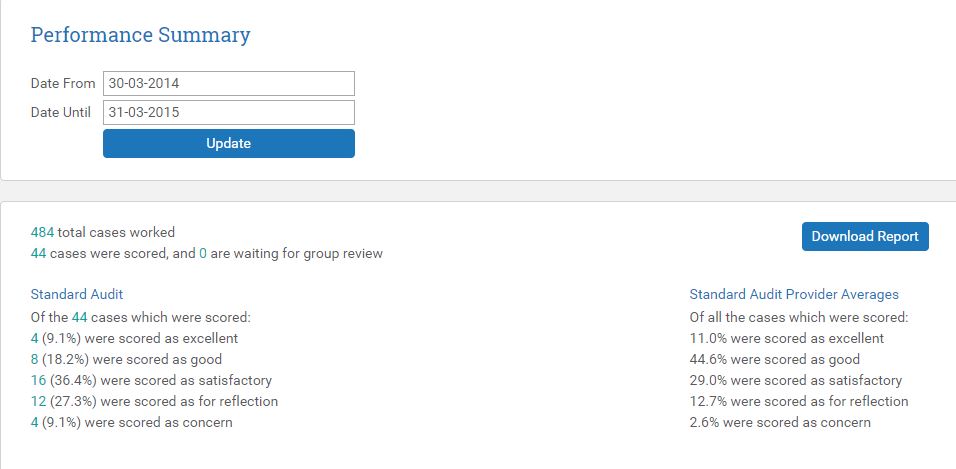
Clinical Guardian allows all the documented cases to be looked at anonymously by other clinicians so that the quality can be assessed. They look at 25% of each clinician’s cases and give each case a rating of ‘excellent’, ‘good’, ‘satisfactory’, ‘reflection’ or ‘concern’. These are then compared with the average results for other clinicians to give a performance summary. The one below is mine and you can see that I come out below average.

CG

This puts me in an amber category so that next month they will look at 25% of my cases again. If I improve (I know what I have to do and sincerely hope I do!) I might improve enough to move up to a blue or green category and only 10% of my cases will be reviewed. Cases that are graded for ‘concern’ are immediately emailed to the clinician concerned and cases for reflection can be responded to on the Clinical Guardian website. One of my cases for concern was a woman who might have had a DVT. I thought she could wait until the morning before assessment but the team disagreed. Cases for reflection in my case were usually because I had failed to document enough detail.

The experience of the doctors working in Bristol was that continually auditing their doctors’ work and discussing cases significantly improved the quality of their documentation and the safety of patient care.

When I was flagged up as ‘amber’ I was asked to meet with two of our other out of hours GPs and we discussed all the cases for concern over the course of an hour in a critical, but friendly, educational supervisory session. I’m very used to clinical supervision and opening my practice up to scrutiny  which undoubtedly softened the blow, but many GPs and consultants spend their lives working without ever having their practice inspected and audited like this.

The meeting last week with other GPs was, at times tense. They didn’t like being being judged on documentation that stripped a consultation of all the vital elements and quality markers of rapport, empathy, compassion, hands-on-skill, complex-shared-decision making and confidence-building. Nor does it include what patients thought of the consultation, although feedback for CHUHSE has been excellent. This audit looks only at the quality of documentation which is only one element of quality care, but nevertheless, we all agreed, an important one. In time, as we discussed our concerns, we gradually came around to the conclusion that a process of regular clinical audit and personal feedback – especially with an emphasis on education and support would be good for us, our patients and CHUHSE.

I’ve looked at the evidence and argued in a forthcoming paper that every clinician should have regular clinical supervision for as long as they are involved in patient care. The clinical uncertainty, ethical complexity and emotional engagement that we face does not fade with experience. I recently had the opportunity to go to a Schawartz round in a London hospital where a panel that included a consultant and a junior nurse sat in front of an audience that included any member of the trust who chose to come – there were all types of doctors, nurses, physiotherapists, and more. The panel presented a case that for them was especially important. The consultant began, but before he could finish was choked with tears. A facilitator sensitively introduced the next speaker while he composed himself and he later finished his version of the events. The details of the case, I’ll not share out of respect for confidentiality. The round lasted for an hour and the audience were invited to respond. In some ways it resembled a large Balint group, except that comments could be directed to the panel and they could respond. The facilitators explained that we weren’t there to give advice, so much as help them make sense of what had happened. We were especially moved by the nurse who said at the end, “I thought it was only the most junior members of staff who felt like this”. It is through role-modelling that virtues such as humility are learned and younger clinicians learn that vulnerability is normal.

When I (or indeed, almost any clinician) discusses the intensity of clinical practice, other professionals such as social workers or psychologists for whom clinical supervision is an essential part of their work, are astonished that we go without.

If we are to survive and sustain high-quality, safe and compassionate care in the face of unprecedented demands to do ever more with ever less, we need to support one-another. One of the best ways to do this is to open our practice and ourselves up to clinical audit and regular supervision- within a supportive, ‘just-culture’. As Don Berwick said after Mid Staffs,

The most powerful foundation for advancing patient safety in the NHS lies much more in its potential to be a learning organisation, than in the top down mechanistic imposition of rules, incentives and regulations.

Further reading:

“We view clinical supervision not as something imposed on medical professionals by their regulators, managers or those responsible for their ongoing training but rather something to be provided for and championed by doctors as something that helps them in their professional lives. In a world where pressures on many professions seem to increase almost logarithmically, it becomes harder to create the space for reflection – and yet that is when it is most needed”. Highly recommended Book: Clinical Supervision in the Medical Profession

Moving on from Balint: Embracing Clinical Supervision. Essay by John Launer

Listening and learning from people living with dementia

Peter

My father at his 79th birthday in 2012

Earlier this month, I was invited to Elizabeth Bartlett’s house in Salisbury. Funded by Wiltshire council, she holds weekly experiential memory support groups for people with dementia and their carers. We were warmly invited with tea, coffee and biscuits and then divided into two groups, one –  for the people with dementia facilitated by Elizabeth and one for the carers, facilitated by her husband John. I spent 45 minutes with each group. They meet to share their experiences of living with dementia and living with people with dementia.

I was invited partly because my parents have been going to the group for the last few months and finding it incredibly supportive, but also because of my enduring professional and recent academic interest in the relationships between doctors and patients. The carers especially, were hoping that I would be able to share their concerns and experiences with other GPs and medical students.

Context matters.

Patients, on the whole, are afraid to criticise their own GP in person. Too much hinges on good relations, and rather than confront each other when things go badly, they tend to go elsewhere. There are of course, exceptions. All GPs, myself included get complaints and not infrequently, doctors and their patients fall out for a while and get back together again. I bring this up because one of my first impressions was that we had the kind of frank conversations that I probably would not have had with my own patients or even patients from my own surgery or even perhaps in a healthcare setting. Being in Elizabeth’s home and being in groups, which had a self-evident camaraderie gave their members greater confidence to speak out, uncovered shared experiences and changed the balance of power.

It mattered also that I was there to listen to the groups talk about their experiences. I wasn’t there to give advice, make a referral, review their medication, or do anything. I was conscious of the importance of listening and Dr Iona Heath’s remarkable essay, The Art of Doing Nothing. This morning I read through my medical students’ learning objectives and realised that even from the second year at medical school there is more emphasis on the advice they’re expected to give patients than the depth of understanding they’re expected to gain about their experiences. I’ve been trying hard to subvert this, but students are understandably focused on stuff they expect to be examined on.

Getting lost.

I began with the dementia group. One of the new members said that after she had passed the GP’s dementia test her daughter complained, ‘but mum, that’s because you’re so competitive!” I remember my father’s delight at passing the more sophisticated Adenbrooke’s dementia score. I wondered whether he might have been diagnosed earlier if the psychologist had come over for a family meal or sent him out with a shopping list. We would have happily cooked or suggested some groceries.

Both the dementia group and the carers said that getting lost was one of the first things they noticed. One of the carers told us that her husband got lost and wandered into a hotel in Salisbury where the staff made him a cup of tea and offered to get a taxi to take him home.  When he could not remember where he lived the hotel staff asked the taxi driver to drive him around until he recognised his home, which, before long, he did.  His very grateful wife offered to pay the taxi driver but he told her he had already been paid by the hotel and it had been a pleasure to help. Getting lost, and having trouble with shopping lists, was often apparent before problems with memory or confusion.

Familiar tasks and familiar places may be much easier and mask dementia. The brother of one of the group who has a rare form of early-onset dementia was working as a GP when he was diagnosed with dementia. He was still competent in his work and loved by his patients but had to retire. Many of his patients protested and said they didn’t care!

The importance of a diagnosis and fears about screening.

Everyone, in both groups agreed that a diagnosis helped a great deal. For most, but not all, the relief exceed the anxiety about prognosis, but for those with an earlier onset dementia, for example Pick’s disease, it was a great worry. Some of the carers and those with dementia had been upset by GPs that had dismissed or tried to normalise their concerns as forgetfulness. One carer recalled their GP saying, “Oh my father’s like that, it’s just old age’. They were equally disturbed by the thought of unsolicited dementia screening and thought that older people had been afraid that their GP might use any opportunity to diagnose them with dementia. They were, on the whole, relieved that the planned NHS screening programme had been dropped but felt strongly that someone coming to their GP with concerns about dementia should be taken seriously. Doctors, like everyone else, are value-laden and some believe that forgetfulness is normal or that trying to diagnose dementia in its early stages is futile or impossible. Before my father was diagnosed, I pushed for a diagnosis, but I pushed too soon, he wasn’t ready and I over-reacted after that, thinking that an early diagnosis was futile and harmful. Both groups and I confessed many GPs, shared concerns that even the most sophisticated tests for dementia can be unreliable but it shouldn’t stop us trying to find what’s causing worrying symptoms. Time, attention and re-testing are all important. Those with dementia, whose symptoms were incredibly diverse, wanted me to know that dementia wasn’t just forgetfulness. “We’re all different”, they said, almost in unison. It is often said that if you’ve met just one person with dementia, you’ve met just one person with dementia.

Better relations between doctors, patients and carers.

We talked in both groups about how to improve relations with GPs and I told them that I have found Atul Gawande’s questions from his new book, Being Mortal, slightly modified, incredibly useful. They make other discussions about care so much easier.
(1) What is your understanding of your health or condition?
(2) What matters to you?  Examples might be, staying at home, staying out of hospital or a nursing home, Staying alive long-enough to see your children marry or your grandchildren graduate,  Being able to see your friends, Having the trip of a lifetime, Keeping your interests going as long as possible.
(3) What are your fears? Examples might be; being in pain, getting lost, not getting to the toilet in time, falling over, being alone, dying, not recognising your spouse/ children etc.
(4) What trade-offs are you are willing to make and not willing to make? For example will you do anything to live longer? Take any amount of medication?Spend any amount of money? Take any risks? Where might you draw the line and why?

I think after speaking to the carers today that they are useful questions for a carer to ask the person they care for and to ask themselves. I think doctors should ask them too. I’ve written a blog about how to make sense of risk and what to ask (or tell) your doctor here. In it I suggest that if your doctor doesn’t think to ask these questions it would be really helpful (from my GP perspective) if someone came along to tell me what they thought about them.

I think it’s important to let the person who is affected to answer them. Apart from the obvious fact that it’s their life we’re talking about, it is also, on the whole, much harder for families to let go. In Gawande’s book he notes that about 2/3 of patients with cancer are willing to undergo treatment they don’t want, if their families want them to. In neurosurgeon Henry Marsh’s incredible book, Do No Harm, he gives an example of a young man with a serious brain injury with little hope of survival. He explains that you can ask the family the same question in one of two ways, “What would you like us to do?” or “What do you think your son/husband/brother would want us to do?” The way the first question is phrased you’re asking, “Do you love him enough to care for him after we’ve operated and he’s severely disabled with no hope of recovery?” The second question lifts that burden of responsibility, yet you can love him still.

Thinking about care and carers.

I think the physical, social, economic, emotional etc. burdens of responsibility on care-givers – who are mostly women, unpaid and under-supported, are enormous and without a doubt under-appreciated. The emotional labour of caring for someone with dementia can be enormous. Psychiatrist/ anthropologist Arthur Kleinman writes beautifully about the nature and moral responsibility of caring for his wife with dementia,

My own experience of being the primary caregiver for my wife, on account of her neurodegenerative disorder, convinces me yet further that caregiving has much less to do with doctoring than the general public realizes or than medical educators are willing to acknowledge

The conversations reminded me that I don’t think I am very good at thinking about care. A doctor’s work is mostly diagnosis and treatment, but surprisingly little involves care. One can be caring, but the physical work of care goes on out of sight of many, perhaps most doctors. Kleinman explains that from his experience he has learned that it’s almost impossible to appreciate what goes on if you’re not physically and emotionally involved in giving care yourself. In GP Dr Margaret McCartney’s book, Living with Dying, she describes how the emphasis – driven by healthy young men in policy, politics and research, is driven towards drugs and technology, which diverts resources and attention away from the immediately necessary human support that people need. The carers reminded me of how important it is that GPs care about the carers and one of them told me about someone she knew who committed suicide because of the stress of looking after someone with dementia. I was ashamed recently when a podiatrist form the local foot clinic wrote to tell me that the daughter of one of my patients with dementia cried at his appointment as she talked about how stressed she was. Even though I’d seen her with her father many times before, I really hadn’t paid enough attention to how she was coping. I called her and we met later the same day and I listened to how she struggled to cope. I don’t think I did anything much beyond listen sympathetically, but I am sure that it helped that I knew what she was going through.  It’s important for GPs not to take what patients and carers say at face-value. They want to put on a brave face and want desperately to be seen as coping. As a GP I’d want to validate that but not miss the fact that they really might need help.

Continuity of care.

An issue that was shared between people with dementia and their carers was the importance of continuity of care. It was at least as important for the carers as it was for the people with dementia, because it mattered so much that the professionals involved knew something of the context in which they were living and caring with dementia. In my own practice of 12 part-time doctors and over 13 thousand patients we have, by hard work and determination increased the proportion of appointments where a patient sees their own doctor, from 50% to 80% in 2 years. If we can do it, so can other surgeries. We prioritise people who have long term-conditions for whom it matters most, but try to make it happen for everyone.

The conversations were especially valuable in part, because we were not in a hospital or GP surgery, where the balance of power leans towards the health professionals and participants are more reluctant to criticise those that are responsible for their care. Having a group of people with different experiences and different GPs allowed me to hear about how experiences shared and diverged, about good and bad. It’s easy for me, or any health-professional to assume that our way of working is typical, or that we know about patient experiences because we know our own patients, but this showed me how limited my own perspective can be.

Stepping out of my surgery and into Elizabeth’s house has taught me a lot about how living with dementia affects people and families, and about the importance of context, power and relationships and the nature of care. It was obvious that for those people living with dementia, like my parents, the group is incredibly supportive and I can easily imagine how much groups like this could help carers and people who are cared for, for whom loneliness and isolation can massively add to their work.

I think that health professionals in training and in practice could learn some profoundly valuable lessons from taking a seat among those we are here to serve, and listening to their concerns and their experiences.

The Case for Intelligent Kindness

Here is a link to a wonderful editorial by Penny Campling about the role of Intelligent Kindness in Healthcare. It’s the kind of thing I’d love to have written myself. Please take time to read it and share it.

The virtuous cycle of kindness:

IK

Editorial: Reforming the culture of healthcare: the case for intelligent kindness

by Penelope Campling

Narrative and reflection

Day 2 of Narrative and Medicine

IMG_2285

The first 2 presentations shifted the attention to the flip side of the narrative coin, reflection.

A narrative, in the context of a therapeutic relationship, demands a response. Morally we are duty-bound to act and the action begins with reflection. Reflection comes more naturally to some people than others, but, as the superb presentations this morning showed, reflection encompasses skills that can be taught, but to be of value must be practiced. This paper by Carmen Caeiro and Carla Pereira showed how a narrative reasoning course helped physiotherapists develop understanding of patients’ experiences and themselves as well as embedding reflective practices in clinical practice. I’ve highlighted the last bit because I think it’s of tremendous importance for medical education in general and medical ethics education in particular because reflective practice is embedded in most medical curricula with little evidence about what it’s doing or whether it continues into clinical practice. The power of the hidden curriculum, the culture that socialises professionals into ways of thinking and acting, is formidable. Reflective practices are subversive of culture because they equip professionals with the conceptual tools and deliberative practices that challenge established cultural norms. The presentation by Alan Weber about a narrative and reflective writing course in Qatar, bought this into a sharp perspective.The Qatari poet Mohamed Rashid al-Ajami was jailed in 2012 for 15 years for a piece of public reflection, a poem that criticised governments across the Gulf region in the wake of the Arab Spring uprisings. Alan’s students have grown up in a culture where personal reflection is discouraged and even to begin to teach the skills has been a huge challenge. By critically analysing safe subjects like arts and literature the students developed the confidence and critical skills which they were then able to turn on themselves, the practice of medicine and culture beyond. They chose to write reflectively about issues like virginity examinations, autonomy, sexuality and other taboo issues, some too dangerous to publish, though many of their essays have been published, albeit anonymously in three volumes. It’s easy for us to think about the Qatar students as being something ‘other’, we’re reflective they are not, we can write about controversial subjects, they can not but I was reminded of Rees and Monrouxe’s work with UK medical students’ professionalism dilemmas. They asked students write about unprofessional behaviour they witnessed, which included doctors inviting students to perform intimate examinations on anaesthetised patients without their consent and bullying of students and other professionals. Reports from Kirkup and Mid Staffs about dreadful, unprofessional behaviour should remind us that we have our own taboos which are being uncovered, but all too rarely discussed in a supportive, reflective setting, where something can be done before it’s too late. If we teach reflective skills and embed reflective practices – which as I argue in a forthcoming paper we should, it can help us challenge our own and others behaviour every day. It can undermine hierarchies and make professionals more sensitive to patients’ experiences. Reflective practices teach us humility and show us that there are multiple perspectives and help us reveal them, value them and judge them sensitively and seriously.

IMG_2300 IMG_2301 IMG_2303 embedded reflection

Teaching reflective skills is not easy. When I go to the annual tutors’ day at Barts and the London it’s very common for tutors to admit their lack of confidence. Careiro and Pereira have both undertaken post-graduate studies in medical humanities at the university in Lisbon and involve sociologists and psychologists in their teaching. Their students have an 8 week course and read challenging texts by Kafka and Nietzsche as well as watching films like One Flew Over the Cookoo’s Nest and The Diving Bell and The Butterfly before each small group tutorial. The course was introduced into a new curriculum with the support of their university. For those of us working in long-established medical schools without their skills, replicating their work will be difficult, but far from impossible.

From Dr Interpretive to Dr Discursive

In Emmanuel and Emmanuel’s classic paper about four models of the doctor-patient relationship they describe an evolution from Paternalistic, via Informative and interpretive to discursive. One of the problems about narrative and medicine is that there is a tendency to get stuck on the interpretive. There is a lot of fascinating theory about how to interpret narratives. In the afternoon sessions we heard about narrative’s interpretive limits in a paper given by A. Sile about the book Exploding Into Life by Dorothea Lynch and her photographer partner Eugene Richards. The book, about Lynch’s experiences with breast cancer is illustrated with Richards’ photographs. Neither narrative nor image stand alone, both are different representations of Lynch’s experiences. Later, Richards who was a professional documentary photographer, said that he wouldn’t trust a photograph without text, and one suspects, text without a picture. I was reminded of UK artist Emma Barnard’s fantastic photographic portraits of patients who have had head and neck surgery for her patient as paper project. The photographs are presented on X-Ray acetates and then the patients are invited to respond by writing and drawing on their portraits. What she shows, beautifully and simply, is that patients can be represented in multiple forms by others and by themselves.

Medicine is, of course an interpretive practice, we interpret a medical history, signs and symptoms, blood tests and scan results, response to treatment and so on. And the things we interpret are themselves representations of the ‘thing’ we are trying to diagnose. Layer upon layer of representation and interpretation. Medicine is not a science, or even an interpretive science, though it is informed by science. It is, among other thing an interpretive practice. Kathryn Monrgomery, another narrative medicine pioneer has written about this in her book, How Doctors Think.

In the last paper I heard today, Briege Casey, who teaches a medical humanities course to nursing students in Dublin, described how established pedagogic practices such as Imagework by Iain Edgar and Ekphrasis can equip educators with simple tools to teach students sophisticated interpretive skills. With these we can help to teach wisdom and intellectual curiosity.

IMG_2312

IMG_2313

She finished with a quote from one of her students that is of profound importance to anyone concerned with patient-centred care,

how would your patients choose to represent you?

IMG_2317

Keynote by Rita Charon

Narrative justice, competence and humility.

Day 1 of the Narrative Medicine conference in Lisbon.

N&M

Details of the conference are here: http://narrativmedicin.wix.com/conference2015

This isn’t a comprehensive review for the most part because I struggled to keep up with the Portuguese interpreting, even though it was pretty amazing that they kept it up all day, in time with the speakers.

Narrative medicine is a branch of the medical humanities that has a particular power because clinical practice already begins with a patient’s history which is a natural space where narratives can be introduced. There is no equivalent for the visual or performing arts.  Medicine then shares its power selectively with the narrative medical humanities and we have conferences in beautiful places like the Calouste Galbenkian Foundation. It’s worth thinking about, but I’m not complaining. Not only because I’m here, but because I do find narratives very useful. More to the point, patients and families complain all the time that they are not given the opportunity to tell their story, their version of events, their interpretation of their symptoms, their experience of care, their fears and so on. Narrative medicine is the conceptual toolkit that enables this. It’s worth emphasising that this is not simply a matter of time, though that’s often the excuse that professionals give.

Taking a structured medical history is not the same as allowing a patient or carer (which is of increasing importance) to tell their story. I’ll be publishing a blog shortly about what people with dementia and their carers think about GPs … It’s a medical maxim that 80% or more of a diagnosis is contained in the patient’s history a figure that has barely changed in the last few decades of technological advance. And yet comparatively little close attention is given to what goes on when a history is given and received. Dinosaurs of the medical education establishment barely conceal their contempt for communication skills training and this rubs off on medical students who see it as fluffy and unscientific.

Applying scholarly rigour, Zsófia Demjen and Elena Semino explained how linguistics could reveal unappreciated aspects of the text of Henry’s Demons, a book written by a father and his son who has schizophrenia. Examples included the different types of language used to describe auditory hallucinations and how the overuse of the pronouns like ‘I, me and my’ were associated with a deteriorating mental state. Their analysis made me think that health professionals would benefit from listening more carefully to the way patients describe their symptoms and the words they use, and not just the factual content.

Narrative is not just about how we listen but how we read. E. Koopman interviewed readers who had differing experiences of depression, during and after they read 3 books about depression; The Bell Jar by Sylvia Plath, Mr Chartwell by Rebecca Hunt and The Noonday Demon by Andrew Soloman. What she discovered was that different texts affect different readers in different ways, which may seem obvious, but it is perhaps more of a concern if we think about why different doctors respond differently to a patient with depression. She showed that readers didn’t have to respond emotionally (or with empathy) to develop a deeper understanding of the experience of depression. I’ve long been sceptical about the possibilities of teaching empathy and this adds to my thoughts that it’s more important to teach medical students about how patients experience illness. Differences in the way they respond depend on their experience of depression and their intrinsic empathy, and to the way the depression narrative is told. How a patient might alter their narrative I’m not sure, but it does raise questions about narrative competence.

Narrative competence as commonly understood is the ability of professionals to be competent at taking a narrative history, but it is also how competent a patient is at giving their account. It’s essential for the professional to have narrative competence for the patient to be at ease and have sufficient trust in order to share their story, the professional must be a good listener and ask perceptive questions sensitively. But even with this (probably too rare) situation to start with, some people just aren’t very narratively inclined. Anthropologist Arthur Frank – one of the early pioneers of medical narratives, described some narratives as chaos and Galen Strawson argues that there are deeply non-Narrative people. Some people are natural story tellers, most of us know people who have ‘a gift’ for telling stories, others are masters or mistresses of poetry or literature. Some of us really struggle to find the words to describe our experiences and infants and those rendered voiceless by disease lack narrative competence.

If patients need narrative competence for narrative to ‘work’ then professionals need narrative humility to recognise that there are a usually several stories to be told, including their own, the patient’s, the carer’s, and any others who might be involved. The evening session with Alexandra Cheira, Cecilia Beecher Martins, Marijke Boucherie and Elisabete Lopes reminded me that narrative may be one of many means to justice. Philosopher Havi Carel whose work I’ve found to be extremely helpful  in everyday practice, united the speakers’ concern that health professionals do justice to patients in their capacity as knowers. Carel describes giving justice to their narratives as ‘testimonial justice’ but she also describes ‘hermeneutic justice’ in which patients’ interpretations are actively solicited and taken seriously. This need not involve narrative. Professor of general practice, Ed Piele has developed Values Based Practice in which patients’ and professional’s values are given serious attention and lead to another kind of justice. This session, like those that had gone before reminded me that for justice to be done, at the very least, there should be patients telling their own stories, or turning their analysis on professionals’ narratives and their use of patient narratives.

Nevertheless it is patients’ narratives that are central to this conference and I like to think that another early pioneer of narrative medicine, Arthur Kleinman, would be pleased.

Competition, choice and commitment

4544914097_f47d59c90e_z

Photo © Lee Jeffries flickr 500px

People who were least able to take advantage of competition and choice were,

less educated, less well-off, more likely to describe themselves as struggling financially, less likely to own their own home, less likely to have internet access, more likely to be disabled or a single parent.

They were also more likely to stick with providers with whom they had an established relationship.

They were identified in the Competition and Markets Authority (CMA) report on competition and choice between energy suppliers. Because of the associations between poverty and ill health these vulnerable people also stand to benefit least from competition and choice in healthcare.

Dr Smith was well past his due retirement, but was unable to find anyone to take over his surgery in a pretty rough part of town where he had been a single partner for nearly 40 years. His wife had been the practice manager until she had a stroke and then had to be cared for in a nursing home. He had been struggling to make money from the surgery for the last few years due to the cost of locum GPs and a locum manager. The building was desperately in need of repair. Dr Smith was tired and struggled to keep up with the paperwork, coming into work every weekend and staying late into the evenings. He hadn’t had a holiday in the last 3 years. He had survived his annual appraisals and revalidation by the General Medical Council and he was allowed to continue working even after the Care Quality Commission made a long list of recommendations after inspecting the practice. Like many GPs it was his considered opinion that the only things guaranteed by regulation and inspection were time taken away from patient care and low professional morale. Dr Smith was loved by many of his patients who known him for years and trusted him unquestioningly, though his treatment regimes were often out of date and he was tended to be pretty blunt.

One day, at work, Dr Smith had a heart-attack and died at his desk. When Dr Jones and partners took over his list, they found that the patients were more likely to be,

less educated, less well-off, more likely to describe themselves as struggling financially, less likely to own their own home, less likely to have internet access, more likely to be disabled or a single parent.

They were also more likely to be over 65 and have cognitive-impairment, learning difficulties or long-term mental illnesses. Other patients had changed GP long before Dr Smith retired. They didn’t need Friends and Family tests, NHS choices feedback, ‘I want great care’ or any other on-line rating system to recognise that the shabby waiting room and the ever-changing locum GPs weren’t ‘great’. But many of those that remained valued the long relationship that they had with Dr Smith and everything they had been through together. A fair few had been born at home and delivered by Dr Smith – twenty or thirty years ago it was common for GPs to deliver babies. He had cared for their parents and grandparents, their children and grandchildren. Personal care from a doctor they considered a family friend was of more significance than anything that could be measured and listed on a GP comparison site. According to the CMA report, energy consumers who valued long-term relationships based on trust and familiarity were also not served well by competition and choice.

The NHS is founded on the basis of equality and fraternity but liberty, as defined by competition and choice are new values for the NHS. ‘Liberating the NHS’ was the name of the 2010 government white paper that preceded the NHS Act, and the focus on liberty has increasingly eclipsed equality and fraternity. Competition and choice are enforced by a new NHS organisation called Monitor and strongly advocated by government advisers including Tim Kelsey, National Director for patients and information and Andrew Taylor, founding director of the NHS Competition and Cooperation Panel and now adviser to NHS providers on competition issues.

A situation where there is less transparency and no choice between providers cannot reasonably be defended, but questions need to be asked such as, What is the point of competition and choice in healthcare? Why must it be enforced? Who will benefit and who will lose out? What if patients don’t want to behave like consumers? What are the alternatives?

The point of choice is that it demonstrates respect for autonomy. Proponents argue that since quality between providers of care varies, patients have a right to know who is best so that they choose accordingly. They argue that if patients choose the best or cheapest providers then all providers will have to increase their quality or reduce their costs to stay in business. When choosing energy supply the cost is not the only consideration, though you wouldn’t know it from the CMA report. Other issues include ‘green energy’ and customer service and the confidence that comes with staying with an established provider.

When choosing healthcare, measuring quality is extremely difficult. Other factors like access, location, continuity or ‘customer service’ may be more important or even conflicting. For example, a service with better continuity of care – assuming such a thing is measured, may be hard to access. Quality, whatever that means, may not be the same as ‘what matters’, because what matters to a young mother joining a GP surgery may be very different for a working man with diabetes or a frail, elderly couple. ‘Choice’ when you are having a miscarriage, when you’ve broken your neck, when you have cancer or when you’ve got depression, hepatitis and diabetes all together or if you are housebound with severe agoraphobia and heart-failure may have very little to do with choice of healthcare provider and a lot to do with the quality of the relationships you have with health professionals. Leaving Dr Smith who has looked after you for 20 years because Dr Jones has got a better CQC report doesn’t make so much sense when you think about the importance of therapeutic relationships.

Healthcare is, for the most part, dependent on the quality of relationships between patients and professionals. It is interactional and cooperative. It is full of uncertainty about the nature of the problems and what should be done. More than ever it is about the care and support of patients with multiple long-term conditions in which long-term therapeutic relationships are most important. At other times care is for emergencies in which speed, not choice is key. Less often health care is transactional -for example when a patient has a clearly defined problem and is in need of a standard procedure for which outcomes are relatively easy to measure and relationships relatively unimportant. Here competition and choice may have value. But for most health care, the relationships between patients and professionals are both complex and caring and depend on mutual trust and respect and time to get to know one another.

Both the CMA and those directing health policy are of the opinion that the problems of choice and competition can be overcome by offering more choice and making it easier to choose at the same time as increasing competition. Underlying their bullish confidence is the morbid conviction that online league tables are more trustworthy than human relationships. Even more disturbingly, because choice and competition can be taken advantage of by the powerful far more easily than the vulnerable, the gap between them will be forced ever wider.

See also:

Competition, choice and quality in general practice

Patient centred care, rhetoric and reality

What’s the point of patient choice?

What’s in a name? Patients, clients or consumers?

High profile public reporting of quality doesn’t affect choice of maternity services

Making it up as we go along

Phil’s spinal surgery hadn’t gone well. From a self-defined 70% of full painless function, he was down to about 30% after the operation. We spent an hour talking and I was struck by how much the poor quality of the interpersonal, relational care was at least as much of a disappointment as the failure of the operation to improve his symptoms. He reminded me of General Practice Professor, Kieran Sweeney who complained, in tears, that while the transactional aspects of his care with cancer was faultless, the relational aspects simply were not.

Medicine is not solely a technical activity and pursuit, medicine is understanding and being with people at the edge of the human predicament.

He goes on to make the distinction between being cared for and being cared about. Those caring for him were kind and competent, but those who cared about him, went beyond this to find out what really mattered to him.

At the end of our chat, Phil (a friend, not a patient) asked if I would give a talk about doctors and patients at his shop, Cyclefit which runs public-lectures. Without either hesitation or thought, I agreed and quite hastily came up with the title, ‘How to tell if your healthcare professional is making it up as they go along’

Making it up

The link to the slides is here and the notes are below.

Art, Science or Practice?

asp

Science has made such enormous strides and contributed so much to modern medicine that it is tempting think that medicine needs to be more scientific. Indeed there is evidence that doctors cannot interpret even the most basic statistics that are used to present the findings of most medical research and the lack of statistical literacy has been described as a large-scale ethical problem. On the other hand, there are those who think that modern medicine lacks humanity and doctors need more training in the arts and humanities. Being embedded in one camp or the other, there are those who believe that a doctor who becomes more of one will become less of the other, and most people if forced to choose between competence and kindness will err towards cold-hearted technical skill rather than compassionate ineptitude.

But they are not mutually exclusive and medicine is neither art nor science, but a practice, in which clinical judgement is not only knowledge of what could be done, but wisdom to decide what should be done. This practical wisdom, or phronesis, the skill to combine expertise and value, science and subjectivity is what makes doctors practitioners, rather than scientists or artists.

hm

Brain surgeon, Henry Marsh’s extraordinary book sets the scene at the beginning of many of the chapters: in a darkened room his trainees are looking up at the projected brain-scans of patients admitted overnight who are being considered for surgery. Eager to impress, they are often quick and confident as they identify the anatomy and the diagnosis and possible surgical interventions. On the question of what ought to be done, whether the risks of surgery or the likely prognosis warrants intervention they are far more reticent. He notes, more than once that, ‘few people outside medicine realise that what tortures doctors most is uncertainty’ a point also made by US surgeon/writer Atul Gawande in his book about care at the end of life.

Evidence-Based-Medicine

The modern pioneer of evidence-based-medicine (EBM) David Sackett, described EBM in 1996 as the integration of individual clinical expertise with the best available external evidence and the patient’s values and expectations. 

EBM = clinical expertise + external evidence + patient values

Sackett was well aware of its limitations,

Without clinical expertise, practice risks becoming tyrannised by evidence, for even excellent external evidence may be inapplicable to or inappropriate for an individual patient.

There may be more fundamental problems.

For one thing, it’s not clear why clinical expertise is on the right side of the equation – as if it is somehow separate from evidence and patient values rather than the ability to integrate them. Why not,

Clinical expertise = external evidence + patient values?

More importantly though, patient expertise and clinician values are excluded despite it being obvious, if under-appreciated that patients are experts and clinician values influence care. Greater attention to clinician values and patient expertise is almost certainly key to understanding variations in care.

A better formulation might be,

Clinical practice is the integration of the best evidence with the combined values and expertise of patients and clinicians.

Taking into account values and expertise is no easy task, and has been the subject of many of my blogs, but the science itself is too often of dubious quality and reliability and most associations tend to be overstated. Clinical judgment is inescapably uncertain.

Making sense of stats.

The misinterpretation of statistics by public figures is a common source of educational material. President Eisenhower’s astonishment and alarm at discovering that half of all Americans have below average intelligence being a well known example. New York Mayor, Rudi Giuliani’s relief at being diagnosed with prostate cancer in the US where survival is twice that in the UK is a good example of how screening can effect survival rates.

ltb

It is easily assumed that the earlier something is diagnosed the better, but there are reasons to be cautious. For one, it may not be possible to do anything to prevent the progression of the condition, so an early diagnosis may just increase the number of years that you’ve got to worry about it. For another, the natural progression of many conditions can be variable and difficult to predict. In these cases, erring on one side of caution results in more investigations and treatment which can do more harm than good, as in the case of breast cancer. A recent review concluded that lives were not being saved by screening adults with no symptoms. Choosing Wisely is one of many movements dedicated to helping doctors and patients make sense of screening and other medical interventions.

Relative and Absolute risk reduction.

RRRARR

Statins, the drugs that reduce cholesterol levels are now the world’s most widely prescribed drugs, but most people taking them don’t know how much benefit they’re getting from them, or whether the benefits are likely to outweigh the risks. There are excellent online decision tools, here, here and here and many others. As statin can reduce your risk of heart attack or stroke by about 30%. This is the Relative Risk Reduction (RRR) and is the same for everybody. The Absolute Risk Reduction (ARR) depends on your personal risk of heart attack or stroke to begin with and so is specific to you. This is the one that matters. If you are at high risk, for example your parents had heart attacks, you have diabetes and high blood pressure, you’re overweight and smoke, then you’ll have a lot to gain – about a 30% ARR. But if you’re a fit 40 year old with none of those risk factors, you will have very little to gain, because your starting risk is so low, about 0.7%, and 30% of 0.7  is about a 0.2% ARR. In the slides I compare 50 year old smoker, Nigel Farage, with 43 year old, recently retired professional cyclist, Jens Voigt. The Numbers Needed to Treat (NNT) is a measure of how many people, like you (or Jens) will need treatment to prevent one heart attack or stroke. For Nigel it’s about 12 and for Jens it’s about 500. It’s worth considering that stopping smoking or eating nuts and olive oil every day would do Nigel more good than taking a statin and that either of them could have other risk or protective factors we don’t know about. Risk prediction is a very uncertain science.

Relative Risk Increase

DM

RIR

Newspapers, especially tabloids, make good use of relative-risk increase statistics, for example the Daily Mail: ‘3 rashers of bacon a day increases your risk of breast cancer by 20%’ headline. As with a risk reduction, a risk increase depends on what your risk of breast cancer is to begin with. Breast cancer is the most common cancer in the UK, affecting 1 in 8 (12.5%) of women. Fortunately almost 80% of women are still alive more than 10 years after diagnosis, but this doesn’t make it much less frightening. Assuming you are at average risk, a 20% increase on top of a 12.5% starting risk means an extra 2.5% risk, which equates to 2.5 cases of breast cancers over the lifetime of a hundred women who eat 3 slices of bacon every day for the rest of their lives. Professor of the public understanding of risk, David Spiegelhalter explains this in a video about bacon and bowel cancer.

What to ask your doctor and what to tell your doctor.

wttyd

One thing that would be good for patients to ask their doctor before taking a statin (or any medication designed to prevent some future illness) is, ‘What’s my risk to start with?’ It may not be possible to put a figure on it, but its definitely worth bearing in mind that the higher your starting risk, the more you’ll have to gain from taking the drug and vice versa. It might help to ask, ‘how many people like me would need to be treated for one to benefit?’ There is a great explanation of numbers needed to treat (NNT) here. I would also ask about what are the risks of side effects of the treatment and the numbers needed to harm (NNH).

Other things that are often overlooked are,

  • What do you know?
  • What is your interpretation?
  • What matters to you?
  • What are you afraid of?
  • What are you (not) willing to do?

These are questions that a good doctor should ask you, but often they won’t, perhaps because they weren’t trained that way. They’re taken from Atul Gawande’s book, Being Mortal. It took him almost 20 years to realise how important they are. They help you build a partnership with your doctor to answer the hardest clinical question of all, ‘what should we do?’

Be careful what you ask for

refscan

It may be tempting to skip the GP and go straight to a specialist, but the specialists’ diagnostic powers depend in part on the GP referring them only patients who have a significantly higher than average risk of disease. Brain surgeon Henry Marsh wrote that the experience he had gained by the end of his career made him much more cautious about who he operated on. Young specialists tend to be keen to intervene and tend to overestimate the value of their interventions. It’s tempting for patients and doctors, to skip this difficult, getting-to-know one-another phase and go straight for a scan or a referral, but without context and background information it can be extremely difficult to interpret results. For example, by the age of 50, 80% of people with no symptoms of back pain will have ‘disc-degeneration’ on an MRI scan.

Once you’ve told the GP about your problem and they’ve examined you, they will often wait and see. When Voltaire said that ‘the art of medicine consists of amusing the patient while nature cures the disease’ he was, for most conditions absolutely right. The most articulate of GPs, Iona Heath has described what we do as The Art of Doing Nothing. But doing nothing may require great strength to bear witness and support patients during terrible suffering, or very serious and careful listening. A good doctor will tell you how long your symptoms should last and make sure you’re seen again promptly if they don’t resolve in the expected time. By now the probability that you’re suffering from something more serious might have increased from 1 in a thousand to one in a hundred or even less. This excellent paper shows you how much time contributes to diagnostic accuracy in general practice and this online tool shows how changing the likelihood that a patient has a condition, radically improves the reliability of medical tests.

Good doctors make it up as they go along. 

Bayes

In the 18th century, Thomas Bayes developed a simple mathematical formula to show how adjusting prior probabilities affected future predictions. Doctors, who do this all the time, have been described as natural Bayesians. The history contributes up to 90% of a diagnosis and most of the remainder is contributed by physical examination and simple tests. Every question in a medical history and every sign in a physical examination changess the prior probability of a particular diagnosis.

Like the cyclists in the presentation, who have prepared as well as they possibly can, but need to be constantly vigilant of changes along the way, doctors are continually reappraising their patients, open to new information and changing circumstances. Good doctors are partners with their patients, sharing information in ways that they both understand, discussing values, risks and uncertainty and creating narratives that make sense to them both … making it up, as they go along.

Further reading:

The James Lind Library

Less is More Medicine

Going the distance

“I have to tell you, good medicine goes the distance with the living and the dead… The dead don’t care much but they do matter. And your presence with those people for whom they matter …  your showing up and pitching in and doing your part, is part of the very best medicine that you’ll ever do.”

Thomas Lynch, Undertaker-poet was speaking to an audience that included many medical professionals at the wonderfully eclectic Dotmed conference in Dublin. His work starts when ours finishes and as he gently reminded us a little overlap might do us all good. His words stuck with me, and were still very much in mind when I got news of John’s death.

At the age of only 29 he died in a motorbike accident just before Christmas. The first thing I did when I found out was to call his sister, Tessa. She was with her mum and they asked if they could come to the surgery, ‘Of course, come as soon as you can’

We met and shared our memories of John and they invited me to say a few words at his funeral. Here is what I said, with some added context and a couple of other memories I didn’t have time to include.

I was John’s GP for 11 years. I work in a practice that has a policy of every patient having their own doctor. Doctors and patients are possessive of, and loyal to each other. I got to know John as a result of asking him to come in for an hour at a time to help teach medical students about eczema. His was pretty severe. But what he taught us was that you can’t really get to know and understand what’s going on with someone’s skin, if you don’t make the effort to get to know and understand what’s going on inside their head. It’s a lesson every doctor with an interest in any organ needs to learn.

I remember the time he came in complaining that he felt ‘weak’. It’s probably the worst thing you can say to a GP because it’s the most common complaint and the least specific. It really isn’t helpful, diagnostically speaking. Inwardly, and sometimes outwardly too, we groan when patients complain of feeling weak. “It’s kind of interfering with my job”, John continued. He was a welder and I imagined him welding panels to the sides of ships. He was thin, but hard and wiry. “OK, OK, I said. Let’s examine you”. I gestured for him to stand up and we stood facing each other. “Now, lift your arms, like this,” I raised my arms out to the sides and above my head. John shrugged his shoulders and with all the strength he could muster, swung his hands up as far as his shoulders. They flopped back down again. ‘oh God,’ I thought, ‘this is terrible’, my fear and frustration came out when I pleaded with him, “Why the hell didn’t you come in sooner, I mean, in what way, exactly is could it possibly not be interfering with your work?!” His understatement had reached an unprecedented level. I called the National Hospital for Neurology there and then, and they said that they could see him in a couple of days. I told him to pack an overnight bag. They kept him in for 2 weeks of intensive investigations and after a couple of years back and forth to their outpatients, eventually he mostly recovered.

Not complaining was typical of John. If he was having a hard time, there was no point asking, ‘how are things?’ because he didn’t like to disappoint you or take up your time. After a while we found our ways of talking about ‘how things were’. Hard as my job is, I suspect it would be a lot harder if more of my patients told me how they were really feeling.

Another thing John taught me was that happiness, good health and self-confidence come from feeling you’re in control. One of the last times we met, he told me he’d been cooking. This was when we were watching Breaking Bad, and I felt a little nervous. I hear a lot of confessions in my line of work but I needn’t have worried, because John had been cooking eczema cream, out of beeswax, olive oil and brine. He had jars of it all over his flat. I tried to coax the recipe out of him, but what he’d really come in to tell me, was that it worked better than anything I’d ever prescribed. As if to prove it he didn’t pick up any of his monthly prescriptions for about six months after that.

What I’ve learned from John has relevance to almost all my teaching and my practice because it is about what it means to be a good doctor: the importance of listening, of not taking what patients say at face value and the importance of being able to manage without doctors.

What I’ve also learned is that the dead do matter and being John’s GP for just a little longer than I had expected was one of the most moving and rewarding things I have ever done.

Everyday ethics

schonIn the varied topography of professional practice, there is a high, hard ground overlooking a swamp. On the high ground, manageable problems lend themselves to solution through the application of research-based theory and technique. In the swampy lowland, messy confusing problems defy technical solution. The irony of this situation, is that the problems of the high ground tend to be relatively unimportant to individuals or society at large, however great their technical interest may be, while in the swamp lie the problems of greatest human concern. The practitioner must chose. Shall he remain on the high ground where he can solve relatively unimportant problems according to prevailing standards of rigor, or shall he descend to the swamp of important problems and non-rigorous inquiry? Donald Schon, 1987, p.3

Schon was referring to reflective practice, as very nicely described by Clare Morris on the Medical Education Matters blog. But he could just have easily have been talking about medical research or, the subject of this blog, medical ethics education.

A review of ethics curriculae in 2000 concluded that, there is a consensus that the ultimate goal of medical ethics, and indeed of medical education as a whole, is to create ‘good doctors’ (Goldie, 2000)

This surprised me and will probably surprise most medical students. Not only does medical ethics play a relatively small role compared to traditional subjects, but it is still possible in many medical schools to graduate without passing ethics assessments. Even when students do pass it’s relatively easy for a bright student to know what to say irrespective of whether or not they believe it, and even if they do believe it, the links between ethical thought and ethical action are tenuous.

What constitutes a ‘good doctor’ may at first to appear somewhat nebulous, but conceptions have been remarkably consistent. Whitehead studied discourses of the ‘good doctor’ over the last century and described them as a carousel, with different aspects rising and falling in prominence. To take one example, apparently contemporary concerns about the lack of humanity in care were also around in 1927 when Francis Peabody wrote in a keynote to Harvard Medical School,

“The most common criticism made at present by older practitioners is that young graduates have been taught a great deal about the mechanism of disease, but very little about the practice of medicine – or, to put it bluntly, they are too scientific and do not know how to take care of patients.” 

What is required to be a ‘good doctor’ is also context dependent, for example there will be times when technical competence takes precedence over sensitivity or quick decision-making takes precedence over patience.

The most interesting work about what it means to be a ‘good doctor’ is being carried out be Charlotte Rees and Louise Montroux who are studying medical students conceptions and experiences of professional behaviour. Unsurprisingly perhaps, students tend to think about professionalism in terms of individual character and action, rather than more general terms, such the GMC ‘Duties of a Doctor’ or the succinct 2005 Royal College of Physicians definition of professionalism,

A set of values, behaviours, and relationships that underpin the trust the public has in doctors.

The contrast between institutional definitions and medical student experiences of professionalism (and the ‘good doctor’) is perfectly described by Donald Schon’s quote above. An overemphasis on teaching principles has left medical students, professionals and patients sceptical about whether we are serious about helping students and doctors to ‘be good’.

A brief history.

For the first half of the twentieth century there was little or no concern with educating for professionalism- a medical ethics reliant on etiquette and paternalism was assumed because a doctor was ethical by virtue of the being the kind of ‘gentlemen’ that doctors were, and medical ethics was not a subject that could be studied as, “One acquired it in the course of learning to become a good doctor,”

Doctors were assumed to be ‘good eggs’ and that was reason enough to dismiss attempts to introduce anything resembling professionalism/ ethics or communication skills training. The problem with this approach was the rather obvious fact that there had always been ‘bad eggs’. Medical ethics education was slowly introduced in the 80s and 90s, but it’s still possible to graduate at the end of medical school without passing exams in medical ethics. Even if a student passed exams in medical ethics it was highly doubtful that knowledge of ethics translated into ethical action anyway. Among the profession, the problem of scandals involving ‘bad eggs’ in recent years caused such a stink that the laissez-faire approach to professional self-regulation could no longer be tolerated. And so the state stepped in and now we have inspections and regulations, appraisals and revalidation which have demoralised professionals with administrative burdens while doing nothing to improve professionalism or restore public trust.

It has become increasingly obvious that neither medical ethics education, nor professional laissez-faire self-regulation, and certainly not state bureaucratic inspection and regulation are contributing to professional, ‘good’ doctors.

How to become and stay, a professional, good doctor.

The 2010 Royal College of Physicians, Future Physician report said,

We call on all doctors to recognise that medical professionalism in a changing world looks beyond the boundries of medicine. (RCP, 2010)

The first, and most important thing to do is realise that being a professional good doctor more than anything else, is in order to benefit patients and society. According to George Bernard Shaw, ‘all professions are a conspiracy against the laity’, and the medical profession is singled out as ‘a conspiracy to hide its own shortcomings’. This is still a popular belief and can only be addressed if professionalism is conceived, taught and practiced in partnership with patients and the public.

The most important part of partnership is humility. The definition of evidence-based medicine as the integration of scientific evidence with professional expertise and patient values, demonstrates the paternalism that still dominates medical thinking. Missing from this conception are the professional’s own values, the patient’s expertise and the expertise and values of other important stakeholders such as family and carers. Putting our own values into perspective can be achieved by values Based Practice. Narrative medicine teaches us narrative humility, the awareness that patients have not only medical, but also personal histories and the awareness that illnesses fit into the context of real lives.  Teaching about epistemic justice reveals that patients have ways of interpreting illness, suffering and medical interventions that are of profound importance.

Awareness that  our own, medical perspective is only one of many requires us to engage with voices and opinions we might not come across in our usual practice. Social media offers huge potential because it is here that people using blogs, Facebook, Twitter and so on are writing their own stories about their experience of illness, suffering and overcoming and about healthcare and professional behaviour. Conversations between patients and professionals are challenging and reinforcing conceptions of professionalism, the good doctor and the good medical profession.

Remaining professional and being good in the ‘swampy lowlands’ of clinical practice requires career-long sustenance. Narrative-based supervision combines aspects of narrative medicine and clinical supervision in a form that students and professionals can use to support each-other with the ethical problems they face every day. This gives greater emphasis to the importance of teamwork, shared responsibility and learning, and mutual support that makes participants active in their own professional identity formation. A model of group support that enables staff of all backgrounds and levels to come together and talk about how they are affected by caring for patients, called Schwartz rounds, is already taking place at over 300 English NHS institutions. Both narrative-based supervision and Schwartz rounds allow more senior professionals to take on the role of supervisee, so that in so doing they role-model clinical uncertainty, ethical difficulty and professional vulnerability, in short – humility.

Traditional ethics, based on principles and case-based discussions should not be abandoned. It comprises part of the instructional scaffolding  necessary for deeper learning and ethically informed practice. Combining technical expertise with moral sensitivity is the art of medicine known as practical wisdom or phronesis.

Combining medical ethics with practical humility would be a sound basis for training, nurturing and sustaining professional, good doctors now and in the future.

What is healthcare for?

Review of Humanising Healthcare by Margaret Hannah

“Who and what is the healthcare for?” is a deceptively simple question, and it’s one which Margaret Hannah has tackled with courage and compassion. At its heart is a conception of health that is based on positive relationships, itself a radical conception in the face of a post-war consensus of individual rights and individual autonomy. She describes the origins of the Pioneer Health Centre in Peckham,

Back in the 1920s a pair of doctors in South London broke ranks with their peers in deciding to discover the enabling conditions that might lead to health rather than the patterns of disease. They found that the key to good health was family and friendship: it was impossible to be healthy alone.

The importance of relationships runs like a golden thread through this book, and with the challenge of an ageing population who fear becoming lonely and a burden more than death itself, this is a message that will resonate strongly.

In his third, and strongest Reith lecture, US surgeon/ writer Atul Gawande turned to the theme of his latest book, Being Mortal. He interviewed over 200 people and families for whom the end of life seemed pressing as well as people specialising in end-of-life care and distilled their wisdom down to two important themes. The first was that we need something outside of ourselves to live for. He gave examples of nursing/ residential homes that introduced pets and plants for the residents to take care of. Being the carer – and not just the cared-for gave them a new lease of life. As Hannah puts it,

We all need something to get out of bed for in the morning. In a metaphorical sense, meaning and purpose are like vitamins and their lack curtails life and flourishing. Meaning and purpose cannot be achieved alone but are built with the hope and belief of others.

Gawande’s second insight was that healthcare professionals need to ask patients about their goals and what really matters to them, and then tailor our medicine to help them achieve that.  This is an aspect of what Professor of General Practice Ed Piele calls Values Based Practice. A serious clinical consultation isn’t just an exchange of facts, but a mutual exploration of values which are frequently messy and contradictory – a world away from clear-cut, simplistic clinical guidelines. Psychiatrist and ethnographer, Arthur Kleinmann highlights the problem,

As patient and primary caregiver for a wife who is in the terrible terminality of Alzheimer’s disease, practitioners and even family members are better prepared by our culture and our health-care systems to express and respond to lists of stereotypes and clear-cut rules than they are ready to deal with divided emotions and hidden values.

Kleinmann argues that we need to teach healthcare professionals skills at critical self-reflection on the complexity and irony of what really matters. Gawande says that we need to ask patients what they understand, what matters and what sacrifices they are, or are not willing to make. This isn’t as easy as it sounds. In one study Gawande quotes, less than 30% of patients and families expected to die within four months had these conversations about what matters with their medical teams. Patients and physicians will recognise that awkward moment in a consultation, when it’s clear the treatment isn’t going well and values are hanging in the air, aching to be pulled down and spread out, but instead of dealing with them, the doctor turns to the computer and says, “I’ll just check the guideline…” Hannah gives an example of a doctor who has changed his practice to put values at the centre of care, describing the tendency to revert to his old disease-centred ways, he confesses, “I am a recovering physician” 

In Humanising Healthcare, Hannah says that we urgently need to ask what we understand, what matters and what we’re willing to do, not just with our patients but with our healthcare system. We need, as the other authors also argue, to get our values on the table. There will be consensus and dissensus, it won’t be easy, but we cannot go on as we are. It’s not just that we’re unlikely ever to be governed by politicians who will raise taxes to spend ever more on healthcare, but there are more fundamental problems with a healthcare system designed around diseases rather than people.

Prof. Trish Greenhalgh reckons that multi-morbidy will be Evidence Based Medicine’s nemesis, like weather forecasting, every new diagnosis and changing social context is a complexity multiplier. Now we live for years with heart, brain, lung, neurological etc. diseases that once would have killed us. Evidence based on single diseases becomes ever-less certain in the face of multi-morbidity. Multiple specialists, clinics and medications add up to an intolerable burden of care. We need specialists in people and relationship-based care, now more than ever.

Hannah explains how a system of healthcare based on shared values and meaningful relationships can be created by describing the development of the South Central Foundation (SCF) healthcare system in Alaska,

Realising that nothing short of a radical reform would both improve services and control costs, SCF … undertook a two-year community listening process to find out what the people really wanted from their health service and how they wanted to be treated. Then they delivered it.  

Few places in the world have the opportunity to start afresh, but evolving ourselves out of the mess we’re in is likely to result in more fire-fighting just to survive until the next financial year. Hannah describes a three horizons model of change. The first horizon is where we are at present and the third is where we would like to be. The second horizon is where these competing visions collide, a zone of numerous initiatives and innovations. Like conversations about values with patients, these collisions will be difficult, but we have to get our values on the table in order to have a vision about what kind of healthcare we want. And if it is healthy relationships and compassionate care that we want, then continuity of care, minimally disruptive medicine, values based practiceresisted medicalisation and patient involvement are a few of the things happening right now that we can carry forward.

Humanising Healthcare is a book that makes us think, ‘what does it mean to be healthy and what do we want from healthcare?’ It reminds us that medicine is only one of the ways to good health. What she thinks, and I agree, is that we need a healthcare system that supports healthy living and healthy relationships, one that calls on medicine only when it’s needed.


What are we afraid of?

Review of

Atul Gawande: Being Mortal: Medicine and What Matters in the End. Profile Books

Margaret McCartney: Living with Dying. Pinter and Martin

First published on BMJ Blogs

Surgeon, professor, and best-selling writer Atul Gawande confesses, half way through his new book, Being Mortal, ‘I felt foolish to still be learning how to talk to people at this stage in my career’. Like every conscientious, solution-focused surgeon he has found an answer by way of a simple, honest phrase to share with his patients, ‘“I’m worried.” ‘They were such simple words’ he says, ‘but it wasn’t hard to see how much they communicated.’

The patient might very well respond, ‘But I’m the sick one, what the hell are you worried about?’ This is an excellent question. Among the things doctors worry about is their own mortality and their inability to cope when they cannot cure. In 2012, Professor of General Practice, Keiran Sweeney found out he had incurable lung-cancer by reading his hospital discharge summary at home. He believed that the other doctors hadn’t told him because, ‘they were afraid to confront the metaphysics of my predicament, I am a man without hope.’ Many doctors are afraid to confront death, and others cannot bear to bear witness to suffering they cannot relieve.

One of the other things doctors worry about most is uncertainty, and as Iona Heath has recently argued, failure to manage uncertainty is an important cause of over-treatment, at the end of life especially. Faced with the question, ‘How long have I got, doc?’ doctors are particularly unsettled. Not wanting to disappoint their patients, or perhaps suffering over-inflated opinions about their treatments, many cancer-specialists tend to over-estimate life expectancy. But the disease of the modern age isn’t just cancer, where life expectancy is hard enough to predict, so much as multi-morbidity, the accumulation of several long-term conditions of which cancer may be one. Any single morbidity can deteriorate at any time, causing the others to buckle under the strain, but with intensive medical intervention you may be brought back to life; or not. You might survive for days or years. The awful truth is that we cannot tell how long you’ve got, and as Margaret McCartney explains at the beginning of her book, Living with Dying, life expectancy isn’t a problem that science looks likely to solve for the foreseeable future. Her previous book, The Patient Paradox was, among other things, a warning against the false predictive certainty of screening, and in Living with Dying she urges continued caution at the end of life. McCartney is a GP who works at the interface between suffering and disease where symptoms frequently defy explanation and the course of action is negotiated in the consultation between doctor and patient. For a conscientious GP, a consultation is as much of a skill and a matter of pride as an operation is for a surgeon. This is why GPs devote a considerable part of their training to consultation skills while surgeons are practicing their technical skills.

Remembering his communication skills training from medical school, Gawande notes that we have moved from Dr Knows-Best to Dr Informative, from paternalism to consumerism. But patients are neither children nor customers, despite the insistence of old surgeons and young policy makers. They are, unless they choose otherwise, our partners in care. Making the shift from Dr Informative to Dr Interpretive (I prefer ‘interested’), Gawande noticed that he was doing a lot less talking and a lot more listening in his consultations. Carefully eliciting our patients’ understanding of their condition, what matters to them, their goals, and how far they are willing to go down a medical route to achieving those goals is, or ought to be the aim of any consultation, not just those pertaining to the end of life. We wouldn’t expect a surgeon to be as skilled in the art of consulting as a GP, any more than a GP would be able to perform surgery, but a decision to operate, without exploring a patient’s values may be the wrong decision.

Much has been made of a tendency to medicalise the end of life, but both authors are clear that medicine still has a lot to offer. Many diseases can cause frightening and agonising deaths and good medical care, especially palliative care has a lot to offer. The last chapter in Gawande’s book, about his father’s death from spinal cancer is particularly harrowing, especially because his pain appeared to be so poorly controlled. I couldn’t help wishing he’d had better palliative care and a subcutaneous morphine pump. Symptom control can be very difficult and I think McCartney is right to be sceptical about the emphasis on helping people die at home. Some of us will require more help than others, and she is right to say, ‘how we die may be more important than where we die.’

Another consequence of medicalisation is to treat death as an illness. Because illness is embodied, a war on cancer or against death becomes a war on people with cancer or a war on the dying. It is an objectionable metaphor, but disturbingly apposite, and both Gawande and McCartney describe patients who suffer the full, brutal, futile force of fourth-line chemotherapy and cardiopulmonary resuscitation attempts. Freud balked at the ideas of doctors practicing psychoanalysis, as they would attempt to cure, rather than illuminate psychic suffering. Around the same time, in 1927, Francis Peabody wrote, ‘The most common criticism made at present by older practitioners is that young graduates have been taught a great deal about the mechanism of disease, but very little about the practice of medicine – or, to put it bluntly, they are too scientific and do not know how to take care of patients.’ In Being Mortal, Gawande writes, ‘We’ve put ourselves in the hands of the medical profession, valued more for their technical prowess than their understanding of human needs.’ We are still not very good at shifting our efforts from curing to caring or even providing both together.

Both books are, in fact, less about how we manage death, than how we care for the frail elderly, who with their multi-morbidities, may have years yet to live. As McCartney explains, frailty is a more reliable prognostic indicator than any medical diagnosis, but there is no drug or technical solution for frailty. My father saw both of his parents and his younger brother, suffer terrible psychotic, personality destroying dementia. Like many elderly people he fears losing his dignity, and his personality, being in pain or being a burden on his family more than death. And yet, as arthritis, heart and stroke-disease, diabetes and dementia take their toll, his greatest fears are unavoidable. And it is on my mother, above all, that the burden of care has fallen. At least he has his family and mostly, though his hearing is poor, his senses. Many elderly people are very lonely, without friends or family, or shut off from the world by the loss of their senses. As the proportion of elderly people rises and families become more fragmented, inter-generational age-gaps widen and austerity bites, the burden on care-givers will inevitably increase. Our inability as a society to provide sufficient resources for this is reason enough to fear aging more than death. The inspirational care-home menageries and independent living schemes Gawande describes are not the places most of us will spend the end of our lives. Carers are poorly paid (if at all), poorly trained (if at all) and for the most part under-supported, but no political party is willing to increase taxation to pay for better care.

With this grim thought in mind, we cannot avoid thinking about assisted dying (AD), though as McCartney, the more political writer says, ‘if we are fearing our death, let us at least not fear the things society can and should provide’. In my view, excellent personal and palliative care at the end of life will minimise, but not entirely eliminate requests for AD, but the spectre of inadequately funded care makes me worry that people will chose AD to avoid being a burden.

There are reasons to be hopeful. Gawande will be giving this year’s Reith Lectures and these issues will be given the high profile and public debates that they fully deserve. The Royal College of Physicians Future Hospital Commission has called for more expert generalists and geriatricians who specialise in managing multi-morbidity and care of the frail elderly. Palliative care, where it can be accessed is usually excellent. Many GPs are prioritising continuity of care, in our own practice, the percentage of appointments where a patient sees their own GP has risen from 50% to 80% in 2 years. Websites like Dying Matters and Death Café are facilitating conversations about death and My Ageing Parent is full of useful advice and support.

It is great that these two doctors have bought these issues to our attention. Gawande’s book is an easier read, in part because he is a brilliant writer, but also because he tells us what we want to hear, but it is Margaret McCartney who has long-known what Gawande has only just discovered, who is telling us what we need to hear. It is up to society and politicians to decide if we are prepared to provide the support so desperately needed for our ageing population.