the fight for a public NHS continues

Congratulations to the hundreds of health campaigners who descended on parliament last night as the government rushed through the Health Bill’s third reading with a majority of 65.


A torchlight demonstration, organised by Keep Our NHS Public, Health Worker Network, Unite and Right to Work, marched from St Thomas’s Hospital to join the TUC vigil at Parliament (which the TUC changed yesterday and brought forward from its original 9.30pm starting time).

Peter Hain addressed the crowd along with Andrew George, one of the four Lib Dem MPs who voted against the Bill. Just a few months ago public pressure forced the Lib Dems to make a stand and the government to halt the Bill. But since Cameron and Clegg agreed their smokescreen deal, they have both done as much as possible to push the Bill through before the party conferences.


The Royal College of GPs, the BMA and the Royal College of Nursing amongst others wrote a letter to the Times yesterday opposing the health bill.  But David Cameron didn’t just ignore them – he pretended they support him!  And all this at the same time as Lord Howe is at a conference telling private companies what an opportunity the Bill is for them. 

Speakers at last night’s protest, including Rachel Maskell from Unite and Wendy Savage from Keep Our NHS Public, gave a clear message that we were not there to mourn the passing of the Bill but to step up the fight to defend the NHS as the Bill passes into the Lords; at the demonstrations at the Lib Dem and Tory conferences; and making plans now to make the government plans inoperable should the Bill be passed.


WHAT NEXT

Demonstrate at Lib Dem and Tory party conferences

Health campaigners are planning protests at both the Lib Dem conference on 18 September in Birmingham and at the Tory conference on 02 October in Manchester as part of the demonstrations. Let us know what your plans are either if you are arranging transport or need it.

TUC leaflet for Tory Party Conference Demonstration 

Lobby a Lord

The Bill will now go to the Lords where both Shirley Williams and Lord Tebbit have said they are against it! Get your group, union or campaign to adopt a Lord and bombard them with opposition to the Bill.

http://www.goingtowork.org.uk/ 

Next London Keep Our NHS Public meeting

What next in the campaign

Tuesday 21 September 7pm

Camden Town Hall, Judd St, NW1 (Kings Cross tube).

 More information from http://www.keepournhspublic.com

letter to a Tory MP about the health bill

Subject: Health and Social Care Bill

Dear Mr Harrington
 
You are doubtless aware of the grave damage the enactment of the proposed Lansley legislation will do, not only to the NHS which is held in such affection and regard by the public at large, but also to the image and reputation of the Conservative Party.  The full impact of the destruction of the present NHS, still seeking to offer a patient-centred, coordinated and collaborative service, and its replacement with a disintegrated, competitive, market-driven parody of the dreadful US commercial system will be only too apparent when the next General Election comes around. 
 
It is particularly revealing to me to note the Prime Minister’s treachery to an NHS to the superb performance of which he has so often and so fulsomely paid tribute in the past.  I have had the good fortune to spend the whole of my professional life working in what has been a morally rewarding organisation with the simple goal of doing as much good as was possible for the public it served.  Along with the great majority of my doctor and nurse colleagues I totally repudiate the government assertion, based upon zero evidence, that the provision of care for the sick and the prevention of disease in the community will be better driven by a business ethic with its commercial bottom line. 
 
To me this Bill is a democratic deception which the government, without mandate, is inflicting on the British public.  You know full well, despite subsequent weasel words, that nothing of this sort was set before the public at the Election.  But it also an historical tragedy that, out of ideological spite, the destruction of a great and successful social enterprise will be the indelible legacy of your Party. 
 
As my representative in Parliament, I call on you to oppose this act of politically inspired vandalism with all possible force
 
Yours sincerely
 
Harry Keen
 
Professor Harry Keen CBE MD FRCP
Unit for Metabolic Medicine
Diabetes & Endocrine Clinical Unit
3
rd floor, Southwark Wing
Guy’s Hospital Campus, KCL, London SE1 9RT

The doctor will Skype you now

Professor Sir Bruce Keogh, the NHS medical director, is drawing up plans to introduce online consultations, and said that IT will “completely change the way we deliver medicine” The Times

NHS doctors ‘to examine sick patients over Skype’ The Telegraph

NHS Medical director urges GPs to use Skype GP for consultations GP news

‘What we don’t do – our mindset isn’t quite in the right place [to consider] – how can we also use it to drive costs down? All other industries when they look at technology, one of the first questions they ask is does it improve quality and does it lower costs?’

He said some GPs already offer consultations via Skype and may interest many others. ‘Then I find myself thinking that’s the sort of thing that will appeal to some people. It would appeal to me,’ he said.

He argued it would be much more convenient for patients and GPs.

‘In a world where immediacy and convenience influence how people perceive the quality of a service, you can see how that kind of thing might catch on.’

When I called Old George from the waiting room this morning I watched him stand slowly from his chair, I watched how he hesitated before he walked across the waiting room, I noticed him reach out to steady himself as he came to the door. When I shook hands I noticed the stiffness in his arm and the swelling of his joints, the deformity of his fingers, the clubbing of his nails, the coarse tremor, his pale mucous membranes, the slow-growing cancer on his right temple, the raised respiratory rate and faint wheeze … and then we began the consultation.

I am a GP in Hackney in East London. It is not the Scottish Highlands or the Australian outback. My patients do not live far away. I work 7 clinical sessions a week. 6 of these sessions are face to face surgeries with 5 patients booked every hour and one blocked appointment (to catch up) so that in a 3.5 hour surgery I see 18 patients, roughly every 12 minutes. I have described a typical surgery here. One of my surgeries is for phone calls and emergencies. This is very varied. At this time of years it is relatively relaxed with about 20-40 patients over 4-5 hours. In the winter it goes up to 80 or more patients, predominantly phone calls. For this service a patient calls the reception to say they need to speak to a doctor and their name and phone number is added to my surgery list and I call them back in the order the calls come in, unless I am warned that someone sounds very sick, for example a feverish baby or an adult with chest pain or breathing difficulties. I invite a few patients to come in after I have spoken to them on the phone and made a decision that they need to be seen, by me, urgently. Others I fit in with their usual doctors and some need a home visit which either I or their usual doctor will do, usually by bicycle. Other visits and phone calls for my own patients are arranged around my other sessions. Paperwork is done either very early, or increasingly very late in the evenings. I’m rarely home much before 9pm.

So where and when might Skype ‘improve quality, lower costs and be more convenient’? (as Sir Bruce claims)

When I called Young George I noticed that he wasn’t playing with the other 2 year olds that like him, had been up all night with high fevers and coughs. He was sitting quietly on his mother’s lap. When she held his hand so that he could walk while she pushed his baby sister, I noticed that he didn’t want to walk. When his uncle Joe tried to pick him up I noticed how afraid he looked and I saw his mother snarl at Joe and tell him to wait. When Young George came in to my consulting room I noticed how he immediately cheered up, but still clung to his mother, his eyes were sunken, he felt hot and clammy, his heart rate almost 200 and his oxygen saturations only 93% and his temperature 39.3 …

This evening my patient-participation group met. They included a digital marketing consultant and an architect. The chair of the group typed up notes on his ipad as the meeting progressed. They were not impressed with the idea of me consulting on Skype, their concerns included:

  • Does this mean you’ll do less surgeries?
  • Will it be harder to get an appointment to see you face to face?
  • How many elderly patients have Skype?
  • How well can you see with a webcam? Isn’t it a bit risky?
  • What if you call back and I’m out? I can answer my phone anywhere, but not my computer.
  • Wouldn’t it be quicker to phone and for you to see me face to face if necessary?
  • Why is convenience always more important than quality these days?
  • Is this just to save money?

Georgina opened the door of her flat on the 4th floor of the fashionable converted warehouse. It was the first time I was aware that some of the flats there were reserved for social housing. It was early afternoon but she was still wearing a nightdress, torn and stained with so far as I could tell, coffee, blood, cigarette ash and faeces. She thanked me for coming to look at her rash. She led me to her bedroom, past the living room where, sprawled over the only piece of furniture, a fake leather chair, lay a man in dirty jeans and a leather jacket, seemingly unconscious with a bottle of cider in his lap. There was an empty bottle of martini beside her bed, and the bare matress was filthy. Her rash was florid, a mixtrure of different bacterial and fungal infections and infestations, she had bruises and cracked ribs, no teeth, and signs of liver disease and malnutrition …

If the business of medicine, and particularly General Practice was as straightforward as it is so often portrayed, then we GPs would very soon be redundant, superseded by Google doctor and teams of medical technicians in developing countries  answering the residual queries with the aid of protocols and search engines.

My practice covers not only some of the worst estates in Hackney, but also Old Street, so-called, Silicon Roundabout because of the concentration of high-tech companies. Many of the people who work there are now my patients and whilst many use the internet to research their symptoms, or more fruitfully to learn about their diagnoses, the majority come in for help with the stress, exhaustion and anxiety related to their work, or injuries sustained whilst training for an iron-man (or woman).

The touch of a handshake, the contact of human flesh is about more than a diagnosis. Physical connection is of profound importance. A physician’s touch is a vital part of how we communicate with our patients. It conveys kindness, compassion, confidence, professionalism and responsiblity long before organs are palpated. It is not long since doctors put on gloves before touching patients with HIV and I have recently been accused of examining a patient aggressively, a complaint that has made me reconsider very carefully what happened, how I might have proceeded differently and what it means when we lay our hands on our patients.

I can see why for some patients, in some circumstances with some doctors, Skype might confer some advantages, but we need to think very carefully before being seduced away from our traditional consultations.

The Doctor that Never Sleeps. Atlantic 15/10/2014

From the Guardian: How to Skype your GP: a handy Guide. 01.01.2013

Do not resuscitate

It’s the cracking of her ribs as I started the compressions I remember most vividly. “Keep going”, the medical registrar calmly instructed, “not quite so hard”. Compared to the Annie the resuscitation doll, Annie the 92 year old woman was made of porcelain, osteoporosis had made her bones brittle and fragile. One junior doctor was struggling to find a vein in her left arm to set up an intravenous infusion while another was trying to take an arterial sample from her right arm and an anaesthetist ventilated her with a bag and mask. The medical registrar calmly conducted as Annie shed blood and the young doctors, sweat and tears. Thready veins collapsed as one attempt after another to get venous access failed. Cotton wool balls were hastily taped over her bruised and bleeding arms. Annie’s ribs crunched loudly with every compression. The defibrillator arrived, we stuck patches on her chest and gave electric shocks. The protocol was followed to the joule, but Annie’s heart didn’t beat again.

As a schoolboy I spent 2 summers working as a nursing assistant on an elderly care ward at Winchester Hospital. After a few weeks the ward sister asked me to spend my night shift with an elderly woman who was expected to die. She had advanced dementia and had suffered a stroke so that she was paralysed down her left side. She slept peacefully, occasionally moaning when she moved. As the night went on the ward sister bought me cups of tea so I wouldn’t have to leave my patient. At about 4.30 her breathing began to change, it slowed and became irregular. I called the sister who came over and drew the curtains around. I held the old lady’s hand and watched her silently and intently. She had no family, no friends left alive with whom to share her last night on earth. Her breaths were so quiet, I hardly dared breathe myself. At about 6am she stopped breathing. With the ward sister’s help we washed her and wrapped her in a sheet before the porters came to take her to the morgue. It was one of the most formative experiences of my life.

Death is in danger of being defined as a consequence of medicine’s failing rather than as an integral and necessary part of its business. By separating off palliative care as the speciality that cares for dying patients, there is a risk that the rest of us consider the survival of the living our business and fail in our duty to our patients at the end of their lives.

Resuscitation attempts are always brutal and for frail nonogenarians almost always futile. Annie’s reuscitation was, for me as a newly qualified doctor, an awful experience, violent, bloody and futile. But it was for Annie that I was most upset. She deserved a more dignified death.

As doctors we have a duty to ask patients whether they wish to be resuscitated in the event of a cardiac arrest. Like every intervention we have a duty to explain what the intervention involves, the risks including the potential disability due to damage incurred by your vital organs being deprived of oxygen in the time between your heart stopping and starting again.

It is terribly hard finding the right time to have this conversation when someone is admitted sick and afraid to hospital. Recently I asked two patients. One was very sick and emaciated from chronic bronchiectasis, “doc, I don’t think there’s anything left to resuscitate” she said. The other, equally sick with heart and lung disease said, “Doctor, I want everything possible done”.

I don’t think we can guess what our patients want at the end of their lives, but I do think we need to have more conversations about it, and if we can reassure our patients that when their time comes we won’t desert them it will be better for all of us.

See also:

Conversations about death are never easy, but we doctors must have them. Guardian 20.10.2014
What we talk about when we talk about death. A case.

Last night in Hackney

I live on the Narrow Way in Hackney. At 4.15 I came home from work very briefly because I had to get back for a surgery from 5-8pm. There were hundreds of police in front of our house and kids running around everywhere with mobile phones and sticks and stones.

By 4.30pm last night after 15 nervous minutes at home, there was a riot about to start on the Narrow Way and the police had formed rows with shields held up ready to protect themselves. There were more kids coming from all directions on foot and on bikes and several adults, mostly male, not the usual shopping mums. These were not career criminals or habitual rioters. They were kids swept up in the rush of adrenaline-fueled excitement, mixed with and egged on by [ir]responsible adults. Back on the Narrow Way I had to squeeze past the police and through the crowds to get onto Mare street where the traffic had ground to a halt and there were people for hundreds of yards around all heading for the Narrow Way.

On the way home at about 9pm there was glass all over the road, bins were overturned, smoke was blowing over from Clarence road and shop windows were smashed. I was warned to avoid London Fields because of gangs of kids mugging people. Back at home I saw a lot of kids, some really young, carrying sticks and bricks all evening until about 1am. They were throwing them at police vans and intimidating people who live locally. There was no thinking about the cars they burned in nearby streets, nor the risks they posed to residents. Residents on the Narrow Way have very good reason to be terrified of being burned in their homes just because they live over the shops.This was brutal street capitalism, the violent appropriation of goods to be sold for a quick profit combined with nihilistic vandalism and intimidation. This West Indian matriach filmed only 200 yards up from our house sums up the intense frustration of locals.

What is equally terrifying is the brutal racist response from the right. I went to the holocaust museum in Berlin last year. There was a poster pointing out that in 1929 Germany was heavily indebted with massive unemployment, the world was on the brink of a financial crisis and people were looking for someone to blame. The parallels are frightening. The actions of the rioters, fighting for cash, not for rights, or justice or social change, will fan the flames of the racists who are baying for blood. Few people imagined in 1929 what would come. None of us knows what lies ahead now …

The potential for extraordinary violence by seemingly ordinary people has been explored at length by many others better qualified than I and it is essential that we reflect on what we have in common. Events in Nazi Germany described in Hans Fallada’s book, Alone in Berlin, the Milgram experiment in which volunteers tortured others under instruction from ‘scientist observers’, the massacre of women and children in My Lai, Vietnam described by moral philosopher Jonathan Glover and the chilling description of Joseph Fritzel who kept his daughter captive in a cellar for 24 years by Nicholas Spice in the London Review of Books all give profound examples of the capacity for violence that each and every one of us have given the right mixture of genes, family and environment. Camila Batmanghelidjh, founder of Kids Company, in an article for the Independent today, Caring costs – but so do riots, gives a clear description of the toxic mix of contemporary pressures affecting excluded urban youths. Those commentators who are so proud that they have escaped the same estates the rioters have come from, need to think deeper than the estate, consider their genetic heritage, their family make up and the potential effect of an excitable crowd on violence and looting at a time of intense economic and consumer pressure.

Ultimately we need to see our destiny as inextricably linked with those we are so quick to condem, the solutions we propose, solutions for us all, the pressures to consume and be defined by consumption our shared problem, and their future security our own.

I’ve written a longer version for Pulse Today

See also:

A short history of moral panic: The Economist

Potlach: London Riots: The Limits of left and Right

Shoplifters of the world unite: Slavoj Žižek London Review of Books

Most of the Kids are Alright: “If you think you are an idealist, get off twitter, put down your placard, stop gazing at your navel to examine your privilege. Put your money and time where your mouth is. Go and volunteer in a primary school and sit with those who are struggling to read, go and become a school governor, go and do a bit of training to become an adult advocate so that when one of these kids goes through the judicial system and their parents can’t or won’t participate in the process, you can be called on to speak to and for them. If you can’t do any of those things, work an extra shift or do some baby-sitting to free up a colleague or friend who can. Unlike gesture politics, these acts will make a difference.”

Or Does it Explode? Communist analysis from the Commune.

The moral decay of our society. Analysis of power and morality from The Telegraph

We all look after Liz Jones

The Daily Mail Journalist Liz Jones caused quite a stir by writing a vitriolic article criticising GPs (and by extension the NHS) after a surgery she was not registered with refused to see her as an emergency to give her travel vaccinations before going to Somalia.

The response from bloggers including a GP The jobbing doctor and nurse Brian Kellett and the public was predictable ire, leading one commentator after Brian’s post to suspect that her intention was to provoke such a reaction.

I’d like to propose a different perspective. I look after a lot of people whose attitude is like Liz Jones. In fact all GPs (and receptionists, nurses, medical secretaries and so on) face this every day in working in the NHS. An excellent post by blogger LisaSaysThis (who runs a mental health trust) covers some of the same points when responding to Oliver Letwin’s ill-considered comments about public service workers needing more fear and intimidation to make them work harder. The fact that we all look after people who behave unreasonably is one reason why there has been such a strong and immediate reaction from medical professionals.

If we are to take Liz Jones at her word and assume that her account is honest, then we know that she has a private GP, hasn’t used the NHS in 20 years and has two therapists, and she suffered with anorexia as a child and had cosmetic surgery as an adult and is still struggling psychologically

… then we also know that she is a lady in need of care and compassion. People like this are sometimes labelled with ‘narcissistic personality traits’ or a ‘narcissistic’, ‘histrionic’ or even ‘borderline’ personality disorder. More often they evade diagnostic labelling. Many end up using drugs or alcohol to cope with their distress. Many fail to secure employment or sustain relationships. Most are not given a diagnosis and continue as adults to suffer without us realising why. What may in childhood have been expressed as anorexia (a very serious psychiatric disorder with the highest mortality of any psychiatric disorder) almost always continues to cause considerable difficulties as an adult.

People like Liz are the daily bread and butter of NHS business long after they have gained weight and the anorexia, as a public expression of personal turmoil has passed. Perhaps because of wealth and status, or perhaps for other reasons Liz Jones has managed to avoid the NHS for 20years, but that is simply not possible for the majority of people who struggle with such difficulties.

The surgery I described last week and the patient I described who had the gastric bypass demonstrate some of the challenging behaviour that presents to GPs every day. If we fail to realise what lies beneath this behaviour, which lets face it, is extraordinary by normal social standards, and respond with care and compassion, then we are, as she provocatively suggests, failing to live up to our reputation as a ‘caring profession’.

It is essential for us to recognise that patients like Liz, whose real needs are hidden, present repeatedly to health professionals with seemingly unreasonable demands, but only considerable patience and continuity of care (which the government’s NHS reforms denigrate on their high altar of choice) will allow a therapeutic relationship to develop in which real care is possible.

A letter to your MP about the Health Bill

This is important. Please act, and then forward it to as many friends as you can.

On 6th or 7th September, your MP will be voting on the future of the NHS.

If you don’t want to see the privatisation of the NHS,  tell your MP to vote against the Health and Social Care bill.

Many of you have already written to and visited your MPs. It’s important to do it again, because MPs are busy people with lots of competing priorities.
6th and 7th September will be crucial to the future of our health service.

Below are sample letters to Liberal Democrat and Tory MPs. Use the text from one of these if your MP is in one of these parties. If they’re in a different party,  just take a few of the bullet points and write a shorter and more personal letter saying why you value the NHS and asking them to vote NO to the Health and Social Care bill on 6th/7th September.

It’s particularly important that Liberal Democrat MPs receive these because the letter explains how the newly amended bill doesn’t meet several of the “essential amendments” required by Lib Dems at their spring conference. The bill was not in the coalition agreement either, so they do not have to vote for this.

Remember to put your address and postcode at the top as they may not read it if they don’t think you are a constituent.

You can find your MP’s contact details by putting in your postcode at http://findyourmp.parliament.uk/

If your MP has two email addresses, copy it to both. For letters, it’s probably best to use their local constituency office address. If you can go and see them, better still. And if you want to visit them and would like some support, let me  know and I can either come with you myself to explain the issues, or find someone else to.

If this bill goes through, our NHS will end up in the hands of big business and we will move to a market-based health service. In America a million people a year are made bankrupt through their inability to pay their health bills. We can’t afford to let that happen here.

Act now!

Thank you, – and let me know how you get on.

Margaret Greenwood
Facebook: Defend our NHS
Twitter: DefendourNHS

The first letter is for a Libdem MP, the second for Conservative, and there is a suggestion for a Labour MP at the end (mine, Meg Hillier, is Labour)

Dear Lib Dem MP,

I am writing to urge you to vote “No” to the Health and Social Care bill on 6th /7th September.

You may have seen an article in The Telegraph “The day they signed the death warrant for the NHS” (25 July 2011) which argued that 19 July 2011 will be remembered not as the day the Murdochs were bought to book, but as the day Andrew Lansley announced that £1 billion worth of services will be opened up to competitive bids from the private sector, heralding the first wave of NHS privatisation.
http://www.telegraph.co.uk/health/healthadvice/maxpemberton/8655242/The-day-they-signed-the-death-warrant-for-the-NHS.html

If this bill becomes law, we will lose our NHS as a state-run service. Healthcare in England will be left to the market. This is what happens in the USA, where a million people each year are made bankrupt because they can’t afford to pay for their healthcare. For Americans, this is a reality.

We cannot afford to let that happen inEngland.

The Health and Social Care bill was not part of the Coalition Agreement, and so Liberal Democrat MPs do not have to vote for it. Many of the Liberal Democrats’ “essential amendments” proposed and carried at the spring conference have not been met. It is clear that this bill is a Conservative bill in spirit.

It is vital that Liberal Democrats make a stand against it.

Here are just some examples of how the amended bill does not meet Liberal Democrat essential requirements:

EU Competition law, privatisation and cherry-picking
The most worrying element of the bill is the introduction of the private sector throughout the NHS.

Despite reassurances from government, a key component of the amended bill is the role of Monitor in preventing “anti-competitive behaviour” (Clauses 58, 59, 67, 70) and in enforcing, concurrently with the Office of Fair Trading (Clause 67, 68, 69, 78), the provisions of the Competitions Act 1998 (Clause 67), the Enterprise Act 2002 (Clause 68) and EU Competition law (Clause 67). The functions of Monitor in regard to competition take precedence over its other roles (Clause 69).

This is something that the Liberal Democrats’ showed that they were firmly against at their spring conference, and the party’s proposed amendments to the bill aimed to rule this out. The Liberal Democrats’ proposed amendments were vital if the NHS was to be protected from privatisation and the rule of EU Competition law.

The amended bill has not met this key Liberal Democrat demand. As a result, if this bill is passed, we will see our NHS move to a market-based model, with all of the frightening consequences of that: soaring costs, a postcode lottery, decisions made on the basis of price, not patient care.

In addition, the bill allows for the sale of NHS assets, which raises the distinct possibility of private companies asset-stripping, leaving local people without the hospitals that they know and depend on.

The cap on the amount of money hospitals can make out of private patients is to be lifted entirely, so that hospitals will be able to treat as many private patients as they wish – even if this does push local NHS patients further down waiting lists.

The government has been saying that there will be no competition on price. This is not quite right: there will be no competition on price where a national tariff for those services exists. Price competition will, however, be allowed for those services where there is no national tariff – i.e. about 40 % of services.

Given the emphasis on Monitor preventing “anti-competitive behaviour”, cherry-picking will be inevitable, and decisions will be made by lawyers asserting EU Competition law where a private provider chooses to pursue business in the newly created health marketplace.

Accountability
The Liberal Democrat amendments called for “democratically accountable commissioning” with “healthcare commissioning to be carried out by locally elected health boards or local authorities”.

Yet again, this demand has not been met by the newly amended bill. The Health and Well-being Boards have to be consulted, but commissioning will be carried out by the Clinical Commissioning Groups under the direction of the National Commissioning Board, neither of which are to be elected bodies.

The Clinical Commissioning Groups will have some transparency at the level of their own Boards, but an amendment (to Clause 21, now renumbered Clause 22) to provide real transparency and accountability was defeated (Public Bill Committee 5 July 2011 Column 290 Division 11). There is no mechanism for democratic control over the National Commissioning Board or its regional outposts.

Undermining the patient/doctor relationship

The Liberal Democrat amendments sought to ensure that the relationship between doctor and patient would not be undermined by GPs’ conflicts of interest. At the spring conference the party called for “The continued separation of the commissioning and provision of services to prevent conflicts of interests”.

However, the Clinical Commissioning Groups will be mainly composed of GPs, who may have conflicts of interest through their involvement with private providers. Again, this key Liberal Democrat amendment has not been implemented.

It is vital that the Liberal Democrats see this bill for what it is and oppose it.

Unfortunately, the third vote will be on either 6th or 7th September – before the autumn conference. Nevertheless, opposition to it is growing.

Evan Harris, who masterminded the resistance shown at the spring conference, says that despite concessions in the small print, the core privatisation principle remains. Monitor still has a duty to prevent anticompetitive behaviour, which will put competition above collaboration.

The British Medical Association has announced that it will campaign for the bill to be withdrawn. Its Council stated on 20 July “that the Government is misleading the public by repeatedly stating that there will be ‘no privatisation of the NHS’”.

This bill must be stopped if we are to save our NHS.

If Liberal Democrats vote against the bill at its third reading, the NHS will be saved for future generations.

We urge you, on behalf of your constituents and the children of the future, vote against the Health and Social Care bill on 6th/7th September. Vote “No” for all our sakes.

Yours sincerely,

—————————————————————————————————

Dear Tory MP,

You will be aware that the Health and Social Care bill is making its way through Parliament, and that as an MP you will be voting on this on 6th or 7th September.

Given the controversy generated by this Bill, this could well be one of the most important votes of your career.

I am writing to urge you to vote against the bill, unless you wish to see the privatisation of the National Health Service and feel that this is what your constituents want to see also.

The vast majority of people in England rely on the NHS from the cradle to the grave. They see it as a publically owned, publically run service which they pay for through taxes, and which they treasure.

The British Medical Association Council made a statement on 20 July 2011 that it

  • “rejects the idea that the Government’s proposed changes to the Bill will significantly reduce the risk of further marketisation and privatisation of the NHS;
  • agrees that the Government is misleading the public by repeatedly stating that there will be ‘no privatisation of the NHS’”

Despite all of the assurances after the listening exercise, and despite the amendments of the recommittal stage, the core concern of protesters that the NHS will be privatised has not been addressed. A key component of the amended bill is the role of Monitor in preventing “anti-competitive behaviour” (Clauses 58, 59, 67, 70) and in enforcing, concurrently with the Office of Fair Trading (Clauses 67, 68, 69, 78), the provisions of the Competition Act 1998 (Clause 67), the Enterprise Act 2002 (Clause 68) and EU Competition law (Clause 67). The functions of Monitor in regard to competition take precedence over its other roles (Clause 69).

If this bill goes through, the health service in England will no longer be a planned and managed service for which there is ultimately government accountability; it will be left to the vagaries of the market, with EU competition law enforcing decisions on communities, regardless of their needs.

An article in The Telegraph entitled “The day they signed the death warrant for the NHS” (25 July 2011) argued that 19 July will be remembered in history not as the day the Murdochs were bought to book, but as the day Andrew Lansley announced that £1 billion worth of services will be opened up to competitive bids from the private sector, heralding the first wave of NHS privatisation. You can read this article at http://www.telegraph.co.uk/health/healthadvice/maxpemberton/8655242/The-day-they-signed-the-death-warrant-for-the-NHS.html

The government will not be forgiven if it goes ahead and privatises the NHS. As a Conservative MP you need to be aware of this.

Opposition to the bill
The passage of the bill has not been straightforward because of the huge amount of opposition to it:

430,957 people have so far signed the petition opposing the bill organised by non-political campaign group 38 Degrees (they are also the group who co-ordinated the campaign against the sale of forests); thousands more have signed the NHS Support Confederation petition, and numerous other petitions continue to be circulated in constituencies up and down the country.

The British Medical Association voted on 20 July 2011 to launch a campaign for the withdrawal of the bill. Dr Hamish Meldrum, Chair of the BMA Council, said “Whilst the BMA recognises there have been some changes following the listening pause, there is widespread feeling that the proposed legislation is hopelessly complex, and it really would be better if the Bill were withdrawn.”

The Royal College of Nursing “overwhelmingly backed a vote of no confidence in Andrew Lansley’s management of the proposed reforms, and in an emergency debate speaker after speaker condemned the planned reforms at their conference in April.” – Royal College of Nursing.

The Royal College of General Practitioners has announced it will back the BMA’s call for the bill to be withdrawn unless ministers make a raft of further amendments to address GP concerns (Pulse, 26 July 2011).

Reasons why you should vote against it

If the bill is passed, you will see

  • Competition at the heart of the process, enforced by EU competition law – regardless of local public needs
  • Money wasted on tender processes and legal fees where private firms dispute processes
  • Rather than GPs making the decisions, decisions will be made by lawyers using EU competition law to assert the right of private companies to compete for services; this will take priority over meeting the needs of patients
  • Cherry-picking by private healthcare firms, leading to the undermining of NHS services, and a postcode lottery
  • A massive increase in bureaucracy ; the Royal College of General Practitioners has warned that the number of statutory NHS organisations will soar from 163 to 521
  • An increase in costs of healthcare as we move to a situation where there are multiple competing providers, each with their overheads and profit margins to take money from the overall pot available for healthcare
  • Damage to the patient/GP relationship where GPs sit on consortia and have interests in private providers
  • A reduction in co-operation between healthcare professionals as they compete for work within the health marketplace – to the detriment of patients
  • An increase in health inequalities as “health tourism” develops within the UK – leaving those who are less wealthy, less mobile – and even less healthy and able to travel – worse off than those with the mobility, money and health to be able to shop around.

As an MP you may well find that you are unable to save your local hospital from closure should it run into difficulties as it will no longer be a matter of public provision, but simply a manifestation of the market: if a private healthcare company takes over the running of your local hospital, and the hospital fails, you will find yourself powerless to stop it from being sold off.

There is a risk of asset stripping. The bill removes the prohibition of the sale of NHS assets, and allows foundation trusts to raise loans for the first time. This raises the real possibility of private equity companies buying NHS facilities to asset strip them. Warnings that the sort of problems witnessed with Southern Cross care homes will be multiplied many times over if this bill becomes law have been raised in an article on the BMJ website at http://www.bmj.com/content/342/bmj.d3760.full

The market-based model that the bill would move the NHS to would be much more expensive than the current model – both for the individual and for the state.

Read what two American professors of medicine think of the market-based healthcare model Andrew Lansley wants to adopt for England: it’s inefficient, very expensive, doesn’t improve health outcomes and stimulates growth in bureaucracy. It also leads to an undermining of state provision – cherry-picking and a postcode lottery. They begin “Why would anyone choose to emulate the US healthcare system? Costs per capita are about twice the Organisation for Economic Cooperation and Development average.”
http://www.pnhp.org/publicatio​ns/competition_in_a_publicly_f​unded_healthcare_system.php

“Ministers have been privately advised to allow schools and hospitals to fail if the government is to succeed in its overhaul of public services, confidential government documents reveal” ( The Guardian, 11 July 2011), as part of the dissemination of the Open Public Services White Paper.

Is this going to be in your constituency?
http://www.guardian.co.uk/society/2011/jul/11/nhs-health?INTCMP=SRCH

England simply cannot afford to adopt an American-style market-based approach to health care. In America 1 million people a year are declared bankrupt because of their inability to pay for their healthcare. We cannot afford to let this happen here.

Research in the Journal of the Royal Society of Medicine this month (July 2011) shows the UK is among the most efficient health services in the world, in lives saved per pound spent. http://shortreports.rsmjournals.com/content/2/7/60.abstract?sid=b0202820-d9bd-4c8f-842d-209571d4972b

For the sake of your constituents, and for future generations, vote on “No” to the Health and Social Care bill on September 6th or 7th.

England cannot afford to lose its NHS. You can stop this happening. Vote “No” in September.

Yours sincerely,

——————————————————————————————————————————————————-

I have sent the following to Meg Hillier, my Labour MP.

Dear Meg,

I am writing to urge you to vote “No” to the Health and Social Care bill on 6th/7th September. Below I have outlined both the problems with the bill and some proposed solutions. Public opposition to NHS privatisation is perfectly expressed by the inspiring words of the Election Manifesto that brought the Labour Government to power in 1997:

Our fundamental purpose is simple but hugely important: to restore the NHS as a public service working cooperatively for patients not a commercial business driven by competition.

If Labour were to oppose the coalition with this promise and a policy proposal to match, I believe that we would see the end of the coalition at the next election.

[beneath this I reproduced the post A better NHS and Allyson Pollock’s proposed amendments]

Yours sincerely, Dr Jonathon Tomlinson.

What doctors do

The following is a description of an actual Tuesday afternoon surgery about 18 months ago. I have left this amount of time to protect the identity of my patients. The intention of this post is to show the range and complexity of problems encountered in inner-city general practice. I work in Hoxton which is now known for its bars, clubs and IT entrepreneurs. It is less well known for its estates and hostels.

My first patient was late for his methadone (heroin substitution), so I called in my second patient.

My second patient had terrible osteoarthritis in her left knee and she had come to see me for a steroid injection. Her right knee replacement had not been a success, perhaps because she was very overweight, but she was clear that she would prefer to continue with physiotherapy, painkillers and the occasional injection rather than have any more surgery. I had arranged for her to come for a double (20min) appointment so that I could teach one of our salaried doctors how to perform the procedure. All the doctors in the practice teach eachother, our trainee GPs, medical students, nurses and even local A-level students who want to experience general practice before applying to medical school. We have several ‘expert patients’ who are brilliant teachers as well. The injection was tricky because of the size of the patient’s knee and the severity of her arthritis, but the relief was almost immediate and she left in relative comfort.

By now my first patient had arrived. We look after almost 100 heroin addicts who are on substitution methadone or subutex prescriptions and many more addicts who are not. Methadone gives them the ability to wake up in the morning without being on the verge of withdrawal and in desperate need of a hit. Consequently it reduces risky behaviour and crime, and gives us an opportunity to help with some of their complex medical, psychological and social problems including hepatitis C, depression and homelessness or domestic violence. My patient had been living rough for the last couple of weeks and using crack and diazepam on top of his methadone. We discussed his situation and agreed to increase the dose of the methadone on condition that he had a script for supervised consumption every day. For his next appointment he would see our drug counsellor.

I apologised to my third patient for being 20 minutes late. She was a young woman who had suffered a stroke thought to be due to the diet pills we had prescribed her. They have since been banned. Since suffering the stroke her depression and panic attacks had worsened, her weight had steadily increased and she was smoking more than she did before the stroke, struggling to cope with the stress. She wanted to change her antidepressant medication and she wanted to discuss gastric band surgery. We talked about how the stroke had affected her, mentally more than physically, what support she had and what she needed. We talked about her experience of antidepressants and weight loss programmes. We explored her ideas and expectations of medication and surgery and went over some of the risks and benefits. We ran out of time and went over time and agreed we needed more time and arranged to meet again at the earliest opportunity.

My next patient came with his carer. I apologised for running 30 minutes late. He apologised for being competely drunk. We have at least 300 alcoholic patients out of a total 10 000 registered at our surgery. They are among the most frequent visitors to A&E departments as well as at the surgery, and cause far more chaos than our heroin addicts, except those that are addicted to both. Many of them also have long-term conditions like liver disease, cancer, diabetes, heart disease and so on. Too many die tragically young. He had come to talk about the pain in his arm, I wanted to discuss his frequent visits to hospital A&E departments. He was too intoxicated for either of us to get very far. Thanks to his carer I managed to assess his shoulder and discuss some strategies for keeping him away from hospital. We were both weary of discussing his alcohol dependence.

Every 6th appointment is blocked to allow me 10 minutes to catch up, so I was only 20 minutes late for my next patient.

He had come in to ask me to complete an insurance report. We looked through his medical record together to make sure it was accurate and I agreed to complete the report after surgery for him to pick up the following day.

When I pressed the key to indicate that I was about to call in my next patient a message popped up to say that social services were involved. I looked through the records. She had suffered post-natal depression and though the psychiatrists had discharged her, social services were still involved because she was binge drinking and her partner had been physically abusive to her and had threatened her child. As soon as she came in to the room she burst into tears. Several tissues and a couple of minutes later we were able to talk about her problems, examine her baby,  contact the health-visitor and arrange a follow-up appointment.

My 7th patient complained that things had got unimaginably worse since she stopped drinking alcohol 6 weeks before. She complained of having panic attacks several times a day and being afraid to go out in case anyone saw her having one. She had insomnia and wanted some sleeping tablets. She also wanted to discuss her son who had been savagely beaten up and was in hospital, but she had originally made the appointment for me to inject her severely arthritic knee. She only remembered this at the end of the appointment. We each pleaded our case and she agreed to make another appointment for this.

The next patient made me wonder whether I was running a specialist alcohol service. Part of the reason is that our surgery catchment area includes hostels for people with learning difficulties, serious mental illnesses and drug and alcohol addictions. I wonder sometimes what our new patients think when they experience our waiting room for the first time. Will young, relatively healthy patients choose to share a surgery with people like this? He had recently been discharged from hospital after an episode of pancreatitis and we discussed, with his carer present, the changes to his medication, the side effects and likely effects of not taking it which seemed to be his intention.

After this it was a relief to meet someone sober and articulate. While he was waiting, he thoughtfully wrote a list of the problems he wanted to discuss. It started with C for cyst, then went to F for fertility and on to V for Varicose veins. I tried to negotiate a pecking order of priority in order to help gain some kind of control over time, but having been kept waiting so long he was not keen. We galloped through all three problems faster than either of us would ideally have liked and I printed off information sheets and web addresses for him to find out more before our next appointment.

Another 10 minute blocked appointment and I was bought back to running only 45 minutes behind time. Despite being so late, I paused momentarily to marvel at how much I was able to squeeze into each appointment, and buoyed by this morceau of self praise I called in the next.

Another patient with learning difficulties came in, this time without a carer. He had fallen over and needed little more than a check over and a quick review of his social situation before I called in my next patient, a lovely old lady who I knew very well.

She inquired about my son, at that time only a few weeks old, before getting to the business of her health. She complained about her worsening arthritis and we reviewed her notes, her experience of physiotherapy, orthopedic surgery, the pain clinic and more. Just as she was about to leave she asked what I made of her right arm that had started to tremor about 6 weeks ago. A few questions and brief examination suggested it was quite likely early Parkinson’s disease. At the end of a complicated consultation a serious diagnosis presents. There is, like so many appointments a tension between my duty to this patient and my duty to those who are still patiently waiting. We agree to meet again before my surgery in a couple of days as an extra appointment to discuss it further. Increasingly my surgeries are getting booked with extra appointments to discuss serious problems at the beginning where I can at least be sure of being on time.

The next patient did have a serious problem to discuss. It was the third time I had seen him with a worsening headache for the last 3 weeks. He was feeling increasingly unwell and we were both worried it might signify a brain tumour. He had his urgent MRI scan, but the result had not come back, so I asked a receptionist to phone the private provider to fax the result to me. He agreed to wait while I saw the next patient.

Another old lady who I knew well. We skipped the social niceties and she handed over the two shopping bags of medications I had asked her to bring in. The last time we met I realised how confused she was about her seventeen daily tablets and I asked her to bring them in to her next appointment. Some of the boxes I tipped out were several years out of date, some had been stopped months ago and some were missing. She was taking too many of some, too few of others and some she would take now and again if she felt like it. She was very reluctant to have them dispensed by the pharmacist into a dosette box with all the tablets divided into trays with each day of the week and time of the day marked: “But that’s not how I take them doctor.” We negotiated hard and eventually brokered a deal.

The MRI scan was reported as normal. This made the headache even more mysterious. The neurosurgeon had agreed to see him on condition I arranged the scan which they claimed I could organise quicker than the hospital. I called them to discuss what to do and they unhelpfully said that since the scan was normal it was not their business. My patient at least said he felt a little better for knowing the result and we agreed to meet again in a few days.

My final patient was seen over an hour after his appointment time. Fortunately we knew each other well, but I could tell he was unhappy with the wait. He came with a list. We did not worry about the time, only a huge pile of hospital letters and about 60 blood test results were waiting now. We discussed the implications of his raised PSA (prostate specific antigen) result, his impaired glucose tolerance and the potential dietary modifications. He asked for and I offered an injection for his frozen shoulder, but after discussing the possible risks and potential benefits he decided against it.

Finally the surgery was over. I poured the cold coffee down the sink and filled the mug with water to parch my thirst. It was 7pm, time to start on the paperwork and blood test results. I wouldn’t be heading home for another couple of hours.

None of the patients were referred. There is an extraordinary empahsis in the NHS reforms on patients choosing which specialist they see after being referred by their GP and precious little about what happens when they see their GP. The political obsession with patient choice neglects the fact that every GP consultation is full of complex choices that need to be very carefully informed and depend on a good therapeutic relatioinship.

GPs spend perhaps 90 per cent of our working lives with the ten per cent of our patients who are the most chaotic and confused, sick and vulnerable. We’re particularly sensitive when policy makers complain that we’re not putting enough emphasis on making our services more convenient for busy working people like themselves, when they make up such a small part of our work. Whilst we understand that everyone needs access and care, let them not forget that we spend most of our days with those who are voiceless and marginalised by society.

Health care is far too complex to be commodified. GPs are paid according to things that can be weighed and measured, but not according to those things that need to be interpreted and negotiated. This is why payment by results such as QoF is causing such concern, human care cannot be broken down and represented by production-line episodes.

Patients deserve better than to be treated as consumers in search of a referral or a treatment. That is not how healthcare works.

See also: Listening and Measuring about the challenge of listening to patients whilst trying to collect data

To defend an NHS that puts patients before profits, please join Keep Our NHS Public today

BMA vote for Health and Social Care Bill to be withdrawn

From Clive Peedell:

Dear all,
We have had a passionate and lively debate at BMA Council today about the Health and Social Care Bill

The following motion proposed by myself and seconded by Jacky Davis was debated.

That this meeting of Council
(a) recognises the medical profession’s lack of support for the Health and Social Care Bill CARRIED
(b) recognises the lack of support from the majority of GPs for involvement in GP/clinical commissioning as proposed in the Health and Social Care Bill CARRIED
(c) rejects the idea that the Government’s proposed changes to the bill will significantly reduce the risk of further marketisation and privatisation of the NHS CARRIED
(d) agrees that the Government is misleading the public by repeatedly stating that there will be “no privatisation of the NHS” CARRIED
(e) calls for the BMA to start a public campaign to call for the withdrawal of the Health and Social Care Bill CARRIED
(f) calls on the BMA to ballot the membership with regard to the BMA taking a position of opposing the bill, rather than critical engagement LOST* 

*An amendment to change ‘ballot’ to ‘survey’ was accepted, but that part of the motion was still rejected 

This was an excellent outcome for us. We now have a mandate for a campaign to call for the bill to be withdrawn 
Thanks to you all for your continued help and support. The fight goes on….. 

Also reported in the Guardian

To help keep an NHS that puts patients before profits, please join Keep Our NHS Public today!

A better NHS

The government’s intention to privatise the NHS continues unabated after a ‘so called pause’ and a ‘so called listening exercise’ in which the rarely spotted ‘future forum’ gathered opinions from carefully selected stakeholders and reported back to No.10. Of greatest significance is that the duty of the secretary of state for health, enshrined in the NHS act since 1948, ‘to provide and secure the effective provision of services’ has been delegated to an unaccountable quango called the NHS commissioning board. Withdrawing the duty leads to the abolition of structures and functions that follow from that duty meaning that eligibility and entitlement to a comprehensive range of NHS services will no longer be assured.

The other significant non-change after the pause is the role of competition which was widely reported to have been watered down, but emerges intact and probably more central than before the pause, with the Competition and Cooperation Panel (CCP) taking on the role of preventing anti-competitive behaviour. They have made it clear that they regard existing NHS hospitals as ‘vested interests’ and that competition is an unmitigated good.[1]

Hostility to the bill is widespread in the medical and nursing professions, with the British Medical Association voting for the bill to be withdrawn at their ARM this month, and protests taking place outside hospitals throughout the country.

The question that remains more than a year after the publication of the health bill is what problems the bill is supposed to resolve. It has never been the opinion of significant numbers of either patients or professionals that the NHS was in need of more choice or competition.[2]

From my perspective as a GP the main problems that need reform are listed below. It is important to note that the health bill fails to address any of them, and in almost every case will make the problems worse.

1.Collaboration. Both hospital specialists and GPs are aware of huge variations in clinical practice, but without good communication and collaboration, little or nothing is done. Evidence from the US Mayo clinic and others shows that when clinicians collaborate rather than compete, costs and clinical errors are reduced and quality increases. In the last few years we have set up historically unprecedented close working relationships between GPs and our local hospital. We have improved the quality of GP management, reduced unnecessary referrals and made sure patients are seen by the appropriate specialist without the need for repeating investigations. By introducing a range of providers to compete with NHS hospitals with the Cooperation and Competition Panel enforcing competition, the health bill will allow private providers to challenge us for colluding unfairly with each other and will fragment and disintegrate patient care. GPs should be federated so that they have to take responsibility for their peers to ensure uniform quality of care in a geographical area. The health bill encourages GPs to collaborate by setting up commissioning consortia but allows them to exclude underperforming practices and challenging patient populations allowing the creation of ‘sink consortia’ and very small consortia with an unsafe risk pool.

2. Management. There is a long history of animosity between clinicians and managers and between NHS managers and the public. This pariah status of managers is unwelcome and unjustified. The promise in the health bill to increase clinician involvement in the planning of services was initially welcome, but any good has been blown apart by the unjustified demonization of NHS bureaucrats, the arbitrary 45% cuts to management and the loss of many of the most experienced managers, the destruction of existing NHS structures at huge cost, and the replacement of 163 statutory bodies with 521 new ones. There is no justification for claims that the NHS is over managed, but it is important to note that since the introduction of the internal market in 1991, administration and transaction costs have increased by about £10bn.

3. The purchaser-provider split. The purchaser-provider split rewards hospitals for doing more and GPs for referring less. Consequently it damages relationships between GPs and specialists and hinders rather than facilitates joint responsibility for patient care because GPs suspect hospitals of over investigating and over treating patients for profit, whilst hospitals suspect GPs of holding onto patients who need specialist attention to save money. The purchaser-provider split needs to be abolished, but it is central to the market-driven health bill. As I explain in another post the costs of managing the purchaser-provider split are enormous. The Nuffield Trust examined commissioning organisations in California and found that the number 1 reason for them going bust was failure to manage the administration costs.

4. Guidelines. The National Institute for Clinical Excellence assesses the cost-effectiveness of treatments. The potential benefits are enormous. Clinical guidelines are all too often not followed because of lack of familiarity rather than clinical reasoning and there are unwarranted variations in both the quality and quantity of care. IT needs to be improved to aid clinical decision making. Guidelines need to be available instantly so as not to interrupt workflow or consultation time. The health bill has lurched back and forth over its position on NICE.[3] Social policies such as a minimum price on alcohol and banning smoking have much bigger health impacts than medical interventions, but worryingly what remains cut is NICE funding for a number of important public health projects including studies into reducing harm from alcohol. Instead the government have entered into public health partnerships with the food and drink industries which have clear conflicts of interest.

5. Inflation. Health care costs are rising because of a number of factors including the costs of new treatments and widening diagnostic and treatment thresholds. Ageing, surprisingly makes little difference, no more than 1% per year. The health bill has no analysis of why costs are rising or what to do about it. By introducing competition and converting health care to a commodity the evidence is that costs will increase much faster than before.

6. Data. The outcome of health care is health gain. It is very difficult to measure health gain because of the huge numbers of variables, the social determinants of health, the subjective nature of health, the variable time-lags between interventions and outcomes and more. If we are to become more efficient, then we need also to agree on how to measure efficiency. For all the emphasis on outcomes and efficiency in the health bill there is nothing in it about how to improve the measurement of outcomes or efficiency.

7. Inequalities. Having worked in deprived and affluent areas I know that general practice in deprived areas is far more clinically challenging and less financially rewarding. There are serious inequalities in the resources available, the quality of care and the incentives for GPs. There is nothing in the health bill to reduce inequalities, indeed funding is already being shifted from poor to wealthy areas and the evidence is that competition in healthcare creates, ‘islands of excellence in a sea of misery’

8. Accountability. There is and always has been a democratic deficit in the NHS. From the secretary of state to the GP commissioner, at every level there will be less accountability as a result of the health bill.

9. The specious separation between health and social care. For general practitioners and patients it is obvious that there is a continuum. When the social care of a vulnerable patient fails too often they end up in hospital where they remain at great cost until appropriate care in the community is found. There are enormous cuts to social care and the NHS will remain the refuge of those with nowhere else to go.

The opportunity to address the problems the NHS faces has been wasted by this coalition government on a neoliberal project to hand a cherished public service over to commercial interests. If the government were seriously interested in preserving a comprehensive NHS, making it more fair and ensuring it is affordable and sustainable for future generations they would be listening to people who spend every day working in it and being treated by it instead of those who see it as a business opportunity.

See also

Allyson Pollock’s suggested amendments to the bill

Kieran Walshe: NHS reform has become a quagmire. Here’s a plan B. Guardian/BMJ


[1] Policy Projects. Delivering Choice and Competition –Operating a Market in Healthcare http://policyprojects.com/reports/21jundeliveringchoice.pdf

[2] Playing with Department of Health statistics, How much choice do patients want? http://markhawker.tumblr.com/post/4421202662/playing-with-department-of-health-statistics

[3] The Changing Fortunes of NICE and Health Secretaries http://www.inpharm.com/news/162430/changing-fortunes-nice-and-health-secretaries

Inspired by Iona Heath, The Mystery of General Practice

To help keep an NHS that puts patients before profits, please join Keep Our NHS Public today!

The NHS needs reform and accountablity, not the opening up of the market

Probably the best available summary of what the NHS faces if this bill goes ahead.

By Debbie Abrahams MP (Labour, Oldham East and Saddleworth) with Clive Peedell, Vice-Chair of the NHS Consultants Association, and Lucy Reynolds, a research fellow at the London School of Tropical Health and Medicine, writing in a personal capacity

Posted at LeftFootForward. Click here to read the post.

Doctors, patients and obesity

“I don’t think I can go ahead with this, I’m so sorry, after everything you’ve done for me doctor”

Trisha pulled some tissues out of the box I keep on my desk for soaking up my patients’ tears.

“I feel like I’ve let you down”

For the last few weeks her panic attacks had been disabling. In the middle of the night she would wake up, soaked in sweat, a lump in her throat, barely able to breathe, her heart pounding. The same symptoms overwhelmed her almost every time she went out and so her 12-year-old grand-daughter was having to collect her shopping or escort her to appointments. She sat in the waiting room while I handed tissues to Trisha.

I asked if she had ever felt like this before.

“Oh yes, a few times, the worst was when I had my teeth wired together”

Trisha had only been my patient for a year and there was a lot I had to learn about her. The benefits of a long-term stable relationship with a trusted family doctor are so clear to those patients and doctors who have experienced them and so easily overlooked by people whose experience of illness is by and large limited to episodic or self-limiting conditions. It is one reason why policy-makers and journalists, by and large, relatively young, wealthy and healthy are so blind to the dangers of NHS reform. The benefits of a long-term stable relationship between a doctor and his or her patients cannot be weighed in the economic balance, or by the sliding scales of pharmacologically malleable biological parameters, nor even perhaps on the digital scales of satisfaction. Long partnerships consist of slow-burning battles through adversity rather than the instant gratification and instant online feedback demanded by the Amazonian generation seduced by websites like ‘iwantgreatcare’.

“I remember waking up one night, literally screaming. All I could think of was what happens if I’m sick, you know, like what if I vomit and I can’t open my mouth? I’ll choke to death on my own vomit. And that was like all I could think about all the time and panicking about it made me feel like I really was going to be sick, and so there I am in front of the bathroom mirror with blood all over my face cutting the wires from off my teeth with these dirty old pliers and I’d only lasted a week”

Ask a GP how to lose weight and they will probably say, ‘eat less and exercise more, and before you ask … the pills don’t work, yes I know what they say on TV, but nobody’s fat in chocolate ads either’. Or in other words, ‘it’s simple really, just don’t believe the hype’. Not all are that blunt, but most of us feel pretty helpless, even if we know it really isn’t simple at all. If a new diet pill passes NICE muster we might prescribe it for a few months before realising that like all the others the effects are short-lived and the side effects are messy. What I fear we are missing when our patients ask us how to lose weight, is to recognise that they are very often asking us for a different kind of help, and we need to ask the right questions. These are not questions suited to a ten minute consultation.

“I used to think it was the pills that started off the panic attacks. My mum and me got them from this private clinic up in Tottenham, you know I’m sure they were amphetamines. My mum lost loads of weight and then she had that trouble with her heart and we both knew it must be something to do with the tablets but we didn’t tell the doctors that were treating her heart anything in case we got into trouble, but she made us stop them after that. I remember having panic attacks then, I don’t know if it was the pills or what was going on with my mum, she was going nuts. They didn’t make me lose weight either, I still used to get up in the middle of the night and get the chocolate and cakes I’d hidden downstairs, because my mum used to search my room, anything to make me feel better, to calm me down. I used to keep eating until I stopped crying.”

Obesity is defined as a body mass index (BMI) of more than 30. At my practice of about 11 ooo patients we have weighed and measured 2082 obese patients with a BMI greater than 30. 382 are severely obese with a BMI greater than 40 and 79 patients have a BMI greater than 50. I suspect our practice figures underestimate our true proportion since there are a fair few patients who we have yet to weigh. The prevalence of obesity among adults worldwide has increased sharply in recent years. In the UK the proportion who were categorised as obese increased from 13% of men in 1993 to 22% in 2009 and from 16% of women in 1993 to 24% in 2009 (HSE). By 2050 the prevalence of obesity is predicted to affect 60% of adult men, 50% of adult women and 25% of children (National Obesity Observatory).

The causes and effects are myriad, as this splendidly complex Obesity influence Diagram shows. Obesity is associated with a wide range of medical conditions including vascular disease, diabetes and cancer. It is also a cause and effect of psychological distress including poor self-esteem, depression and even suicide. This is hardly surprising since the overwelming cultural message is that obesity is a punishment for the twin sins of gluttony and sloth.To add insult to injury, most, if not all of the new antipsychotic drugs cause weight gain. Unsurprisingly there is a trend to treat obesity as a disease,

While it might nevertheless be possible to achieve a social consensus that it is a disease despite its failure to fit traditional models of disease, the merits of such a goal are questionable. Int Journal of Obesity 2001

One effect of treating obesity as a disease is to expand the medical ‘treatments’ available for it. Since the tablets have been tried and found by and large to be at best intolerable and ineffective, and at worst fatal, the present trend is for even more intolerable, occasionally fatal, but more dramatically effective gastric surgery. It is a sad fact of NICE guidelines that most doctors skip the complex preamble about the social, psychological and political determinants of disease. It even says in the guidelines that healthcare professionals should support and promote community schemes and behavioural change programmes facilities that improve access to physical activity, such as walking or cycling routes. I doubt many have done this, even if some of us still consider ourselves to be ‘social physicians, in the service of society’. Perhaps this is unsurprising since our familiar tools are a prescription pad and a scalpel rather than a legislative pen. Sadly, I fear we are becoming ‘technical physicians’, allowing politicians and economists to have us judged and paid according to empirical data at the expense of therapeutic relationships.

Meanwhile the duty of politicians to ensure health protection is being continually eroded, by for example, the relationship between the government and the food industry which they treat as an economic ally rather than a crucial component of the nation’s health. Medicalising obesity fits conveniently with the present political obsession with devolving responsibility as far away as possible from the ‘upstream political determinants of health‘ such as the availability of unhealthy foods and the cost of healthy alternatives, or the possibility for safe and affordable exercise, or fundamentally, inquality. But while the responsibility for change is being shifted downstream there is no transfer of power. Responsibility without power or resources with which to act compounds the sense of helplessness and despair. Yesterday I received a letter from a kidney specialist to say that he was very worried that one of my patients with bipolar disorder and renal failure had his benefits stopped and was so worried about his finances that he was not taking his medication regularly and his kidneys were failing fast.

For many people, food is comfort when times are hard. This simple obesity locus of control map is my attempt to put the various factors in their place. Biology, for example diabetes, is influenced by both personal behaviour and environmental pressure.

I know now it’s hard to believe, but I really didn’t think about why I was eating like that until I was in my early 30s. By then I must have spent thousands on every diet under the sun and joined literally dozens of gyms and I even bought an exercise bike and everything you can think of, I must have tried it.

The enormously profitable diet industry which has benefited from thousands of pounds of Trisha’s cash, in return for no loss of flesh, doubtless includes rare instances of benign intent, but mostly it is the worst of big pharma and the food industry combined. According to the Economist in the US over the last four years, the price of the healthiest foods has increased at around twice the rate of energy-dense junk food.

Having tried the wire, the diets and the gyms and failed, I asked Trisha why she had changed her mind about the gastric bypass.

I can’t imagine how I’ll cope. What will I do … when I’ve had my bypass and I can’t eat and I can’t cope with how I’m feeling … what will I do? I know it’s wrong, and I know it’s my own fault and only I’m the only one who can do anything about it, but I just don’t think I’ll be able to cope if I go through with it … food is the only way I know of dealing with it when I feel that bad …

A year later, increasingly disabled, she decided to go ahead with the surgery, and I met with her afterwards. I hardly recognised her. She had lost so much weight that her face had completely changed. She was wearing an old track suit because none of her old clothes fitted her, but she was losing weight too fast for it to be worthwhile buying any decent new ones. Her weight had plummeted down from 25 to 17 stone. She was finding it easier to get around, but her knees were still sore and she had frequent, severe stomach aches and nausea. She will have to take vitamin supplements for the rest of her life and have regular blood tests. Because she can only eat very small amounts of food very slowly, she avoided eating in company or going out for meals. But the panic attacks had stopped, her blood sugar levels had normalised and her diabetes was cured. Her breathing was easier, and in spite of the problems, she had no regrets about the surgery.

It seems obvious now, but I was really naive when I was young. I thought that’s what your dad did because he loved you. I thought that’s what all dads did. That’s why it went on for so long. I never told no-one, not ’til I told my sister, and you know what, that’s what really hurts, I thought she would help me, but she didn’t, she hated me for that, and we’ve never spoken since. By the time I told my doctor, it was too late, my dad was dead for years. I’ve had counselling and all that, but by then I was gone too far to lose weight, my knees were knackered, I got out of breath just getting to the front door, I felt … like … shit. I remember seeing this program on TV about this woman who had a gastric bypass and I thought that’s the only chance I’ve got, otherwise I’m going to die.

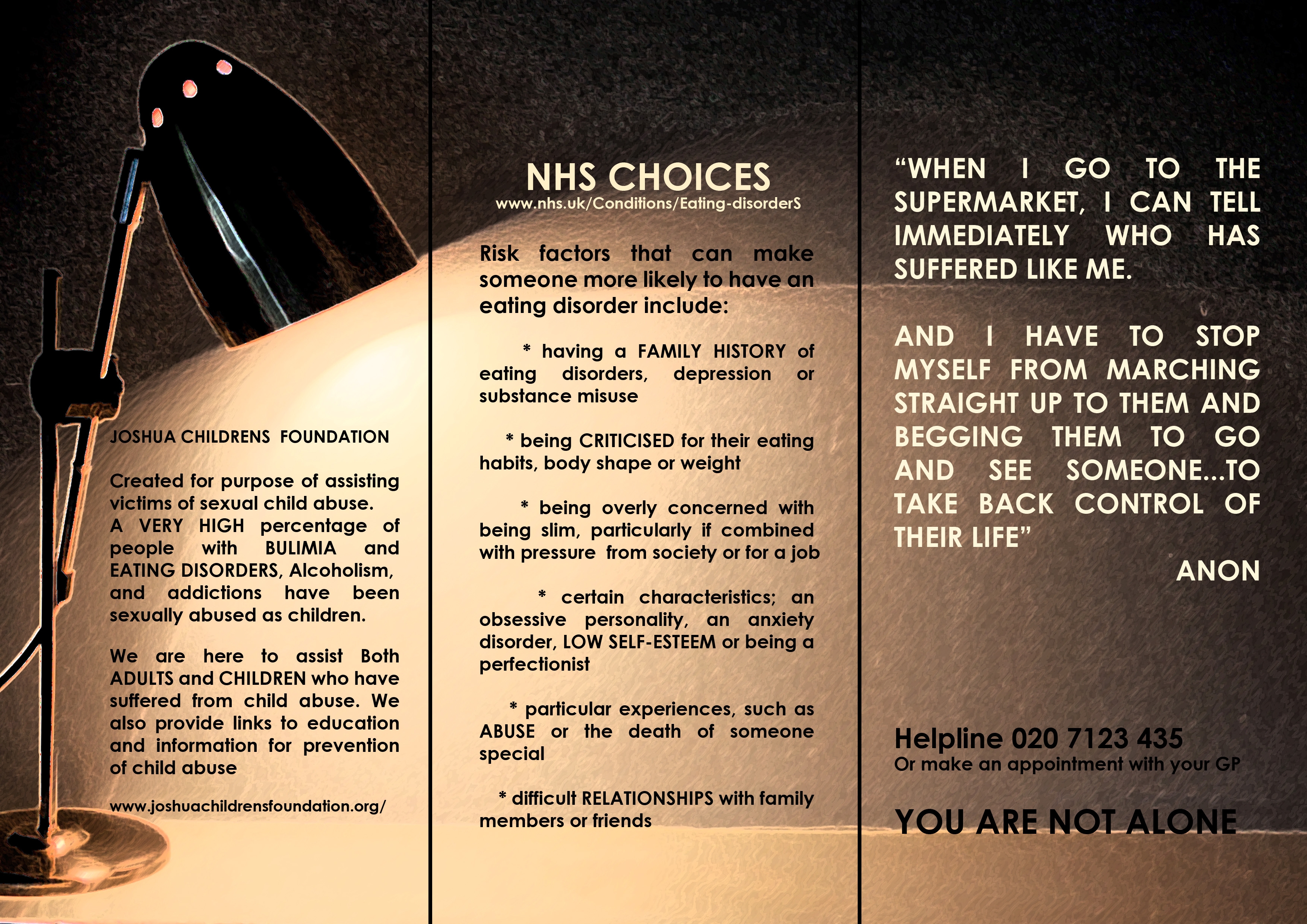
Leaflet designed by Caroline Kilduff. 1st year medical student.

More on the Joshua children’s Foundation

Further reading/watching.

“Fat patients know that we are fat and we know what doctors think of us” Brilliant medical student blog

Fat Politics. Collected Writing by Deborah Lupton Sydney University

As doctors call for urgent action on Britain’s obesity crisis, six readers tell us of their experiences of diet and weight issues. Guardian Feb. 2012

In [the] obesity epidemic, poverty is an ignored contagion. NY Times March 2013

If obesity is a disease, why are so many obese people healthy? Time Jun 24th 2013

Consumption Junction: Childhood Obesity Determined Largely by Environmental Factors, Not Genes or Sloth Scientific American

Cause specific mortality, social position, and obesity among women who had never smoked BMJ

Adult socioeconomic, educational, social, and psychological outcomes of childhood obesity BMJ

Stuffed and Starved video lecture by Raj Patel about the food industry

Why our food is making us fat. BBC documentary. Guardian review.

Precious. Essential film about an obese 16 year old girl and her violent and abusive parents.

Filling the void. Powerful patient story from the Journal of the American Medical Association.

Is obesity a disease? 2 hour audio download. PLOS blogs

Your body is beautiful. Thoughts on society, medicine and culture. Lashings of ginger beer blog.

The readers’ editor on… avoiding stigmatisation in illustrating obesity stories. Guardian April 2013

TODAY A Stark Glimpse of Tomorrow NEJM (medicalisation of obesity and diabetes in adolescents)

The Extraordinary Science of Addictive Junk Food. NY Times

Obesity discourse and fat politics: research, critique and
interventions Editorial July 2013

The patient described in this post is a composite of several patients I have met over my years working as a GP. It was also inspired by the film Precious.

Drug dealing

I have a headache today. It is the kind of headache I’d associate with a morning after a late night drinking whisky around a camp-fire, characterised by the sensation that the meninges that cover my brain are peeling away from the inside of my skull. Last night I sat outside drinking pints of water reading about the history of the stomach. I do not think this headache is self inflicted.

I do think it is related to the ulcer inside my lower lip that has been there for the last 10 days. I know the ulcer is a sign of a worn down immune system due to late nights fretting about the healthbill and soothing crying children. I know that there is nothing I can do to speed up my recovery, no gels or ointments to put on my ulcer, nothing to boost my immune system. The claims of the drug peddlars mean nothing to me. Only a tincture of time, hopefully only a few more days, will resolve the ulcer and fatigue.

My headache however is another matter. I know from past experience that 2 paracetamol are curative and will see me comfortably through my afternoon surgery and with this in mind I went to a pharmacy. Like every doctor I know, I immediately scanned the shelves for the cheapest, generic version. Pharmacies are an interesting comparison to GP surgeries because in terms of culture and practice they have travelled further down the road that leads to free-market health-care consumerism. That same road we are all being shepherded onto with barely audible bleats of protest or criticism from people educated enough to know better.

I rarely go into pharmacies and I was struck by the amount of glitter on the packaging. It was like looking at cheap jewlery through my steamed up, post cycle ride glasses. Eventually I found the paracetamol. In search of a bargain I looked at the large pale-blue box with a picture of familiar white tablets on the front, but this was £2.75 for 24 dissolvable tablets. I was hoping not to pay more than 2p per ordinary 500mg pill. Further along the shelf was a booklet type packet with a green and yellow cover with silver edging at £1.79 for 14 caplets. Next to it was a similar packet with added red exclamation marks: £2.49 for 14 ‘rapid melt caplets’. I stood there for a couple of minutes before going to the counter and asking for a box of their cheapest paracetamol, 79 pence for 32.

It is all paracetamol. It all does the same thing, but it varies enormously in cost from just over 2 pence to just under 18pence per 500mg. The cheapest version was hidden behind the counter. The expensive versions were laid out at eye level in the main part of the store. The cheapest version is in a light-blue box, the expensive versions are in multi-coloured booklets with reflective covers.

About twenty percent of my patients do not speak english and about 10% are barely literate. Over 100 have learning difficulties, many more left school without qualifications. A large proportion of my patients are chronically anxious. It is very, very easy to take advantage of people like this.

And yet while I was pondering all this at the counter, a stressed young woman in a suit put down £1.79 by the till and waved a packet of 14 paracetamol melts at the pharmacist before hurrying out of the shop.

If we are so easily manipulated with something as simple as paracetamol, is it really so difficult to predict the dangers that await as we travel further down the seemingly one-way road of medical consumerism?

Competition in healthcare: the risks.

“It is so appropriate that this meeting for Keep Our NHS Public is in Somers Town community hall, where people matter more than corporate appearances” Professor Allyson Pollock, KONP AGM June 25th 2011

How different it was from conferences held by commercial healthcare providers and think tanks like the Kings Fund who seem to be endlessly talking about how to extend the use of competition in the NHS. Their uncritical enthusiasm for competition is encapsulated in this report from Lord Carter, Chair of the Competition and Cooperation Panel. There is a world of difference between them and Keep Our NHS Public. It is not just the venue and the lunch, but also the language that contrasts. Instead of words like ‘innovation, choice and efficiency‘, the words we used most often to describe the health service we wanted were ‘fair and comprehensive‘.

Fairness means fair rationing.

The NHS was introduced not simply to deliver free care, but to distribute it according to clinical need, rather than by ability to pay. Rationing was always part of the NHS, even Bevan said that the NHS should provide a floor below which no-one can fall. Rationing not only determines the level of the floor, but who should get a share of the available resources, so that we distribute what we have according to who needs it most. For example, we screen people who are at risk of disease, instead of wasting our tests on people who are not.

Fairness and efficiency.

Nobody at the KONP AGM was against ‘efficiency’, but all were aware that markets are one of many ways to achieve efficiency and in health there are significant risks. Key to understanding the risks is the fact that neither patients nor health professionals are acting as market consumers, but instead they are co-producers of health gain. The consequence of this is that any market failure is due not only to institutions, but also to patients who are integral to them, and if the institutions suffer, so do patients.

There is an enormous amount of research demonstrating the risks of market-driven healthcare efficiency. I have summarised them as follows.

  • Baumol’s Cost Disease This is an economic phenomenon whereby certain sectors like health care do not see the same productivity gains as other parts of the economy because healthcare depends to a large extent on human interactions, so you cannot get more for less the way you can in manufacturing. Baumol’s original example was that it still took four people to play a string quartet. In healthcare it still takes a nurse to wash and feed a patient and the most important part of a diagnosis still depends on the clinical interview between a patient and a doctor. It means that markets are severely limited in their scope for driving up productivity. It is important to remember this when KPMG or the government come up with suggestions for ‘efficiency savings’  that involve cutting nurses or reducing the time doctors spend with their patients. For as long as anyone in my practice can remember the accountants have told us that we have too many doctors and too few patients. Every year our patients complain that from their perspective the opposite is true. We could earn more by seeing more patients with fewer doctors. We would probably be ‘more efficient’ but our patients already complain that they have to wait too long for appointments. This tension is inevitable. The pressure to replace doctors with nurses is increasing, but it  overlooks the complexity of the doctor-patient relationship. An investigation into care for people with diabetes in the New York Times showed that it was more profitable to pay for treating the complications of poor diabetic control with amputations and kidney dialysis than to prevent them with labour intensive education. Another example is the use of drugs instead of psychology for patients with mental illnesses. It is cheaper to use sedative drugs than to provide psychological therapies, even though the drugs used are very expensive. There has been a lot written about this, including this review in the NY review of Books. Among my patients seeing psychiatrists I have noticed a significant rise in the use of anti-psychotic drugs for patients with personality disorders and anxiety, but with no history of psychotic illness. There are 30% cuts to psychology services locally. Seeking productivity gains in health care by cutting staff leads to unwashed, unfed elderly patients in hospitals and care homes, people with mental illness without access to psychology and patients without access to their own GP.
  • Risk selection. This is the most obvious danger. Healthcare can be made more efficient if you limit your service to people whose care is straightforward. Ways to do this range from sterilising people with inherited conditions or aborting damaged fetuses to refusing to register or provide care for drug addicts or smokers, refusing to operate on high risk patients and refusing to insure people with complex conditions or increasing their insurance premiums to an unaffordable level. This is also known as cherry-picking and lemon-dumping. This is why there are so many uninsured people in America. It is the Inverse Care Law. Patient selection on the basis of risk has no place in the NHS. A fair and rational health service should select patients according to need, not risk so that the most vulnerable, sick and complex patients are prioritised. This is the whole point of a publicly funded and provided NHS. Sadly the structures of the NHS have already changed risking the selection of patients and providers according to risk. A practice in Kingston, run by Dr Charles Alessi, refrom enthusiast and member of the Future Forum, dumped 48 vulnerable patients on the PCT so that they had to be registered with other practices without notice.
  • Conflicts of interests. These are impossible to avoid in healthcare market. Fraud costs in the US levied on health insurers including UnitedHealth run into hundreds of millions of dollars. UnitedHealth in the UK have been working with the department of health since 2002 and are running GP commissioning services in west London.I have written more about COI and NHS reforms here.
  • Fraud is an enormous problem that seems inseperable from healthcare insurance, as described in this article from the Center for Health and the Public Interest: Healthcare fraud in the new NHS market, a threat to patient care.
  • Perverse incentives. Healthcare markets lead to excessive healthcare procedures being performed because each procedure earns a fee/ profit. There are wide variations in numbers of procedures between different hospitals. Atul Gawande’s now famous investigation compared different models of care in the US. He showed that linking profits to procedures raised healthcare costs substantially and had no effect on outcomes. It resulted in patients having many more unnecessary invasive medical procedures. Since the internal market was introduced to the NHS in 1991 it has started happening here. Data, now available on the NHSCA report (page 19) comparing England with Scotland where they have eschewed the purchaser-provider split shows that in the last decade English inpatient and day cases increased 26 times more than Scotland; outpatient referrals 13 times and A+E attendances 4 times.
  • Disease mongering. A part of perverse incentives, this is the trend of lowering diagnostic, screening and treatment thresholds and promoting public awareness in order to expand the markets for those who sell and deliver treatments, which may include pharmaceutical companies, physicians, and other professional or consumer organizations. A small reduction in definition of high blood pressure can lead to millions of new people being diagnosed. See the PLOS medicine collection and Ray Moynihan for many more examples.
  • Industrial medicine. The cheapest, most efficient care can be the most inhumane. Sterilising people with genetic disorders would be very efficient, but is prohibited. Industrial childbirth is becoming a reality. It is more ‘efficient’ to have women booked in for elective caesarian sections than to allow natural deliveries, especially home deliveries, as another report from Atul Gawande reveals.
  • The ‘bureaucratic absurdity’. The costs of administration in the NHS have risen from about 5% to 14% due to a large extent to the introduction of the internal market in the early 90s. In the US the costs vary from 20% to about 35%. The reasons for the costs include billing, risk adjustment, accounting, and so on. The problems of risk selection, perverse incentives and conflicts of interests are so serious that very expensive bureaucratic regulatory systems have to be put in place. At a recent antenatal appointment in hospital a patient had 5 separate interactions, each with a different set of costs and bills to be sent to the referring PCT to be presented to the GP, examined, challenged if necessary and so on.
  • Excess capacity. For markets to operate there has to excess capacity. Most NHS hospitals have been over capacity for years. I do not know how it can be efficient to pay for hospitals to have excess capacity.
  • Market failure. The average life of a European company is only 12.5 years. In that time there may be takeovers mergers and restructuring. Diabetes is for life. For a patient with a chronic disease a long-term relationship with their doctor matters. Continuity is much more important than choice. If a hospital of GP surgery goes bust it may not matter much for young, mobile occasional users, but it can be catastrophic for the seriously sick, the housebound, elderly and disabled. Thousands of elderly people and their families are anxiously waiting the fate of care homes owned by Southern Cross.
  • Indication creep and prevention creep. Technology has made surgery to remove gallbladders much safer and cheaper to perform. The overall cost however has increased as the threshold for performing these operations has significantly fallen and people who would previously lived with their gallbladders intact have them removed by enthusiastic surgeons. There is a longer discussion of this phenomenon in the Journal of the Americal Medical Association
  • The costs. See this article from the Washington Post: Why an MRI scan costs $1080 in America and $280 in France “Providers largely charge what they can get away with, often offering different prices to different insurers, and an even higher price to the uninsured”

The consequence of all of these market failings is that healthcare driven by markets and competition is inequitable and unaffordable.

The Cooper controversy.

Zack Cooper is an economist at the London School of Economics whose research has been cited as evidence that competition between hospitals improves care and reduces costs. The research makes a lot of assumptions which undermine its credibility. I have summarised the controversy below.

The evidence and justification for markets appears to be that they can, with sufficient money and in certain circumstances, for certain conditions … lead to improvements in quality. There are some papers supporting this written by economists Zack Cooper from LSE and Carol Propper. They are a drop in the ocean of evidence about market risks. Allyson Pollock criticised Cooper’s paper in the Guardian recently and Cooper has replied. Their arguments about quality will go on, but say almost nothing of the risks.

A new paper by Cooper was published at the end of February 2012 here. It showed that in hospitals assumed to be behaving more competitively, length of stay (LOS) before and after elective surgery was lower than in hospitals assumed not to be so competitive. That is all. Nevertheless they make a lot of assumptions including,

1. that reduced LOS was the same as either greater productivity or efficiency. They confuse the terms. To provide evidence of greater productivity they would have to show that one consequence of reduced LOS was that more operations were being performed. To prove greater efficiency they would have to show that the operations were being performed at a lower cost. They chose not to do this but assumed it instead.

2. “we assume that the impact of competition on pre-surgery LOS captured overall improvements in hospital efficiency” That is a big assumption. There is no reason why reduced LOS before elective surgery should mean that, for example patients were being rehabilitated after strokes more efficiently or receiving their chemotherapy more efficiently. They chose not to do this but assumed it instead.

3. They asssume GPs are making choices about where to refer their patients and that hospitals are responding competitively. As a GP, I do not choose hospitals as a result of performance data. The data is not easily available or reliable enough. If Cooper et al. wanted to show that there was competition driven by GP choice, you would have to interview some GPs to find out about their behaviour. They chose not to do this but assumed it instead.

Response to Cooper by Allyson Pollock, Ian Greener and Alison McFarlane: Bad science concerning NHS competition. LSE blog. Response from LSE: Bad science or bad blogging.

What seems clear from international experience is that markets lead to ‘islands of excellence in a sea of misery’. America and South Africa give good, if extreme examples*. They have the best possible care for those who can afford it and the bare minimum for many who cannot.

*There are always people who object to comparing the NHS with the US. The US does not have a health service, it has many different systems. That is one reason it is useful to learn from, as Paul Corrigan (a health advisor to Tony Blair) has explained today. I would respond that US health insurers like UnitedHealth and Humana have been trying to influence reform of the NHS for the last 20 years. European insurers have had nothing like the same influence. Secondly, an advisor to a Tory MP told me via twitter recently that his party were reforming the NHS to be like the French or German system. It goes to show how little MPs know of the health bill. The reason for these comparisons is that historically France and Germany have led Europe on international comparisons of outcomes, not because our reforms have anything to do with either the French or German systems. Critics rarely mention that France and Germany have spent about 20% more than the UK for the last 2oy or more. The NHS Wanless report in 2001 said that given the £267bn shortfall in funding, it was a wonder the gaps between performance in the UK and Europe were not wider.

The Dutch healthcare reforms.

The Dutch system appears to be the favoured comparison at the moment, especially since the recent French fall from the podium because of unsustainable costs. In the Netherlands they have experimented with market oriented reforms. Unfortunately the Dutch system is failing the people who really need it for almost all the reasons I have outlined above. Qualitative interviews with 27 surgeons and 28 general practitioners in The Netherlands, held 2–3 years after a major overhaul of the Dutch health care system involving several market reforms. Surgeons now regularly advertise their work (while this was forbidden in the past) and pay more attention to patients with relatively minor afflictions, thus deviating from codes of ethics that oblige physicians to treat each other as brothers and to treat patients according to medical need. Dutch GPs have abandoned their traditional reticence and their fear of medicalization. They now seem to treat more in accordance with patients’ preferences and less in accordance with medical need. Health Care Anal 2011

The second criticism people make of organisations like Keep Our NHS Public is, ‘well what would you do instead?‘ I have some suggestions here and Allyson Pollock’s suggested amendments to the health bill are here.

Perhaps the reason our political leaders of all parties, wedded to the hegenomic politics of neoliberalism cannot come up with an alternative to markets is best summarised by Nye Bevan.

The National Health service and the Welfare State have come to be used as interchangeable terms, and in the mouths of some people as terms of reproach. Why this is so it is not difficult to understand, if you view everything from the angle of a strictly individualistic competitive society. A free health service is pure Socialism and as such it is opposed to the hedonism of capitalist society.
—Aneurin Bevan, In Place of Fear, p106
—————————————————————–

If you want to help keep the NHS fair, comprehensive and affordable please join Keep Our NHS Public today and write to your MP to let them know the implications of accelerating the transformation of the NHS from a public service into a series of competitive markets.

See also:

Markets or Muskets? Why competition isn’t working in the NHS 19.06.2015

Markets and the dis-intigration of the NHS BMJ Blogs 11.06.2015

Competition is ripping the NHS from our hands. Kailash Chand Guardian 05/08/2014

Why privatising the NHS would be A Very Bad Idea by Andy Cowper/ HPI Policy Insight 04/02/2014

NHS in England: market competition and health care | The NHS used to be based on collaboration and co-operation; and now it is a partly marketised service. David Lawrence explains why this is really not good for our health. David Lawrence NHS Managers 03/01/2014

What the NHS can learn from the introduction of markets in social care. LSE Blog.s December 2013

The High Costs of American Health Care: Forbes 09/01/2014

As Hospital Prices Soar, a Stitch Tops $500 NY Times 02/12/13

The misuse of competition law is undermining care and integration. Richard Vize, Guardian 28/11/2013

John Appleby: Competition in the NHS, Good, Bad (or something else) Kings Fund.

Competition is killing the NHS, for no good reason but ideology. Guardian 15th November 2013

The future of England’s healthcare lies in the hands of competition lawyers. BMJ 15th March 2013

Competition Regulations issued under Section 75 of the Health and Social Care Act (2012) will lock CCGs into arranging all purchasing through competitive markets  Soc. Health Jan 2013

Public sector paid big four outsourcing firms £4bn last year, NAO reveals

Scale of outsourcing to Serco, Capita, Atos and G4S prompts fears that firms are becoming too big to fail. Guardian November 2013

Does competition to provide insurance for Medicare recipients reduce costs? Or does competition simply increase the tab picked up by taxpayers? Physicians for a National Health Program. June 2013

Bitter Pill: Why Medical Bills are killing us Time Magazine. ” … you see nothing rational — no rhyme or reason — about the costs they faced in a marketplace they enter through no choice of their own. The only constant is the sticker shock for the patients who are asked to pay.”

A Hospital War Reflects a Bind for Doctors in the U.S NY Times Nov 2012. Excellent article about what happens when hospitals compete with eachother.

How a competitive healthcare model fall short. The Atlantic Sept.2012

No evidence that patient choice in the NHS saves lives. Allyson Pollock et. al. Lancet

What would the NHS have to look like for competition to work? Ian Greener

Competition hasn’t worked in healthcare. Washington Post.

Competition in Healthcare Nigel Edwards

Going for gold: The redistributive agenda behind market-based health care reform. Nuffield Trust

Competitive tendering will be as importantss as ‘Any Qualified Provider’ HSJ

“So the first guiding principle is this: maximise competition. There are, of course, potential benefits from privatisation in terms of access to capital, flexibility, and creating new markets; but private sector ownership is a secondary consideration to competition, which is the primary objective.” Andrew Lansley.

Update 02.07.2013

Competition in the NHS, is the toothpaste out of the tube? NHS competition blog.

Competition and Collaboration in the New NHS. Center for Health and the Public Interest.

Update 08.02.2012

Earl Howe letter 22 December 2011 Letter about evidence for competition with comments by Lucy Reynolds

Update 19.02.2012

Lessons from public healthcare privatisation in Sweden. Open Democracy

Sobering lessons from the Netherlands. New England Journal of Medicine

Update 03.03.2012

Market Failure in Healthcare. Part 1 Market failure in theory. Clive Peedell

Market Failure in Healthcare. Part 2. Market failure in practice. Clive Peedell

Competition in healthcare and the NHS. Lucy Reynolds

Thank God for the NHS. A British ex-pat’s impression of German Healthcare

The cost of patient choice

Post edited 19.7.2011

“It’s about knowing how to play the game”

Local commissioning executive

Because of the purchaser-provider split which was introduced to the NHS in the 90s by Kenneth Clark, we (GPs) are purchasers and hospitals are providers and so we pay every time our patients attend hospital. This is what makes the ‘any willing/qualified provider (AWP/AQP) proposed in the government’s health bill possible.

GP commissioning is sold to you the public as a concept whereby GPs design and commission the services you need from hospitals. It is why the government keep saying they are giving GPs control. The pro-market reformers enthuse that you, the patients, will get better quality care and we, the GPs, will save money because the hospitals will have to compete with each other to provide the cheapest, best quality service.

If you think we are going to be endlessly decommissioning and recommissioning services according to cost and quality, you are mistaken. Commissioning is a time-consuming, expensive, complicated business. We have been offered £20 per patient to do the administrative business that our PCT was doing for £60. We do not have the time or the money. You need us in our consulting rooms.

However, you will be pleased to hear that we are commissioning some excellent services from our local hospital including 29 care pathways. But the government say…

“You can choose any hospital in England funded by the NHS (this includes NHS hospitals and some independent hospitals)” NHS Choices website

The problem then is that patients are free to choose services that we have not commissioned. In fact, they are being encouraged to choose services we have not commissioned. Not only are they being encouraged, but the Competition and Cooperation Panel has been set up to make sure we do not collaborate collude with our local hospital where we have commissioned services.

There is a large shiny PFI hospital not so far away that our patients sometimes go, where we have not commissioned services. It is spending large but undisclosed amounts of taxpayers money on marketing. Down the road is our local hospital which is spending a lot less on marketing. The shiny hospital is costing us a lot more money and there is very little we can do about it.

“[I] cannot see gpccs [GP commissioning consortia] shaping markets, they will be buying off the shelf. Patient choice + awp [any willing provider] = no commissioning” Anna Dixon, Director of policy, King’s Fund (via twitter)

In 2008-9 our PCT asked us to look at the bills we were sent by hospitals under PBR (payment by results). A treatment episode is asigned an HRG code which has a tarif/price allocated to it. For example if a patient is seen in hospital with a major upper respiratory tract infection it costs £541(!) If they have ‘complications’ (unspecified) there is a £50 surcharge. 2008-9 must have been a bad year because almost every patient seen in hospital had ‘complications’.

Our practice looked after about 10 ooo patients in 2008-9. In total we were charged £801k by hospitals under PBR. We checked every single bill for that year. To check them you have to read every patient record and hospital discharge summary (if you get one). It takes a long time, up to 20 minutes per patient. We found reasons to challenge £700k worth of bills because of reasons such as not having received a discharge summary, being charged twice for the same episode, being charged for patients that were not registered with us, innapropriate HRG coding, inadequate information, patient not referred by us, etc. Because of the amount of time it took the PCT to look at our figures they only covered the first 2 of 10 pages of challenges we returned to them. For that we were reimbursed £323K that had been erroneously billed to us. The money covered a large part of our £363 PBR overspend, and had they looked at all 10 pages it would have more than covered it. The money reimbursed has to be paid back by the hospitals to the PCT and it is then available for referrals for the next year. It is not a direct loss (or profit) to our practice, but is pooled within the PCT and shared over more than 30 practices. Since we were overcharged at least £323k and there are approx 250k patients in our PCT that amounts to an estimated £8 075 000 overcharged by providers.

Very few practices checked at this level of detail. We were doing it ‘as a favour’ to the PCT to help them examine the scale of the problem. Our administrator who checked the data explained what was involved one month. On April 22nd the hospitals were supposed to have their data uploaded. By April 30th the PCT were supposed to reconcile it and by May 7th we were supposed to prepare our challenges. The data never arrived on time. It would come piece-meal and if you did not check your inbox regularly you would finish your challenges only to find a hundred or more new HRG codes to check. Very late nights were spent investigating.

What they discovered was shocking. One patient with a minor head injury needed glue to his scalp but the A&E department had run out so the sent him to another hospital for glueing and we were charged several hundred pounds for each A&E attendence. A psychiatric inpatient attended A&E every day during his admission, but never got past the reception but we were charged £50 every time. A woman who was pregnant was admitted with pneumonia and then delivered her baby, but stayed in becasue of her pneumonia and we were charged a maternity rate (approx double a medical rate), total cost approx £30k. Patients who missed a follow up appointment were discharged and asked to see us for a new referral which costs double a follow up appointment. The major errors were for episodes for which we were charged twice, one of which cost £150k.

This was a trial. It is no longer happening because there are not enough people, time or money to keep checking at this level of detail. At present data is aggregated to give average costs or selected areas are examined, for example frequently attending patients, or antenatal care.

In the first 6 months of this year we have discovered:

A patient referred to our commissioned antenatal service is seen 8 times, but a patient seen at the shiny PFI hospital is seen 14 times. A patient seen for their first antenatal appointment at the shiny hospital had 5 separate health professional interactions for blood and urine tests,blood pressure etc. each of which was coded and we were billed.

The average number of outpatient follow-ups at the shiny PFI hospital is 4.12 compared to 2.8 at the hospital down the road. Even if the tariff was the same, a hospital can increase its profits by calling patients back more often.

The tariff for the same ENT outpatient appointment at the shiny hospital is higher, £200 vs £170 for the hospital down the road. This is supposed to cover the costs of all the polishing needed in a central london location. We pay the difference.

The re-referrals. A patient referred to a commissioned gastrointestinal service with bleeding from the bowel would be properly investigated and managed by the commissioned service. If one of our patients chooses to go to the shiny hospital they need one referral to the gastroenterologists for the stomach another referral to the surgeons for the colon.

Another way the shiny hospital makes money is by telling my patients that I need to refer them to a different specialist at their hospital. Then I have to say, “look I know Professor Spratt said you need to see his delightful colleague, Mr Nibbs, but I really don’t think it’s necessary” And the patient replies, “that’s just because you’re trying to save money” …

Shiny hospitals hang on to their patients with an iron grip. Most notoriously the London Integrated Hospital. Unsurprisingly for a homeopathic hospital, the patients do not get better, so they are never discharged and we pay for their supportive counselling, which is, for many vulnerable patients, very helpful, but it is very expensive form of counselling.

If we object to the bills the shiny hospital are sending us we can ‘challenge and reaon’. Sometimes an agreement is reached, but sometimes arbitration is threatened. This is far too expensive and so the threat effectively results in us coughing up. Providers like the shiny hospital have the cards in one hand, our balls in another and enormous PFI debts hanging over them. No wonder they’re squeezing.

This overtreatment by healthcare providers is a consequence of ‘perverse incentives’. As George Bernard Shaw said 100years ago,

That any sane nation, having observed that you could provide for the supply of bread by giving bakers a pecuniary interest in baking for you, should go on to give a surgeon a pecuniary interest in cutting off your leg is enough to make one despair of political humanity.

It is one of he reasons why market-based, competitive healthcare is so expensive, as US surgeon Atul Gawande showed by comparing different systems of health care delivery in the US.

Our patients are not just normal folk who are mesmerised by i-gadgets and racked up to the eyeballs on credit spent on toys they do not need or play with any more. No, they are far more likely to be undereducated and over anxious, ideal fodder for unscrupulous marketing departments of shiny hospitals. These dupesters are spending money that ought to be spent explaining how your chemotherapy works, what physiotherapy can achieve, or the risks vs benefits of knee surgery hypnotising our patients with their beautiful reflective buildings and augmented nurses. This stuff gets to people when they are making a choice. In fact it matters more than very difficult to analyse outcome data, which is much less easy to polish on photoshop. It matters less than locality or convenience for most of our patients for now, but it is very early days in the world of heavily marketed shiny i-hospitals.

It might be going too far to say the cost of patient choice is gaming. There is as much erroneous coding as deliberate over treatment. The only way to prevent this is to have armies of detective administrators meticulously examining every bill for every patient. One reason this can never work is because healthcare is not a commodity and to treat it like one is to commit a ‘category error’. Coding episodes of care is to be forever hammering square pegs into round holes. You cannot have healthcare markets without market bureaucracy.  This is why administration costs in the US are at least twice what they are in the UK and why, according to Ruth Thorlby of the Nuffield Trust, the single biggest reason health care commissioners in California went bust. Because of the internal market administration in the NHS has risen by so much in recent years and transaction and administration costs account for about £10bn a year. The latest changes to NHS bureaucracy completely dwarf what we had before. This is the very opposite of what the government promised, but even that pales before what we will need if the health bill goes ahead.

If the over charges for 250k patients for our PCT are approximately £8 million per year and we assume an English NHS population of 52 million, this is approximately £1.6bn in excess charges every year. If there are insufficient resources to examine all this, as there would seem to be, you can see why the private sector providers are so keen on NHS reform.

The NHS reforms will divert money away from where it is needed and will render the NHS unsustainable in a very short time.

I believe that this might very well be the government’s intention.

Further reading:

Time to abolish payment by results? Prof Alan Maynard (Health Economist) Health Policy Insight

Clinical activity in the English and Scottish NHS before and after devolution. NHSCA “In summary, increases in English inpatient and day case hospitalisation rates were 26 times those in Scotland between 1998-99 and 2009-10. Increases in new outpatient referrals were 13 times greater in England than in Scotland over this period and increases in A&E attendance rates were almost four times greater.”

Doctors paid for cardiac investigations order more: NY Times

Up-Coding a hazard as pressure for payment by results grows. e-health insider (excellent comment

The myth of the trivial consultation

What is happening to the therapeutic relationship?

The myth of the ‘trivial consultation’

Despite the best efforts of a modern, scientific medical education, most GPs realise that when a patient presents, the pathological process is only one of several processes, (social, psychological, economic, environmental, spiritual, etc.) that contribute to the patient’s sense of illness or well-being.

The nature of general practice, by which a doctor gains, over time, a knowledge of their patients lives enables them, through the development of a therapeutic relationship, to act as a holistic practitioner, understanding their presenting symptoms in the context of a broad range of contributing factors.

The trivial consultation.

Increasingly we complain about ‘trivial consultations’, and eager to support us, politicians, policy makers and managers help us think up creative ways to ease the burden of the General Practitioner so that someone (or something) else; a nurse or pharmacist, or their assistant or deputy, or perhaps a receptionist or NHS direct, an Internet site, in fact, anyone -or anything- paid less, can deal with them so that the overworked, over qualified and over-paid GP can concentrate on the type of complicated, high risk consultation that their expensive years of education and indemnity premiums justify.

There can be little doubt that education can inform and empower patients to manage many health matters without the interference of their GP, or for that matter anyone else, just as there is no doubt that the other sources of advice and treatment listed above can offer an excellent service -many as good, and some -for some patients with some conditions in certain circumstances, better than a GP. Patients have always made use of a wide range of advice and treatment options and the majority of ailments have always been managed without the ministrations of the GP. This will always be the case. What is changing is the range and number of options that come with our approval and encouragement, increasingly also assessed as being ‘quality’, ‘efficient’ or most of all, ‘evidence based’ and ‘cost-effective’.

Under pressure, either implicit or more direct, patients are encouraged not necessarily to deal with problems themselves, but by exploring a plethora of other alternatives, to avoid bothering their GP unless absolutely necessary. The GP is increasingly being marketed as a last resort, rather than a first line. Once the patient has tried the advice of friends and family, taken some over the counter medicines, searched for advice on the Internet, seen the herbalist, read the practice leaflets and made a case for their need to see a doctor to the interrogatory receptionist, passed the triage nurse and taken the course of antibiotics prescribed by the nurse practitioner, they finally see the stranger whose name is on their NHS card. At this point they are faced with a stranger, a doctor in name who knows nothing of their lives, their relationships or their experiences of illness and health, hopes, fears or expectations, someone who they have been deprived of the opportunity to grow to know and trust.

Continuity of care is being increasingly devalued and undermined, not only by the factors outlined above, but by the loss of personalised lists, subcontracted out-of-hours work, reduced home visiting, and increasing amounts of management and administrative responsibility. As we lose continuity we will lose the ability to form therapeutic relationships and act as holistic practitioners.

Increasingly patients are turning to alternative models of healthcare that attempt to integrate a more holistic approach. Whilst offering varying degrees of holism, none of these view the patient from such a range of perspectives as offered by a GP with the knowledge gained over years.

If we believe in treating patients rather than conditions and see each consultation as an opportunity to develop a relationship with our patients, then we will become more effective and more satisfied with our work. To do so involves a change in attitude towards each patient consultation and the right conditions to allow us to develop relationships with our patients.

Note.

This was originally written for the New Generalist magazine in 2006. The magazine no longer exists. It is exactly as I wrote it then. My concerns about the changing nature of primary care started long before this government.

NHS unboundaried

There are 2 very important changes that signal the end of the NHS.

The first is the free for all for Commissioning consortia. Historically PCTs have covered a geographical area and have been responsible for care of all the people in that area. PCTs are to be replaced with commissioning consortia. The Royal College of General Practitioners, based on international studies of similar organisations said that they should have a minimum of 300 000 patients in order to have a sufficient economy of scale to effectively commission the range of services their patient’s need. Many doctors warned that they should be co-terminous with local authorities and responsible for a geographically defined area. The government have allowed anyone to set up a consortia. There is a list of consortia here. In london they range from 7 to 67 practices in size. They are not obliged to cover a geographic area.This allows GPs to select the most efficient practices and avoid the least efficient.

The second important change is the loss of GP boundaries, now set for April 2012. Spun as patient choice, this may allow GPs to choose patients. Patients who are housebound or have long-term serious illness are much less likely or able to choose a practice that is not very close to them. The patients who will be looking for a practice away from home will be the young, fit and mobile. Business minded practices will be looking to register these patients because they earn money for registering them, but they do not incur costs caring for them. By contrast, a very sick patient incurs a lot of costs because of time for home visits, prescription costs, nursing time, hospital admissions and so on. I have written about practice boundaries here.

The combination of selecting practices and patients and the abandonment of the duty to provide care for a defined area is a MASSIVE change in how the NHS works. In the very near future, patients will register with a consortium to be entitled to the services the consortium provide and have commissioned.

This sets in place perfectly the structure for commissioning consortia to form Health Management Organisations (HMOs), the US insurance companies that select patients and set fees according to risk. Yesterday Mike Birtwistle blogged about the underlying conservative committment to converting the NHS to this system,

Many on the Conservative right believe that any reforms which do not lead to a move towards insurance-based healthcare should be decried for their timidity.  You only need to read a Reform report on health to realise that this strand of thinking is alive and well and very attractive to certain sections of the Party.

Colin Leys and Stuart Player warned about it in their book, The Plot Against the NHS.

Update 27.01.2012 CCGs further widen health inequalities

How many more warnings do we need?

Meet the privatisers

Protest on June 15th and meet the privatisers

NHS Choices

GPs and private businesses

A very short letter from a Tory MP in response to a detailed and serious letter from a constituent raising concerns about the government’s proposed NHS reforms:

Thank you.

Are GPs private contractors?

Should they be nationalised and made salaried state employees?

Sir Peter Bottomley MP

To answer a constituent’s seriously considered letter of concern with a rhetorical question is bad enough, two rhetorical questions borders on contempt.

Nevertheless the first ‘question’ pops up quite frequently, though usually as a statement, “GPs are private providers! (ah ha, I bet you never thought of that, all your arguments against privatisation are now null and void!”) Usually that is the breadth and depth of their contribution to the debate.

The first ‘question’. Yes GPs are private business, but …

A GP working in private practice sees private (non NHS) patients. That is people who prefer to have a different service (longer appointments, unusual hours) or do not qualify for NHS care, eg. diplomatic staff, etc. The majority of GPs work to NHS contracts, follow NHS guidelines and see NHS patients. They do not compete for patients, or profit in the way competitive providers of healthcare do.

GPs services are increasingly being run on APMS (Alternative Provider of Medical Services) contracts. The ‘traditional contract’ is GMS (General Medical Services). GMS terms are set nationally and renegotiated from time to time with GPs. APMS contracts were introduced in 2004 by New Labour to allow some ‘constructive discomfort’ for existing providers by encouraging ‘any willing providers’ to run primary care services. The ‘privatisation of the NHS‘ was started years before the present government, hence the reforms are ‘evolutionary’. The pace, the restructuring and the cuts mean that they are also ‘revolutionary’.

There have been two main consequences of opening up general practice via APMS.

The first was the introduction of ‘alternative providers’. These are the private health companies who had been lobbying the department of health, private equity companies looking for new profits, and entrepreneurial GPs. They include Richard Branson’s Virgin group who operate at least 350 GP surgeries and Sainsburys who have 6 GP ‘surgeries’ and are planning to open more in-store surgeries. Opening up the NHS also helps MPs with private healthcare business interests. These are described in detail in the book, The Plot Against the NHS.

The second was to allow practices, including all their patients, to be treated as commodities to be bought and sold for profit. Chilvers McCrea was set up in 2003 by GP Rory McCrea and Nurse Sarah Chilvers. The company began with the management of a failing GP practice in Chelmsford, Essex and by 2009 had APMS contracts for over 35 GP surgeries and three walk-in centres. They were bought by another private company, The Practice in 2010, thanks to investment from venture capitalists, MMC Ventures. They have been criticised for their staff contracts and for closing a practice in Camden this year. This year the UK branch of US health insurance giant UnitedHealth, UnitedHealthUK sold its six practices to The Practice.

Traditional general practice is a cottage industry. The old system of independent GP surgeries allowed GPs to provide a long-term stable service to a community and over the years build up a detailed knowledge of their patients and the local area. In my own practice, the retiring partner has been here for 28 years and there are over 100 years of combined experience amongst the other 5 partners. We have personally invested in the practice and the community. General practice for us is a ‘labour of love’ more than it is a business opportunity.

Comparing traditional general practice with the new private players may be like comparing Arthur’s cafe with Starbucks. It may not matter if your barista changes every couple of months, but for people with long-term conditions, a long term relationship with a GP is vital. There are already examples in general practice. International IT company, Atos origin won a tender for a GP practice in East London after bidding against established local surgeries. They lost the tender only 3 years into a 10year contract because they could not provide the service needed at the unrealistically low price they had bid. Too much emphasis was placed on cost and too little on local knowledge. Patients complained that there was a high turnover of salaried doctors and continuity of care was very poor. Atos have also had severe criticism for their work capability assessments.

Reasons to support ‘alternative providers’.

One reason supporters of NHS reform give for ‘alternative providers’ is that they want to introduce competition and break up the NHS monopoly. There is no monopoly in General Practice. Or at least there was not until the APMS contracts started. Now The Practice are running nearly 60 surgeries. This is unprecedented in the history of the NHS. Private company Care UK run 13 GP surgeries. They were bought by private equity company Bridgepoint last year. Very soon there will be more consolidations and fewer independent GP practices as this report from the NHS federation details. Before long, your local GP with a long-term committment will be replaced with the part-time salaried employee of a global giant and there will be very limited or no choice at all. This will be a disaster for continuity of care on which our most vulnerable patients depend.

It is very uncommon for a traditional GP surgery to go bust and be forced to close, but large corporations do so with alarming frequency. Circle Health is Europe’s largest healthcare partnership and has been given the contract to run Hitchinbrook hospital. Uncritical journalists and politicians fall over themselves to laud it as the saviour of the NHS, but as an article published today reveals, it is in dire financial straights. Richardblogger goes further with his analysis. Southern Cross runs 752 elderly care homes with 31000 residents, and is in a desperate bid to avoid administration.

The consequence of ‘alternative providers’ is that some will become ‘too big to fail’, raising the ugly spectre of massive multinational corporations having to be bailed out with taxpayers money. All over again. The alternative is that they will be ‘too big to save’.

The second reason supporters of the government’s NHS reforms give for allowing ‘alternative providers’ is to allow entrepeurism. One such entrepreneur is Dr Paul Charlson. According to Spinwatch,

Dr Paul Charlson, is indeed a GP in favour of Lansley’s reforms. He also runs a private centre which specialises in cosmetic anti aging treatments (Botox), not typical of most GPs. Charlson is also spokesperson for a lobby group called Doctors for Reform, which is supported by the free-market think tank, Reform. Funding for Reform has come from the UK’s largest private hospital group, General Healthcare Group and other private health companies set to benefit from Lansley’s reforms.

Dr Charlson and I both spoke to the Health Committee last year,

Dr Tomlinson: I don’t believe that it is in patients’ interests to have lots of people competing to do your blood test. Why do not all of my patients have it in my surgery? Why have somebody open up, next door, for instance, saying, “Blood tests. Come here and get them done even quicker than Dr Tomlinson”? What’s the point of that?

Dr Paul Charlson: It is innovation. That’s the point. It is encouraging innovation. That’s what you need because that’s why we have been stuck …Okay, but the fact is we have been stuck, for years and years and years, not being able to innovate. I am a real innovator and I have been incredibly frustrated by the restraint of what we have at the moment. We just cannot innovate and provide better services for patients. That’s what it is about.

For Dr Charlson and others, entrepreneurism means profiting. It has nothing to do with addressing the needs of vulnerable people. Private companies are not queuing up to provide drug and alcohol rehab or psychological treatment to people around here. I know a lot of innovative GPs who are not ‘incredibly frustrated’. Many GMS surgeries already offer a wide range of services that patients need that were previously only available in hospital, like physiotherapy, psychotherapy, minor surgery, blood tests, heart tracings and so on. None of the GPs I know would consider replicating or cherry picking a perfectly good service just because they could make some money. None of them believe that patients are consumers or that health and healthcare should be treated like commodities to be traded for profit. All of them are committed to improving patient care.

In answer to Sir Peter Bottomley MP’s second question, I would say, ‘possibly’. The advantages of a cottage industry of independent GPs is most eloquently argued in this essay by an American GP (Family Practitioner) David Loxterkamp, The Dream of Home Ownership. He contrasts the traditional model with the corporate model where GP surgeries are owned by large corporations or hospital networks. This is what we should be comparing, because whether I believe that nationalised, salaried general practice is preferable to the traditional model or not, it is not the choice we have, or are likely to have in the near future.

Updates

US study finds smaller, physician-owned practices have lower rates of hospital admissions. (link to study) 19/08/2014


When the privatisation of GP practices goes wrong Guardian 19.12.2012

The Rise of the Corporate Physician, and the “Metastasis of Big Corporations” 

Healthcare renewal blog, “Public discussion has raised more questions over the last few months about physicians taking care of patients as corporate employees”

08.02.2012

Private firm closes flagship GP practice in north London Camden New Jounal

GP practices in north London have been told they must absorb 4,700 patients in the next two months after the leading private health provider The Practice Plc announced it will close a high-profile GP practice less than a year after taking over the service. The Camden Road Surgery – a long-standing GP practice which has been at the centre of the NHS privatisation debate ever since it was taken over by US health giant UnitedHealth in 2008 – will close its doors in April, with plans in place for a ‘mutual termination’ of its APMS contract with NHS North Central London.

No plans to open new surgery Camden New Journal Feb 16th 2012

Dr Douglas Russell, medical director of the North Central London sector NHS trust, was speaking at an emergency debate at the Town Hall last Thursday about the closure of the Camden Road Practice.

Its private operators, The Practice Plc, announced last week that the surgery will close in April leaving 4,700 patients astounded.

Dr Russell said that under government reforms the NHS could no longer employ its own doctors or buy new premises for a new surgery in the area.

He added that tendering for a replacement would simply invite more private firms looking to profit from the NHS in Camden.

Dr Russell said: “I am struggling to understand what the alternative action is. We don’t provide services directly, we are not allowed to any more.

“A few years ago, we would have been able to take the practice over ourselves and directly employ staff and doctors. We are no longer allowed to do that. Surely you are not asking us to go through another tendering exercise – are you? Be careful what you wish for.

“My experience is that other providers find it incredibly difficult to make a success of general practice.”

It’s is very rare indeed that a ‘traditional’ GP surgery closes.

Patient protest at troubled surgery run by Concordia Health Isle of Thanet Gazette June 22nd 2012