How’s my consulting?

A couple of weeks ago I invited Sarah, another GP in our practice to observe one of my surgeries. All the patients were warned before-hand that another doctor would be there. She watched and listened intensely and took notes as I consulted. Before calling in some of my patients, I explained about their background:

I’ve known Brian for about 7 years, he was diagnosed with Parkinson’s disease when he was just 45, and has had several falls, fracturing his hip and shoulder in the last couple of years. He had to take early retirement and sell his building firm and has been severely depressed. His wife does everything she can to look after him, but she’s at a loss, and to be honest so am I. He’s lost a lot of weight because he stopped eating. I asked the psychiatrists to see him but he hasn’t had an appointment yet. I’ve really been worrying about him.

Being able to describe to another clinician, an experienced, trusted peer, how much I knew about my patients along with my concerns and fears, was really powerful. Like every doctor who values continuity of care I know the majority of my patients, but being given the opportunity to describe them to Sarah, really made me think about how important this is.

So much of what we do in clinical practice is done in silence. While I listened calmly and intently to Mehmet my mind was silently whirling, trying to identify clues that might help me make sense of his constellation of symptoms and the investigations he’d been through and medications he had tried. So much of general practice is spent in the ‘swampy lowlands’ between suffering and disease, where symptoms are far easier to describe than to explain. The tools of our trade: protocols, pathways, guidelines and diagnostic categories can be applied to a minority of the problems our patients present with. Multimorbidity is the price we’re paying for longevity, so we can now survive with an array of diseased organs, but they’re intricately connected; a drug for one is poison for another, and if one fails the others struggle to take the strain, in often unpredictable ways.

But working in isolation, we rarely articulate the uncertainty that characterises so much of our work. The limits to how much we can tolerate move in and out with the tide of our resilience. Confidence and strength, far from being sure of the answer, is being able to live with the anxiety of not yet, or perhaps never knowing. My friends and colleagues are more stressed than ever before, and an inevitable consequence appears to be more referrals to hospital where the burden of uncertainty can be shared, a phenomenon already understood. Sarah and I shared the uncertainty, and discussed how to help Mehmet.

I had watched Sarah in a surgery the week before. One of the things she asked me to look for was the way she concluded consultations, she wanted to know how to conclude a difficult discussion with one patient and not keep the others waiting – we have only 12 minutes for each appointment. I had written recently about how we give reassurance, whether we do so for our benefit or our patients, and how giving confidence might differ. I took notes and we discussed how she worked, how patients responded, where she thought it went well, and how it might go better.

Opening your practice up to close scrutiny and learning from the experience, means being able to say, ‘I’m struggling with this’, it’s not about showing off, so much as exposing yourself. The majority of doctors never do this. To do this requires trust; that the person you’ve invited in, understands what you’re trying to do and that they are there to help. John Launer’s wonderful work on clinical supervision, teaches us that a very powerful way to help one-another learn is by curious questioning – helping the person you’re supervising to think deeply about the way they’re consulting. He concludes,

Collectively, good conversations can be transform a working culture from one that is technocratic, impersonal and potentially dangerous, to one that is both kinder and safer.

The Berwick and Francis reports into poor patient care at Mid Staffordshire hospital recommended above all, that patient safety depends on lifelong learning, aware perhaps, that the features that unite under-performing doctors are isolation and lack of insight. Sadly all of the emphasis has been on more regulation and inspection and the experience of many clinicians is that they have less time for education and are less supported than ever before.

US surgeon and writer, Atul Gawande argues convincingly that the most experienced doctors can benefit from coaching in the same way as professional sportsmen and women do. Gawande, an experienced surgeon, was used to operating independently, without supervision, but invited a respected colleague to watch him perform a routine operation. His colleague made several critical observations that made Gawande realise that unless supervision is required or actively solicited, opportunities to improve the quality and safety of patient care will be missed.

We owe it to our patients and each other to open ourselves and our practice up to our peers who can provide education and support in equal measure. Clinical supervision should be for life, we cannot afford not to make time for this.

Postscript.

Several people have asked how we found time.

We both came in on our half-day to observe, in our free time. This isn’t sustainable, but it was far more valuable than many (most) conferences or ‘educational’ meetings I have been to, and I would happily use some of my study leave to do this in future.

How much do you cost the NHS?

First published on Open Democracy

Tory MP Jesse Norman has come up with an idea to send everyone who uses the NHS an Annual Healthcare Statement. It is designed to dissuade people from presenting to hospital or GP surgeries unnecessarily by showing them how much they have cost the NHS and ‘by implication the value of NHS services’. The report goes further to suggest that ‘more incentives’ could be added in the future.

Fear that a free NHS would result in overwhelming demand has been around since the very idea of an NHS and has been superbly deconstructed by Julian Tudor Hart. Politicians and economists couldn’t believe that free healthcare wouldn’t result in unsustainable demand and in a panic, introduced prescription charges which led to Nye Bevan’s resignation.

In 1951 the first postwar Conservative government set up a Royal Commission to measure abuse and extravagance. After painstaking studies the Guillebaud Commission found no evidence of either, only hard-working staff and stoical patients, underfunded and lacking investment.

Study of a poor inner city area in the early 1970s showed that for each person who consulted with a minor problem, more than two others failed to consult at all, despite recent severe or worrying symptoms. Contrary to subjective impressions of overworked doctors, fear and denial of illness were more powerful than avidity for free consultations. Despite free universal access to the NHS, for most important chronic conditions less than half are medically recognised, of which roughly half are treated, and roughly half of these are controlled. Far from expecting infinitely, NHS patients expect too little.

The most vulnerable patients already fear that they are a burden on the NHS and consequently attend too little, or fail to attend because they are feeling ashamed, or even because they are feeling too unwell. Parents of young children feel strongly influenced by a sense of responsibility to act as competent parents and the fear of overwhelming guilt should they fail to do so. And consequently feel ashamed and stigmatised if they are made to feel they are wasting professionals’ time. I have had a patient present with a breast cancer that had almost completely destroyed one breast, another that had a stroke but waited 3 days until they could see me instead of going to A&E, and another who ended up on a ventilator because she thought she was wasting NHS resources because her asthma is so difficult to control.

For the last two years GPs have been required to review their patients who attend out of hours, A&E and the GP surgery most frequently in order to try to identify whether they can be better cared for. The majority are very sick with severe heart, lung or neurological diseases, often requiring intensive treatment. I can think of one patient who spent 6 months in hospital with recurrent perforations of his intestine due to his Crohn’s disease.Under Jesse Norman’s proposal patients like him would be presented with the highest bills. Others have serious mental illnesses, sometimes compounded by illicit drug or alcohol use.  There are certain groups of patients who attend frequently, who on superficial analysis might be assumed to be attending inappropriately. Some of them are suffering from ‘medically unexplained symptoms’. These are physical symptoms like chest and abdominal pain, headaches, blurred vision, numbness and tingling, weakness and so on. In some cases they represent serious, difficult to diagnose disease, and in other cases the symptoms are a manifestation of unresolved, and often unresolvable psychological pain.

Other groups that frequently attend are patients who are extremely anxious, those that are suffering domestic violence, those that have been abused and the the very lonely. Experienced GP John Launer has asked, ‘What is an emergency?‘ He recalls diagnosing a child with meningitis who appeared, at the time they came into his surgery, entirely well. He continues,

I will happily accept having seen tens of thousands of mildly snotty toddlers over the years, giving their anxious parents a bit of friendly advice and education, and seeing them on their way in less than 5 min. We cannot, in other words, preach the importance of our own expertise and at the same time berate people for making use of it.

Jesse Norman said to me this morning, that it would be very easy to see a GP reviewing an annual account with a very vulnerable patient and encouraging better use of services with better outcomes. He said that it would be ‘especially valuable to the most vulnerable patients’.

When we meet with our most vulnerable patients, we spend the time trying to work out how best to help them. Usually we know them very well, because they come to their GP a lot as well. I have a pretty good idea about the impact of an Annual Statement. It will almost certainly add to their sense of being a burden on society and the NHS, something that they already feel. It will add to the anxiety parents of young children feel when they try to identify the goldilocks zone where their child is sick enough to warrant medical advice, but not so sick that they’ve left it too late. It will encourage a superficial view of healthcare as a commodity, rather than care as something complex that happens between people. Something recorded as a minor illness on a hospital letter happens to someone with a history and a home-life, hopes and fears. Once you start to understand these, you might come to the conclusion that there’s no such thing as a trivial consultation.

Which coincidentally was the first blog I ever wrote.

How to handle shame

“I feel so ashamed”

Vivienne had just been told by Hannah, the young gynaecologist that she had pelvic inflammatory disease (PID), an inflammatory condition caused by sexually transmitted infections.

“I didn’t know how to respond” Hannah later confessed. “I wanted to tell her that it was nothing to be ashamed about, but that seemed so insensitive, because she she really did feel ashamed. But also I didn’t want to say, “it’s OK to feel ashamed”, because then she might think that I was saying, “yes, you ought to feel ashamed”.”

We had been discussing an essay I had written about how shame presents in clinical encounters.

The bottom line is that shame is never a good thing. Which is not to say that shame never leads to a positive personal transformation, because there are plenty of testimonies to show that it sometimes does, but rather that the negative consequences of self-harm and self-loathing, isolation and the rebound effects – doing more of the things one has been shamed about – considerably outweigh the positives.

Shame often leads to unbearable loneliness so one of the best things we can do for people who are feeling ashamed is simply to stick with them and see them through it.

Brene Brown uses the example of someone who is feeling ashamed sitting at the bottom of a pit to show how we can helpfully respond.

Vivienne is sitting at the bottom of a deep, dark pit.

Hannah is walking past with another doctor. Her colleague peers in.

“Oh dear” her colleagues says, “Sorry to see you there, it looks pretty bad. I hope you can get out soon.”

She walks off.

Hannah looks down.

“Hi, I’m sorry you’re stuck in the pit”

silence

“I’d like to come down and see what it’s like, but it’s too far”

silence

“Is it as cold and dark as it looks down there?”

“It is. It’s really dark. And cold and damp too”

“oh, that sounds awful”

“it’s the cold I hate the most”

“Would you like a blanket?”

“Yes please”

“I’ll get one for you”

“Thanks”

“Are you on your own? Is there anything else down there?”

“I prefer not to see anyone. Sometimes my sister comes down, but not much. I think it’s too dark and damp for her”

“I’m sorry to hear that, do you get lonely?”

“I do, but I can’t really handle other people, and I don’t think they can really handle me either”

… continues …

When Brown describes empathy she describes someone climbing down into the pit to sit with the person. She proposes that what people need when they are feeling ashamed is empathy, someone willing to let them know that they too also feel ashamed and vulnerable at times. I think that this is too much to ask of young doctors who have probably never experienced anything like what their patients are going through. It’s made even harder by differences in age, class, culture, power and so on.

What I think matters, in these professional interactions, is showing an interest, a gentle curiosity, a sincere desire to know what it’s like to be at the bottom of a deep pit, – that is, what is like to live with a chronic illness, or be faced with an serious or incurable disease, or to feel ashamed. We need to let our patients tell their stories.

Philosopher Havi Carel is very helpful here.

Living with a serious illness herself she reminds us,

  • Describing to others what it is like to live with and experience a serious illness can be really difficult (even for a philosopher). Patients might need our help to do this
  • Doctors and healthcare professionals are interested in symptoms, but rarely ask patients what it is like to actually live with and experience illness
  • Patients’ interpretations are often uninvited, unrecognised or ignored because of lack of time, or a perception that they are unimportant
  • Patients are afraid to offer descriptions of their lived experience – what Carel also calls the phenomenology or embodied experience of illness because professionals are in a position of power over patients and only allow patients to tell the medical narratives they want to hear
  • I would go further and say that at a policy level there is no accounting for the time and continuity of relationships necessary to have these conversations

In Illness as Narrative, Ann Jurecic explains,

“if one of the consequences of modernity is that we no longer depend on traditional explanations for suffering, loss and morality, and if doctors’ offices and hospitals cannot function as spaces where personal meaning can be developed, then the existential questions about human fragility and significance have to be asked and answered elsewhere” (Jurecic 2012)

Patients may feel very exposed when they tell these stories, especially if they include shame or fear of death, disability or loss of independence. They need to be invited, not forced to share them with us. Doctors may be afraid of inviting patients to tell these stories because we share the same fears ourselves. The lessons of doctors who have been patients is that when we do this both doctors and patients benefit.

As medicine continues its transformation from being curative to supportive because more patients are living longer with more serious conditions it will become increasingly important for us to understand their experiences. The sacking of NHS managers, impossible to achieve savings, and an obsession with regulation and targets is forcing doctors and nurses to spend ever-more time staring at computers and sitting in meetings, leaving little time to listen to patients.

Closer attention to our patients’ narratives can make our work more humane and effective. We must demand more time with our patients and better continuity of care, so that we can do this.

Further reading:

Click to access DaringGreatly-EngagedFeedback-8×10.pdf

Listening and measuring. Abetternhs blog.

Patient reassured. How to give patients confidence. Abetternhs blog.

Patient voices. Illness and epistemic injustice. Havi Carel

Epistemic injustice in healthcare: a philosophical analysis: Havi Carel

Seen but not heard. Children and epistemic injustice: Havi Carel

Patient stories, narratives of resistance and the ethics of humane care: a la recherche du temps perdu Mishler 2005

Perceived weight discrimination and changes in weight, waist circumference, and weight status. 2014

‘Care left undone’ during nursing shifts: associations with workload and perceived quality of care. BMJ Quality Safety 2014

Computer templates in chronic disease management. Swinglhurst 2012

Giving voice to the lifeworld. More humane, more effective medical care? A qualitative study of doctor-patient communication in general practice. 2001

“Patient reassured”

“Patient reassured”

GPs write this so often in patients’ records that by the time we’ve written Pat… the software has completed the phrase. It’s almost certainly the commonest concluding remark of a consultation, especially one involving a parent of a sick child or someone worried about a symptom that they had associated with something serious like cancer. We spend a lot of time learning about communication in medical school and afterwards in our GP training (believe it or not), and I am still learning.

Maisy’s ears look fine, her throat is a little pink, her glands are a little enlarged, her chest is clear and her tummy feels fine, and her temperature is just a little bit up at 37.8 It looks like she’s got a viral infection and I expect she will be like this for another two or three days before she gets better

I watched Keris, the trainee GP describe her examination findings to three-year-old Maisy’s mum. Keris looked kind, friendly and concerned as she faced Maisy’s mum, consciously ignoring the computer screen next to her. Maisy looked tired and pale and sat on her mother’s lap with her head leaning against her chest. Her mum looked tired and worried. Keris noticed this,

“Was there anything else you were worried about?”

“No not really, thank you. I suppose, well you’ve checked her and you’ve said she’s going to be OK”

“If she gets any worse, or you’re worried, you can always call us again and we can see her if necessary”

“Thanks, and thanks for seeing us so quickly” Maisy and her mum left and Keris turned to finish typing up her consultation. She began to type, “Pat …”

We looked at each other, was Maisy’s mum really reassured? Was reassurance what she wanted or needed?

A series of studies looking at parents of sick children suggested that what parents want is not only reassurance – that there are no signs of serious illness and their children will be OK, but reassurance that they have done the right thing at the right time, by asking for medical advice. Beyond reassurance, the articles suggest that what parents want and need is confidence in the doctor and confidence in their own abilities.

In one study, parents

felt excluded from the apparent mystique of the professional’s assessment. The commonest example was seeking advice about a chld’s cough when they feared infection “on the chest” because the child’s chest sounded, and even felt, “rattly”. However the doctor would pronounce the lungs “clear” on examination despite apparent evidence to the contrary. Parents would then find it difficult to question the doctor’s authority and were left feeling silly for worrying or still perplexed by the problem.

The significance of this is highlighted by another study about parents experience of criticism when presenting with sick children,

Parents reported being made to feel stupid or silly in these negative encounters with health care professionals, usually doctors. They felt that they had been criticised, even when no directly critical comments were made the criticism was communicated through the attitude or manner of the doctor concerned.

Being made to feel stupid or silly makes parents feel of guilty or ashamed, for example that they’ve wasted health-professionals’ time or that they are bad parents. The consequence of this felt or enacted criticism was that parents tended to feel more anxious about their abilities to recognise and manage their childrens’ illnesses. Thinking back on my own experience as an inexperienced A&E doctor and an exhausted GP, particularly before I had children of my own, I have no doubts that I left parents feeling bad about wasting my time. My intention, in a rather careless, ignorant or callous way, was to try to make sure they didn’t come back with a similar problem in future. My role was conflicted between my duty to my patients and my duty to stem the tide of demand. These pressures are even higher now as a result of cuts to NHS funding at the same time as rising demand and increasing emphasis on individual responsibility. Parents feel in a double bind, expected to find the ‘Goldilocks zone’ where their child is sick enough to warrant medical advice, but not so sick that they’ve left it too late, whatever the illness. Signs on buses and A&E (Emergency) departments warning parents and patients not to waste healthcare professionals’ time highlight the ignorance of government advisers, suggesting, “You won’t get any sympathy here if you’re child isn’t seriously ill”. GP and educator, John Launer has asked, rhetorically, “What is an emergency [anyway]?

ae-bus (1)

Doctors who make parents feel bad about bringing in sick children may believe they are avoiding patient dependency especially when the parents don’t come back. But,

Parents leave such encounters without the capacity to manage the situation, still anxious about their child’s illness and therefore may need to seek advice again.

And so, still anxious, they present elsewhere where they are less likely to see the same health professional again or where they think they are less likely to be criticised. It has been suggested that because of their position of authority, doctors are more likely to be perceived as critical than nurses. I’ve met gentle doctors and fierce nurses, but in general this rings true.

What should we do?

We should start by acknowledging, explicitly if possible, that parents are,

strongly influenced by a sense of responsibilty to act as competent parents and the fear of overwhelming guilt should they fail to do so. (Kai)

So we should reassure them, not only that their child is OK, but that they are not wasting our time and we understand their concerns. GPs are taught to explore parents ideas, concerns and expectations, but while these shouldn’t be pre-empted, it helps to know that in one study, parents of children coughing worried that their children might die, by choking to death or that they might develop long-term damage like asthma. Almost all parents have experienced a child who has been listless, feverish, coughing and miserable all night only to perk-up as soon as they get to the GP or hospital and wonder how or why they did that.

Secondly, the experiences of parents of sick children reveals that we need to go beyond learning about ideas, concerns and expectations to understand informal social rules, our  role as moral agents, how actual or perceived criticism can lead to guilt or shame, and how to use our own power to empower parents (and other patients).

Thirdly, we need to give explanations that make sense to parents. In the first study, If the doctor told them that,

their child had ‘a virus’ or ‘a bug’ it was confusing, provoking anxiety rather than reassurance, and sometimes anger. Some parents believed that a viral explanation was offered when the doctor was unsure about the diagnosis.

Finally, we need to go beyond reassurance, to give parents and patients confidence in themselves and their ability to cope. One of the reason this is difficult, especially for inexperienced doctors is that first they have to reassure themselves that the child is OK, and have confidence in their own abilities. Sometimes when we think we’re reassuring patients, we’re really just trying to reassure ourselves, like Keris above. My own experience and that of other older doctors is that trainees these days have more anxiety-provoking assessments, but less confidence-building experience than they used to. We also need to think critically about patient choice and information – the twin obsessions of policy makers, because they are only means to the ends of patient reassurance and confidence. Used carelessly, too much choice and information and can worsen parents’ anxiety and undermine confidence.

One of the most effective ways I learn is by watching my colleagues and trainees work and by inviting them to watch me. When experienced surgeon Atul Gawande noted that even the most experienced sports-stars benefit from a coach he invited a colleague to watch him at work and was amazed by how much he could learn. I’m in a fortunate position of teaching trainees when I work, but I’m now making time for my experienced colleagues to watch one another.

Even though I’ve been a GP for 14 years, I still find this useful. Just as parents share stories, which often take the form of moral tales, about their experiences with sick children and medical professionals, by sharing stores about how we struggle to be better doctors, we realise we’re struggling with the same issues. To be a good GP – or indeed any healthcare professional, is difficult because it’s bound up with sensitive relationships. We need to articulate this to policy makers who think our work can be automated or industrialised and we need to support one another and know that we can help each other change.


Further reading: 

Why do mother’s consult when their children cough? http://www.ncbi.nlm.nih.gov/pubmed/8359610 1983

What worries parents when their preschool children are acutely ill, and why: a qualitative study http://www.ncbi.nlm.nih.gov/pubmed/8892420 1996

Parents’ difficulties and information needs in coping with acute illness in preschool children: a qualitative study http://www.bmj.com/content/313/7063/987 1996

The role of felt or enacted criticism in understanding parent’s help seeking in acute childhood illness at home: a grounded theory study. http://www.ncbi.nlm.nih.gov/pubmed/22137590

Safety netting – a guide for professionals and parents of sick kids from GP Paedtips

Shame. How it affects patients and their relationships with health care professionals. https://abetternhs.wordpress.com/2012/11/16/shame/

What is an emergency? John Launer

Conversations inviting change. John Launer

An immodest proposal for medical education

Right at the very beginning of their studies, medical students have strong ideas about what kind of doctor they want to be, even if they know very little about how to actually be a doctor. In one study medical students regarded empathy, motivation to be a doctor, good verbal communication, being ethically sound and honesty as the most important qualities. Medical education needs to be radically reformed if it is to support these ideals which are too easily lost.

Educationalist, Sir Ken Robinson interviewed on radio 4 last week, was asked whether he thought it necessary to master basic skills in literacy or numeracy before giving expression to language or mathematics. He responded,

“Well it’s wrong … it’s just not true. It is important that you learn these things as you go on , but this is a matter of pedagogy. I mean for example, we’re here in Liverpool, this was the birthplace of the Beatles. When they started out they knew about three chords but they had fantastic energy, compassion, enthusiasm for music. Well, nobody would deny that they became much more sophisticated musicians as they went on, but they were impelled to become more sophisticated by their passion for the music they were creating.”

He continues to say that great teachers give students a passion for their subject and their enthusiasm for learning follows from that. We need to give medical students a passion for the practice of medicine right from the first day they start medical school.

I’ll acknowledge here, that increasing numbers of medical schools have introduced patient-contact in the first year. But it needs to go much further.

The entire first year of medical school should be vocational.  Students should spend the whole year seeing how medicine is practised from the perspectives of different types of doctors, allied health professionals, managers, policy makers and most important of all, patients. They need to know what it’s like to live with a chronic disease and deal with doctors and the health and social care systems in which they will one-day work. They should learn about what it means to be a professional, about the privileges, responsibilities and stresses of their profession. They should learn from close observation and role models about the responsible use and irresponsible abuse of power. A grounding in narrative medicine and the medical humanities will be essential for them to develop the ability to critically balance such a wide range of perspectives.

They should learn about medicine’s historical, social and political roots, the role of advocacy and the importance of global health, public health and the social determinants of health.

To make sense of this they will need plenty of opportunities to meet with their peers and more experienced mentors to see how their experiences fit with their preconceptions and their ideals. This is how most medical education should happen, especially if we want our students to understand the complexity of clinical practice. These groups would be ideal fora for discussing the contested grounds of professional behaviour and medical ethics and learning about the value of narratives, the skills of peer supervision and the ability to reflect.

At the end of this year, they should be asked a question,

Which of you still wants to be a doctor?

If the experiences are sufficiently rich, both wide-ranging and deeply considered then there will be a minority who have discovered that medicine is not at all what they had expected (or it is as bad as they had feared, but had hoped it was not) and they will have the opportunity to change career before investing several more years of their life and money.

Those that remain will be much clearer than most medical students are at present, about what it means to be a professional, why medicine matters and what matters to patients.

And when they then start their basic medical sciences their ideals will be rooted in an ethically informed professional identity, a much clearer idea of their heritage and their future.

And, one would hope, their learning will be impelled by their passion.

Beyond first impressions

“Jennifer Jones?!”
“Jennifer… JONES!”
“Mrs JONES!”

Three times I called, increasingly loudly across our large, busy waiting room, each call louder and more impatient than the last. A few patients, especially those who were hard of hearing or didn’t speak English, stood up, looked hopefully or asked me to say the name again. I all-but-scowled at them. I was exhausted, my surgery was running 25 minutes late, I was the only partner in the building and almost every consultation was interrupted by a phone call from another doctor, nurse or receptionist.

Somebody who evidently wasn’t Jennifer Jones – because she was a lot younger than the 86 years I knew Mrs Jones to be – almost ran over to me.

“I’m really sorry Dr Tomlinson, she had to use the toilet, she’ll be out in just a minute”

The woman ran back and knocked on the toilet door, “quick mum, the Doctor’s calling you!”

I sighed, gritted my teeth and looked at my watch. I was holding open the door between the corridor outside the consulting rooms and the waiting room, as other patients walked passed and other GPs called their patients in.

“Fatima!” Dr Brown cheerfully called her next patient in by her first name. Fatima stood up, obviously in discomfort, but greeted her GP with reciprocal warmth, and they walked down the corridor side by side.

Several patients were watching all this from the waiting room. Jennifer Jones’ daughter was helping her mother shuffle over towards me and I was shuffling irritably on the spot. I spotted my next patient and apologized for the wait, gesturing to Mrs Jones.

The next day I was supervising a trainee GP working in our out of hours service, CHUHSE. She is a fully qualified doctor, with 3 years of hospital medicine behind her, but this was only her 4th out of hours GP session and she wanted to watch me manage a few calls from patients and then for me to watch her. Most of the out of hours work is answering patients’ calls by phone. A few days before, in preparation for our session, I had asked her to read an essay by GP/sage, John Launer called, The Three Second Consultation.

We imagined what it might be like if we taught medical students and doctors the importance of the first three seconds of any encounter with a patient. This would mean training them to be alert to every verbal and non-verbal cue that patients brought with them into the consulting room. It would mean making sure that our initial responses were calculated to put patients at their ease, gain their trust and set the scene for a productive consultation.

Before we stared I asked her if she had read it, she said she had but wasn’t sure of what to make of it – after all, it’s what she tries to do all the time. So for the next few consultations we agreed to concentrate on the first few seconds. We prepared by reading the records we had. We listened for how the phone was answered; hurriedly, anxiously, suspiciously, or more relaxed. What background noises were there? A screaming child, street sounds, a bus? We made sure that we gave callers our full names and titles, explaining as often as was necessary. Our calls began with #hellomynameis. We asked who it was we were speaking to with the same attention to detail. Very often we were speaking to a friend or family member rather than the patient and names were often difficult for us to understand, so we checked spelling. The trainee and I listened carefully to the tone of each other’s voices, for kindness, concern, confidence and reassurance and to the tone of the caller’s voices for fear and concern, comprehension and any other clues about how they were feeling. As we worked our way through consultations the effort required for such close attention became progressively less and it felt more natural.

After a couple of hours we had a short break and I had to share a confession. I told my trainee about how I had behaved in surgery the day before with Jennifer Jones, about the tone of my voice, her anxious daughter, the looks on the faces of the other patients in the waiting room, about the impression this must have given to the other patients, the stress and irritability that must have spread and affected the rest of the surgery.

What I discovered when I went back to work the following day, even though I had far too little sleep after the out of hours shift, was that I was so attuned to the first few seconds of every patient meeting, that every consultation seemed a little easier than usual. Our receptionists, who saw me stand in the doorway to the waiting room 19 times that morning and call every patient in with a smile and greet them with an introduction and a handshake, noticed the atmosphere in the waiting room lift.


What I learned was not just the importance of first impressions, but what can be learned from having someone watch me at work. Making the implicit – what you do unconsciously – explicit for the benefit of a witness, reveals things you knew but had forgotten or neglected, or let slip under the duress of workload and stress. I’ve been a patient often enough myself to appreciate just how often simple courtesy is neglected. As accomplished surgeon Atul Gawande notes, even the best sports-stars or doctors can benefit from coaching but we need to be prepared to perform under the watchful eyes of others and be open to critical feedback.

Feedback from our peers, who understand what it is like to try to be cheerful, patient and compassionate when we are stressed, running late and constantly criticised, is essential. My trainee was as quick to respond with kindness and forgiveness to my ‘confession’ as she was to appreciate the value of what we were achieving by paying such close attention to the first few seconds.

As doctors we need to be critically reflective teachers and to do this we must be able to reflect on our own practice, invite our peers, our students and our patients to appraise our practice, and engage with the literature that illuminates the things we may have forgotten.

80% of GP practices have one or more GPs suffering from Burnout

Andrew McHugh is pracmanhealth's avatarAndrew McHugh - Cherwell

Are you in despair for your future in General Practice – Final Report

In 2013, my practice advertised in the British Medical Journal, on two occasions, for a salaried GP with a view to partnership. This recruitment process resulted in only one credible candidate. At the time my surgery constructed an unconvincing narrative to explain our failure to recruit. During the year and early in 2014 we spoke with other surgeries in Oxfordshire and realised that we were not alone in being unable to recruit.

In April 2014 we ran a Survey Monkey questionnaire across GP practices in Oxfordshire. We received 167 replies in the space of a few days. This convinced us that there was a serious situation developing that could affect the future of General Practice. At the end of June 2014, at the request of a group of concerned GPs from North and North-East Oxfordshire the survey was…

View original post 838 more words

Smoking, oxygen and COPD

In this edition of Inside the Ethics Committee the question is, ‘should home oxygen therapy be allowed in patients with severe chronic obstructive pulmonary disease (COPD) who continue to smoke?’

I don’t have time for a ‘proper blog’ but here are some brief notes and links.

The reasons that oxygen might not be allowed are because in the presence of oxygen, things (like oxygen tubing, facial hair, clothing, etc.) are much more flammable and patients, including one of mine, have set fire to their heads resulting in serious burns and occasionally even death.

Oxygen therapy is used in patients who have Chronic Obstructive Pulmonary Disease (COPD), and is delivered through plastic tubes that go up the patients’ nostrils. Quite a lot comes out of the nostrils and effectively bathes the face, head and clothing. Patients have set fire to themselves when not smoking, for example lighting stoves, and one patient was killed when an e-cigarette exploded.

The tubes that the oxygen goes through are made of PVC which is quite flammable and releases highly flammable vinyl chloride gas when it burns.

Oxygen therapy is used in patients with COPD to reduce the risk of complications like pulmonary hypertension, heart failure (caused by the strain of pushing blood through the damaged lungs) and polycythaemia (thickened blood). In very severe COPD when the oxygen levels fall below about 92% patients feel confused or ‘foggy headed’ and the oxygen helps with this. Stopping smoking is a far more effective way of reducing these complications than oxygen therapy.

An assessment for oxygen therapy is often completed when a patient has been admitted to hospital with a deterioration of their COPD, for example with a chest infection. Unfortunately the assessment is not often repeated after the patient has been discharged. This is unfortunate because by then the patients’ condition has considerably improved and oxygen may no longer be necessary.

The symbolic value of oxygen.

Everybody knows that you need oxygen to live, and without it you die.

Taking oxygen away from patients is very difficult.

The perception (I’ve spoken to some of my patients about this) is that once you need oxygen, it’s pretty much the only thing that’s keeping you alive, and if anyone takes it away, pretty soon afterwards, you’ll die. Hearing these concerns, taking them seriously and working through them is difficult. I left the programme not entirely convinced that we had explored this issue enough.

Whole person care.

Anxiety, depression and feelings of shame and guilt are very common among patients with severe breathlessness, especially among smokers who quite frequently blame themselves for being a burden on their families and others. A smoker interviewed for the program who set fire to himself while using oxygen was too ashamed to go to hospital and waited until the next day when the pain was unbearable, before going. The more we punish and shame people the more isolated and self destructive the are likely to become. Our job is to help people who need it. Oxygen therapy provides relief from some of the anxiety, but sadly effective psychological support is often lacking and oxygen is a kind of substitute.

The bottom line.

I think that we should only prescribe oxygen therapy to smokers if certain conditions are met:

  • we have done everything we can to help them stop smoking
  • they are fully aware of the risks and awareness is not impeded by intoxication or other reasons, e.g. dementia
  • they have demonstrated the ability to smoke safely, i.e. stop the oxygen for 10 minutes and then going outside before smoking
  •  we have made every possible effort to help them with underlying anxiety, shame and depression (where it exists)
  • they have been given every opportunity to discuss their understanding about the risks and actual (and symbolic) benefits of oxygen therapy
  • We have done what we can to mitigate the risks, e.g. good ventilation, safer oxygen delivery systems
  • We have repeated the assessment to show that oxygen therapy is still effective and no safer alternatives exist

It seems very unlikely that in the case of the last patient discussed in the programme, that these conditions could be met and oxygen should not therefore be prescribed.

Links 

Use of oxygen therapy in COPD 

In New Calculus on Smoking, It’s Health Gained vs. Pleasure Lost. A little-known cost-benefit calculation that public health experts see as potentially poisonous is the happiness quotient. It assumes that the benefits from reducing smoking — fewer early deaths and diseases of the lungs and heart — have to be discounted by 70 percent to offset the loss in pleasure that smokers suffer when they give up their habit. NY Times August 6th 2014

Doctors, patients and shame – stigma, shame and blame experienced by patients with associated with lung cancer.

Some patients said that family or friends had not been in touch since they heard about the diagnosis. One patient with mesothelioma said that his daughter had not telephoned because she felt “dirtied” by contact with cancer.

Long-term oxygen therapy and quality of life in elderly patients hospitalised due to severe exacerbation of COPD. A 1 year follow-up study: In conclusion, the future need for LTOT cannot be judged after a few days treatment in hospital due to exacerbations with hypoxaemia in elderly patients with COPD. A standardised oxygen withdrawal test can be safely done. Health-related QOL is low in patients during the stay in hospital, but improves after returning home.

Home Oxygen Therapy and Cigarette Smoking: a Dangerous Practice: Patients are told not to smoke, but recent surveys show the percentage of home oxygen users still smoking to be between 14 and 51%. The use of a less combustible material for cannula tubing and a more efficient oxygen delivery system may reduce the incidence of such burns. Another suggestion would be labelling the oxygen cylinders with large stickers emphasizing the danger of smoking in the presence of oxygen.

Got a match? Home oxygen therapy in current smokers  Fortunately, at least 30% of patients meeting the criteria for domiciliary oxygen after 1 month of apparent stability no longer met the same criteria after an additional 3 months of observation

Smoking and Home Oxygen: Doubling the Danger There is no safe way to smoke when using home oxygen. Until patients quit, they can practice safer smoking. Should an individual need to smoke, it’s important to first turn off the tank, and wait 10 full minutes before going outside to smoke. This practice should decrease the amount of oxygen in the home and on the person. The best way for patients to protect themselves, their families, neighbors, and emergency responders is to quit smoking.

Home oxygen therapy. Adjunct or risk factor? 27 patients were admitted to a burns unit as a result of burns sustained while using oxygen therapy over 10 years, 25% were had terminal illnesses and ‘many’ were receiving hospice care. 24 were smoking, 2 were lighting pilot lights, 1 was lighting wife’s cigarette. 4 (15%) Died

Palliative care in chronic obstructive pulmonary disease: a review for clinicians.

The Wounded Healers

John barely noticed the rain that soaked through his expensive shoes and made his cigarette smoulder. Lisa’s pink fur slippers soaked up the rain like sponges but her feet were warm enough. Anna stood more comfortably between them in brown suede boots, as they leaned over the railings in front of the Accident and Emergency department gazing blankly through the rain. Ambulances rolled in almost silently, lights flashing, sirens off. It was raining less heavily than it had during the day, but it made the darkness feel closer. They smoked in silence. Across the car park, they could see the glows from near the gates, where those inhaling more pungent substances huddled together, occasionally sharing their smokes with the security guards.

The rain tapped on the windows as lights pulsed from machines that pipped quietly in the night, controlling the drip of fluids in and data out of Sally’s arms. She looked peaceful now, so different from when her ambulance rushed her in this morning. John had watched helplessly, banished to the side-lines as paediatricians and anaesthetists worked their way through their protocols. Watching was unbearable, and not only because it was his own child being stabbed repeatedly with needles, masked, bound and gagged, blooded and drugged, which is of course the brutal reality of what happens when emergency care meets serious illness. Worse was watching the blundered cannulations, the repeated transgressions of aseptic technique, the delays in administering drugs, the failure to find the right piece of equipment, the delay in summoning the consultant, the arguments about whether to transfer her to another hospital. This was unbearable.

On one of the wards one of the nurses had left her evening medication round to help a distressed and demented patient, “Somebody’s stolen my slippers!” the old lady wailed and other patients called out to tell her to be quiet. The drug trolley was left open and unsupervised as together they looked under her bed. Nearby, they noticed a little pool of intravenous fluids dripping onto the floor. Lisa’s bed was empty. In the treatment room, the ward manager and senior sister argued in hushed, but heated voices about forty milligrams of morphine that had gone missing that afternoon.

Calls from patients were stacking up slowly in the out of hours GP co-op, located in an annex to the A&E department. By this time, most people had given up on finding a cure for their symptoms before Christmas day and were prepared to wait until at least after the turkey and mince pies. A late cancellation by another doctor whose daughter had been admitted to hospital meant that the night shift needed filling at just a few hours’ notice. Anna had volunteered with barely a thought. It paid well, but she didn’t need the money, she did it because they needed her. She got a faint glow of satisfaction when her manager called her straight back to express her gratitude, but she shrugged it off, she was only doing her job. The same feelings of satisfaction she used to get from grateful patients barely registered any more. She wondered why.

It was impossible to recollect clearly what had happened that morning. Sally had been feverish all night and had to be woken up. They were late for her ballet class and John had been irritable and impatient getting her ready. Of course he hadn’t performed a clinical examination, he was her dad. Like a hundred or more children he had seen at work that week he’d felt sure it was ‘just a virus’. Once, about a year ago, when her younger brother had burned himself, Sally had told her father to take him to the doctor. ‘But it’s ok, daddy’s a doctor’, he had said in his reassuring, doctorly voice. ‘No’ she replied firmly. ‘You’re not the doctor, you’re daddy’. He related this to his colleagues at the time and one by one they out-did each-other with tales of broken bones, metabolic disorders, and overwhelming infections that were left way beyond what they would expect or hope from their patients. He imagined how outraged Sally would be to hear them.

Lisa left her flat in the early hours of the Friday morning. She cannot remember quite what she had intended, but imagined that she’d gone in search of something else to drink or something to jump off. Until ten days before, she had managed to continue working without fault, as the senior clinician in her department. She noted with some satisfaction that in spite of drinking the best part of a bottle of gin a day for the last 2 months she still performed better than her colleagues. An invitation to apply for the post of clinical director, almost unheard of at her age, sat with a star on it among her emails to be dealt with. Drinking, in her mind was about testing boundaries, she liked messing with her head. Her mother had schizophrenia and coped remarkably well with it and was a successful geneticist, researching her own condition – what else? Lisa explored her mind in other ways, experimenting with hallucinogenic drugs in adolescence and at medical school and then, in the interests of trying to understand what her patients had to go through, tried all the different psychiatric drugs she was expected to prescribe for her patients.

Anna’s husband and kids would all be in bed by now. She had meant to call them, but didn’t think to stop and have a break until it was too late. They were pretty understanding really, they had to be with a doctor for a mum. She wondered whether other families were less forgiving, made their medical relatives feel guilty about the all the time they spent at work, the unsocial hours and unscheduled shifts. The kids had protested in their own way, when they scrawled with crayons across the calendar, ‘mum’s at work, mum’s at work, mum’s at work …’ She had tried to make it up to them by bringing presents home after spending last weekend at a conference, but they had taken the presents and ignored her. She felt cold as she thought about it. It wasn’t just the December rain.

By 6 years of age Sally was already showing precocious talents at whatever she, or more accurately, her parents, chose. John had always felt that he could have done a lot more with his life and didn’t want Sally to grow up, plagued by his regrets. None of his family had been to university and his parents had been incredibly proud, if a little bemused when he managed it. He chose medicine, a little half-heartedly, ‘to keep his options open’. At the time, he saw it as serving an apprenticeship and having a trade to fall back on, but what he really wanted was to play football, or the guitar. A medical degree was just supposed to be insurance, but gradually, medicine took over his life. John the centre-forward and Jonny the lead guitarist were subsumed by Doctor Davis the A&E consultant. He had recently lost interest in watching football or listening to music as the stars grew ever younger and reminded him of what was no longer possible.

Lisa’s childhood had a mixture of benign neglect or liberal laissez faire and she was naturally adventurous and talented. She found success wherever she applied herself and not infrequently in places where she didn’t try. She entered medicine because she thought it would be a challenge, but found her peers intellectually dull and unsophisticated with the exception of a clique who seemed destined for psychiatry. She had a natural affinity for her work, and an easy empathetic way with patients and staff, and progressed quickly in her academic and clinical roles. She was an obvious choice to run the sick doctors programme. She quickly became very close another psychiatrist with schizophrenia who she had for a long time admired. Their professional relationship was bound by the strictest confidences, but they shared a rebellious desire to test boundaries and experiment not only with medications but their roles.

Anna’s parents separated when she was twelve, just after her mother’s second breast cancer. She never forgave her father for abandoning them after everything they had been through, while her mother was in the depths of depression and undergoing palliative chemotherapy. She cared for her mother for the last year of her life and knew from then on that she was destined to be a doctor. She quickly became disillusioned by how impersonal and scientific medical education was, compared to her experiences with her mother and the doctor she wanted to be. She wanted to right the wrongs, to re-humanise care, to make doctors talk honestly with patients and families about death and dying, to admit when care was futile, not to abandon them at their time of need. She found her home in palliative care and general practice, where she had time to build up relationships with patients. By drawing on her own painful experiences she discovered her gifts for empathy and caring.


We have made virtues of independence and objectivity, though it is where lives intersect that medicine is practiced. We teach doctors about clinical depression but very little about human misery and we teach them how to treat cancer but next to nothing about how to deal with the fear of death. We train doctors to be scientist problem solvers, viscera-mechanics rather than holistic practitioners who will sooner or later discover that what ails the body also ails the soul.[i] In part this is because medicine has provided us with a taxonomy of suffering according to whether it can provide diagnostic proof, therapeutic intervention or profits. What falls outside is none of our business, in the widest sense of the word. We propagate a medical persona, individually and collectively internalised, that unlike our patients we are healthy, resilient, rational and indefatigable.[ii] We proudly display our passports for the kingdom of the healthy, because secretly, we believe that the kingdom of the sick is a punishment for weakness of the will, lack of stamina or moral torpitude.[iii] [iv] Little surprise then that for too many doctors, death is preferable to being seen to be vulnerable or weak.[v] Ours is a one-way mirror, designed to protect us from our own suffering and vulnerability, but allowing us to look right through it and see in others what we fear in ourselves.


As they turned to go back to the hospital, they caught sight of one-another for the first time. There was something familiar about the mixture of sadness and determination. The roots perhaps of their vocation.


Further reading:

The Bad Doctor: The Troubled Life and Times of Dr Iwan James. Brilliant comic book delving deep into the life of a GP.

The Emotional Labour of Care

Do Doctors need to be kind?

References

[i] Kennedy I. Reith Lectures: 1980 Unmasking Medicine Lecture 2: The New Magicians

[ii] Zigmond D. Physician Heal Thyself: The Paradox of the Wounded Healer http://www.marco-learningsystems.com/pages/david-zigmond/physician-heal-thyself-3.htm accessed 28/02/2014

[iii] Sontag S. Illness as Metaphor and AIDS and its Metaphors. Penguin Books 1983

[iv] Wallace J. Mental Health and Stigma in the medical profession. Health (London) 2012 16: 3

[v] http://www.kevinmd.com/blog/2014/02/doctors-commit-suicide.html Accessed 28/03/2014

Transforming the culture of healthcare: Sick doctors and the GMC

Originally posted on the Centre for Health and the Public Interest


Two recent reports from Civitas and UK and international researchersabout the treatment of doctors under investigation by the GMC raise very serious concerns. Their findings can be summarised in a quote from recent chair of the Royal College of GPs, Clare Gerada, in her capacity as a director of the Practitioner Health Programme – an organisation that provides confidential care for sick doctors:

‘The GMC is “traumatising” unwell doctors and may be undermining patient safety.’

Doctors are traumatised by a lack of support and help with personal illnesses, intimidating communications, and excessively prolonged and poorly handled investigations.


Few doctors would seriously doubt that investigation by the GMC is extremely stressful. A powerfulpersonal account from Dr Shibley Rahman illustrates the devastating consequences of a failure to provide support during an excessively prolonged investigation of an obviously sick and vulnerable doctor. Ninety six doctors died while under investigation by the GMC between 2004 and 2013. It is likely that some of these deaths were suicides but an investigation announced by the GMC last September has yet to be published. The Civitas report concludes that the GMC and NHS employers are failing in their duty of care to sick and vulnerable doctors and this is a risk to the safety and quality of patient care.


Nevertheless the report leaves out a lot of evidence that can strengthen their case for reform. Just culture and patient safety, kindness and compassion and patient-professional partnerships are vital components of a culture of care that includes both patients and professionals. Doctors’ health is threatened not only by the regulatory and disciplinary culture of the GMC but also a pernicious regulatory, target-driven NHS culture and the pressures of ever-increasing workloads in a climate of inadequate funding, under-staffing and increasing competition.

Just culture


A just culture is one in which people are not afraid to admit mistakes because they are confident that they will be dealt with fairly. Recommendation 86 of the 2001 Bristol inquiry states:

‘The culture of blame is a major barrier to the openness required if sentinel events are to be reported, lessons learned and safety improved.’

The Francis report 2013 quotes Liam Donaldson:

Honest failure is something that needs to be protected otherwise people will continue to live in fear, will not admit their mistakes and the knowledge to prevent serious harm will be buried with the patient.

The Berwick report into patient safety begins:

‘Abandon blame as a tool, NHS staff are not to blame – in the vast majority of cases it is the systems, procedures, conditions, environment and constraints they face that lead to patient safety problems.’

When airline pilot Martin Bromiley’s wife died in 2005 during a routine operation he wanted to find out what happened:

‘…he assumed that the next step would be an investigation – standard practice in the airline industry after every accident. “You get an independent team in. You investigate. You learn.” When he asked the head of the intensive-care unit about this, the doctor shook his head. “That’s not how we do things in the health service. Not unless somebody complains or sues.” ‘

This captures so much of what is wrong with how we deal with errors and complaints. Bromiley set up the Clinical Human Factors Group with just culture at its heart.


The ability of patients to speak up and share their concerns about care is also vital for safety and they need to be able to express their concerns, and complaints if necessary, without contributing to an adversarial culture. The GMC at present is contributing to an adversarial culture in which doctors are afraid to admit their mistakes.


Doctors as victims


The emphasis in the Civitas report is on doctors as victims, not only of the excessive and bungling efforts of the GMC, but also of vexatious patients or employers, an intrusive and salacious media, and unaccountable users of social media and feedback websites. We should be very wary of implicitly blaming patients. On page 11, they claim that the rhetoric of patient entitlement and choice has contributed to ‘a massive escalation in cases dealt with by the GMC‘.


A report from Plymouth University commissioned by the GMC showed that complaints are fuelled by traditional media’s portrayal of ‘bad doctors’ and facilitated by social media. They describe the considerable public confusion about complaints procedures that is leading to complaints being made to the GMC that ought to have been dealt with locally without escalation. In common with the Civitas report, they found ‘a general perception that the nature of the doctor-patient relationship has changed, with patients becoming less deferential, better informed and more willing to question the care they receive.’


The authors of the Civitas report appear to view this as a threat (page 33/34), rather than an opportunity. There are a considerable number of doctors like myself and patients who use social media to challenge one another and the wider goals of medicine and health policy in a spirit of enthusiastic curiosity. There are vigorous and encouraging debates challenging medical paternalism and the notion of doctors as victims. The Kings Fund and the BMJ are doing excellent work with patients as partners. Shared decision-making between patients and professionals is not only a philosophical/moral position that challenges medical paternalism, but has a rapidly growing evidence-base and an NHS websitePatients’ preferences matter and so does good communication.


The rose-tinted view of the competent, skilful doctor who ‘lacks empathy and wastes little time on social niceties‘ as the innocent victim of unreasonable complaints (page 33) doesn’t stand up to the evidence above linking good communication with appropriate clinical decision making, nor the importance of kindness in care. Patients have every right to want to be treated kindly and involved in decisions about their care and doctors (even older, male surgeons) can do this.


Wider cultural issues


The extent to which the activities of the GMC are responsible for doctors’ distress is important and under-appreciated. The authors of the Civitas report are absolutely right to draw our attention to the sad fact that the GMC is not providing support where is needed and is almost certainly contributing to the problem. Nevertheless there are many other important reasons for doctors’ distress at present, some of which will increase the likelihood of a doctor being reported to the GMC.


Surgeons and physicians who make errors are badly affected even without being investigated. They tend to blame themselves and are more prone to burnout and future errors. Burnout is a serious issue among doctors, and recruitment to general practice has reached crisis point. The government policy of naming and shaming GPs who are below average in diagnosing cancer adds to our despair. Increasing competition at a time of austerity in hospitals leads to them being castigated for ‘failing’, leading to a spiral of decline, demoralisation, and cultural drift. Work pressures and poor management identified after Mid Staffs remain a serious cause of stress and illness for many NHS staff who are under increasing pressure to work when they feel unwell. All these factors are undermining the good health of professionals on whom patients depend.

Conclusions


It is essential that patients are protected from doctors whose behaviour puts them at risk, but we need better preventive as well as treatment measures and we need to minimise the harms when GMC involvement is necessary. Professional isolation and a lack of insight correlate well with under-performance and better support and teamworking, for example through coaching and mentoring can help.


This is a very important report with implications far wider than the treatment of individual doctors by the GMC. It is the interests of patients that doctors caring for them are cared for themselves. Added to evidence about just culture, patient safety, kindness in healthcare and doctor-patient relationships – this should prompt a significant cultural shift towards much more compassionate relationships between institutions, professionals and patients which will benefit us all.


Further reading

Ballatt J, Campling P. Intelligent Kindness: Reforming the Culture of Healthcare. RCPsych Publications 2012

Anthony Cooper QC to probe GMC investigations of former whistleblowing doctors. HSJ 01.08.2014

Where do we start? Evidence-Based Medicine and antibiotic prescribing.

Fahima was my third patient of the day. I was running almost on time and relatively unstressed.

She bought in two of her children with her, and opened the consultation by saying that she had made the consultation for herself, but now the girls were ill, so she wanted  me to see them instead. This happens quite a lot. I also have patients cancel or fail to attend appointments if they feel too ill to attend or refuse home visits if they don’t feel well enough to make themselves or their homes presentable.

Like many GP practices, we still have ten minute appointments for each patient even though they might have one or several, straightforward or complex complaints. Now there are two, or possibly three patients who may have three related or otherwise, simple or ill-defined problems to work through. Medicine is a practice that continually involves decisions about what to do in unexpected situations like this.

The practice of medicine is cultural, social and philosophical and far more besides being scientific or ‘evidence based’. My decision to attempt to deal with Fahima and her daughters in a single appointment is in part driven by anxiety, ‘what if I miss something serious?’ In part it is pragmatism, ‘I’m pretty certain they’re here with straightforward, related complaints – in fact, they all appear to have colds, I know them and I can hopefully deal with them effectively in the time I have’. I hope that I can use the opportunity to invest some time exploring Fahima’s concerns, that might then reduce their likelihood of attending with the same problem next time. It’s also moral, ‘I’m the kind of doctor that helps patients when they need me, so I’m not going to send them away to book another appointment with another doctor or go to A&E’. These decisions, conscious, but implicit are also evidence-based. There is evidence that continuity of care and exploring parental anxiety improves the safety and effectiveness of care. But I also happen to be the kind of doctor that feels guilty for making subsequent patients wait when this consultation takes longer than ten minutes, and I wonder how harmful this might be.

I know Fahima and her daughters well. I know that her husband used to beat her and they were separated but now he has come back, and though she denies it, I’m not sure he isn’t beating her still. Social services are involved. I know that she has struggled to look after her children, that they are under-nourished and have both been in hospital with chest infections and their asthma and eczema is under-treated despite input from community paediatric nurse specialists. I know that Fahima has panic attacks and her oldest daughter Aisha, who is only 9, has missed school a lot to look after her mother. They have a constantly changing stream of relatives and relative-strangers in their damp, two bedroom flat, many of whom sit up at night, smoking and playing cards with their dad. I’m wondering how ‘evidence-based medicine’ can help me here.

The modern pioneer of evidence-based-medicine (EBM) David Sackett, described EBM in 1996 as the integration of individual clinical expertise with the best available external evidence and the patient’s values and expectations. 

EBM = clinical expertise + external evidence + patient values/expectations

Sackett was well aware of its limitations,

Without clinical expertise, practice risks becoming tyrannised by evidence, for even excellent external evidence may be inapplicable to or inappropriate for an individual patient.

There is a now a critical campaign for a renaissance of ‘real EBM’, headed by Prof. Trish Greenhalgh. According to these critics, the evidence in EBM is misappropriated by vested interests, excessive in volume, of dubious significance, unreliable in the kind of complex patients seen in practice and management-led rather than patient-centred. All of which might be true, and I suspect they are right. After all, doctors are not very good at understanding the statistics on which most evidence is based, and it does seem that evidence is still seen by many health professionals as being authoritarian rather than facilitative. But evidence is only one part of the equation. Much of their criticism focuses on the unreliable external evidence squeezing out clinical expertise and patient values. There may be more fundamental problems.

For one thing, it’s not clear why clinical expertise is on the right side of the equation – as if it is somehow separate from evidence and patient values rather than the ability to integrate them. Why not,

Clinical expertise = external evidence + patient values?

More importantly though, patient expertise and clinician values are excluded despite it being obvious, if under-appreciated that patients are experts and clinician values influence care. Greater attention to clinician values and patient expertise is almost certainly key to understanding variations in care.

A better formulation might be,

Clinical practice is the integration of the best evidence with the combined values and expertise of patients and clinicians.

The degree to which the expertise and values of both parties is drawn upon varies considerably according to changing contexts such as how strongly values are held and how much expertise each party has, or is willing to share. Many patients have strong opinions for or against antibiotics, and some have suffered unusually severe throat infections that take significantly longer than average to resolve and know from experience that antibiotics are effective.

Qualitative research can help to reveal hidden values and expectations. In one study from 1976, GPs were found to be far more likely to prescribe antibiotics if they expected patients to have difficulty getting to the practice, if they had an exam or travel commitments the next day or if a sibling was in hospital with pneumonia. I used to look after an opera singer who expected antibiotics within hours of every sore throat, and was very upset when I attempted to challenge this. I was relieved to read in a study published this year that I wasn’t alone in prescribing antibiotics to avoid an unpleasant confrontation with patients. The same study raised the point that GPs tend to over-estimate how often patients want antibiotics and perhaps we expect conflict too often. Almost certainly if we are stressed this is more likely.

Stress and burnout is a serious problem among GPs and is associated with a reduced ability to tolerate uncertainty, for example the point at which an antibiotic prescription may be appropriate. Many GPs will admit in private that they are more likely to prescribe antibiotics at the end of a busy clinic that is running late than at the beginning of a clinic that is running on time. In part this is because prescribing is quicker when delivered with, all you need to do to get better is to take the pills, rather than explaining why antibiotics are not required and discussing how else the patient (or parent) might mange their symptoms. Obviously conversations about what else can be done should happen whether or not a prescription is issued and discussions about why antibiotics are prescribed are just as important as discussions about why they are unnecessary. A point we are well aware of but might skip over in order to keep to time.

One way that doctors try to avoid conflict is to use the clinical examination to build a rapport with patients and the strength of the rapport influences whether they are able to take control of the decision to prescribe. The clinical examination is often used as a time for reflection or an opportunity to uncover a patients’ hopes and fears. In another study from 2002, GPs who were least likely to prescribe were more likely to be older, to spend longer with patients and be more interested in their relationships with patients. Those who prescribed more often described their role with patients in terms of a ‘professional service’ or a business exchange. Interestingly they were also more likely to describe themselves as being ‘firm believers in evidence based medicine’ than their peers who prescribed least. Low cost prescribing doctors had a more relaxed attitude to evidence, being less likely to attend educational meetings and were less concerned with labelling symptoms with a diagnosis.

Continuity of care enables doctors and patients to get to know and trust each other and also increases the likelihood that antibiotics will be prescribed prudently. Continuity and mutual trust can make a brief consultation successful, but lack of continuity can eliminate the effects of knowledge and professional skills. One reason parents expect antibiotics when they, or their children have a cold or a sore throat is that they lack confidence in their ability to cope. A known and trusted doctor is more likely than a stranger to give them the confidence they need.

All of this takes place in a wider social context. I am only able to make a decision that combines evidence, expertise and values if there is a meeting between myself and Fahima and her children. A system of healthcare that enables people to see a GP without charge, when they need, makes this possible. The culture of my GP partnership values timely access and continuity of care and allows doctors the autonomy to see extra-patients where necessary and the time required to discuss values and share expertise. We provide protected time for supervision to help reduce the risk of burnout and give staff the opportunity to discuss difficult cases.

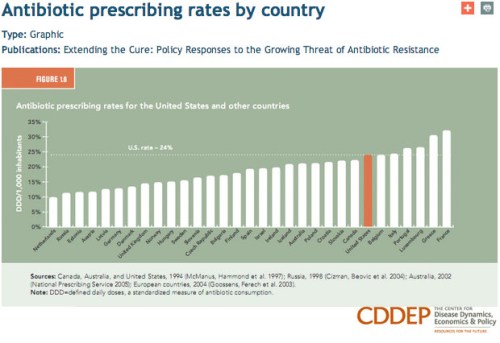
In a broader social context, national culture has a significant influence over decisions to prescribe antibiotics as well. A Dutch GP working over here thinks we’re terribly laissez-faire but we point out that we prescribe less than half as many antibiotics as the French.

Antibiotic prescribing rates by country

Why we prescribe antibiotics matters because of the growing problem of antibiotic resistance, where bacteria previously sensitive to the effects of antibiotics develop resistance as a result of excessive exposure.

If we think we (or the French) are to blame, then we need to look also at what is happening in developing countries. I have worked in Afghanistan, Nepal and India with doctors and nurses whose careers have taken them all over the world. A very common situation is as follows. A poor person goes to see a doctor or other healthcare professional with a cough. The ‘professional’ assesses their ability to pay for treatment and gives them a scrap of paper with a list including antibiotics, pain-killers, vitamins, antihistamines and possibly more and sends them to their brother’s pharmacy where they buy whatever they can afford. Often they won’t complete the course of antibiotics, so they give (or sell) them to someone else. In many, perhaps most poor countries it is possible to buy antibiotics direct from pharmacies, and during the avian flu panic a few years ago there was a roaring trade in antiviral drugs being sold from online pharmacies in rich and poor countries. The widespread use of antibiotics and antiviral in intensive livestock farming is also alarming. In the case of TB (tuberculosis) the problem of resistance is significant because antibiotic treatment has to continue for several months and is frequently interrupted by conflict, natural disaster and so on. Medications are frequently sold or exchanged for other medications, food, etc. Unsurprisingly totally drug resistant TB is now, officially a thing.

I don’t wish to ignore the  enormous efforts to circumvent these problems with directly observed TB treatment programs and attempts to provide Universal Healthcare Coverage in poor countries, but the damage is being done all the time.

The future for prudent antibiotic prescribing at home isn’t much brighter. A political agenda that is aggressively encouraging patients to consume and professionals to compete and be judged according to superficial measures of patient satisfaction, combined with a loss of continuity of care and the premature retirement of older GPs is worrying to say the least. External evidence – about when antibiotics should be prescribed-  is occupying too much attention in our efforts to make medicine more ‘evidence-based’.

Back in my own surgery I am faced with Fahima. Her experience of healthcare in Turkey was that colds were quite frequently treated with antibiotics and other medicines and it has taken me about two years to build the trust necessary to convince her that she and her children can manage without them. Nevertheless she is very anxious, both children have been sick recently and I had seen one of them with symptoms of a cold about a week before they were admitted to hospital with a chest infection and her confidence in my diagnostic skills has taken a blow. In fact my confidence in myself took a knock after that. She spends most of the allotted appointment time complaining about the overcrowding at home and how much it is contributing to her children’s ill health so we have almost no time to discuss the use of antibiotics. Most of the conversation takes place as I examine them all one by one, on the couch. I’m examining their behaviour as much as I am their lungs. When the examinations comes to an end, I am prepared to talk about antibiotics and self-care, even though I am running late, but Fahima is gathering her bags and getting ready to leave,

“They’re OK? Yes?” she asks, with her hand on the door.

“Yes, they’ll be fine” I say, taken by surprise.

“Thanks doctor, thanks for listening”

Update

Time of day affects decision to prescribe antibiotics: JAMA Dec 2014 http://archinte.jamanetwork.com/article.aspx?articleid=1910546

16/10/2014 Prescribing of antibiotics by GPs in England fell by 4.5% between 2012 & 2103. https://www.gov.uk/government/publications/english-surveillance-programme-antimicrobial-utilisation-and-resistance-espaur-report

05/08/2014: Public Health England study into antibiotic prescribing in General Practice 

Critical Voices

I’ll be speaking at this on Saturday and asking the question, ‘how do we doctors know what it’s like to be a patient?’

Critical Voices A4 Flyer-1


Critical Voices A4 Flyer (1)-2

Diagnosing cancer

“What do you think this is, doc?”

Mike opened his mouth as wide as possible and pointed to his right tonsil.

It was about the size of a conker and grey. I’d never seen anything like it.

“I’ve never seen anything like it” I said. “But I really don’t like the look of it”

“So what could it be?” he asked.

“Mike, I’ve never seen tonsil cancer before, but I really think we should find out what that is as soon as possible.”

“Thanks doc, what do we do now?”

I referred him to the local ENT specialist and 2 weeks later he was diagnosed with cancer of his tonsil.

****

“Could you sign my insurance form please?”

Aimee had been seeing a private physiotherapist for her back pain which started a month ago while she was gardening.

“Is the physio helping?” I asked. Aimee was a fit-looking 32 year old who worked for a city bank.

“Not much yet” she said. “I’m still taking pain-killers and doing the exercises though”

I’m not sure I examined her, she was in a rush, I was running late and she looked well.

Three months later I discovered that she had metastatic breast cancer. The back pain started when one of the vertebrae (bones) in her back fractured because the cancer had metastasised (spread) there. She saw three other doctors before one of them arranged for blood tests which showed signs of inflammation, then a bone-scan showed the metastatic spread and further tests revealed the breast cancer.

Both Mike and Aimee died last year.

I see about 2-3 new cases of cancer a year. Some are like Mike, some are like Aimee.

The secretary of state for Health, Jeremy Hunt has announced, to cheering headlines from the Mail and the Mirror, that GPs who are slower than average to diagnose cancer will be ‘named and shamed’. If I have two patients like Mike I’ll be fine, two like Aimee and I’ll be named and shamed. One year green for good, the next year red for dangerous. If you want to wait until I’ve seen enough patients with cancer to be statistically significant, you might have to wait another 20 years.

Another problem is about which of the three GPs, one A&E doctor and two physiotherapists is responsible. I only saw her once. Guidelines recommend that we start investigating when a new episode of back pain hasn’t resolved by six weeks, but she had only had it for a month when she saw me.

After Aimee’s diagnosis our practice arranged a meeting with all the doctors and trainees to discuss how we could have helped her sooner. I reviewed all the literature I could find on back pain and breast cancer and presented a summary to the other doctors. We read the hospital reports and discussed Aimees concerns and opinions. We instituted a policy of every patient having a usual doctor, because one factor in the delay was seeing different doctors who were more likely to watch and wait than a doctor who had already made their own assessment and done that once. We also made a decision to discuss every patient who was diagnosed with cancer, whether or not their diagnosis is delayed, like Joan who didn’t see a GP until her breast was covered with a giant cancerous ulcer.

I don’t know if it has made a difference, because as a practice of 12000 patients we only see about 20 new cases of cancer a year. But we haven’t had any significant delays in cancer diagnoses since then and all of us really appreciate learning from the cases. Cancer very often presents in ways we don’t expect.


Shame is never useful. The natural response to shame is to hide, oneself or one’s actions or both. Another response might be to refer every patient who might possibly have cancer so that someone else, anyone else is responsible, but not you. That would be a disaster. Shame and blame are the last things you want if you’re looking for a culture of openness and safe patient care. The Francis and Berwick reports after Mid Staffs, both pointed to the dangers of a culture of fear,

Honest failure is something that needs to be protected otherwise people will continue to live in fear, will not admit their mistakes and the knowledge to prevent serious harm will be buried with the patient. Francis

Abandon blame as a tool and trust the goodwill and good intentions of NHS staff.  Berwick

According to airline and patient safety expert Sidney Dekker,

Accountability is the willingness to share accounts.

Fear is a grave risk to patient safety.

Shame as a policy satisfies our desire for a simple explanation, a bad doctor for example. This is an ancient myth we tell our children and ourselves; if we can identify the bogeymen, in this case the bad doctors, then we’ll be safe. Shame is also the product of a desire for retribution. Behind policies designed to shame people are not simply newspaper editors looking for headlines, or politicians looking for simple answers to complex problems, but aggrieved relatives, policy-makers or journalists trying to cope with a delayed diagnosis or a medical error.

Their concerns deserve to be taken seriously, very seriously indeed.

But if shame continues to shape policy, it will be a disaster for patient safety.

Of course, this policy may have nothing whatsoever to do with patient safety. It has always been a fantasy of Tim Kelsey (who Paul Nuki from NHS Choices said might be behind this idea) and other policy makers that patients should act more like consumers. In order to do that, the bond between patients and their GPs who they know and trust (but may be a little slower than average in diagnosing cancer) needs to be broken. One might even wonder if the constant denigration of GPs is part of this project. Then with alarming headlines and league tables patients will be scared (enabled) to choose another GP …. (thanks to Richardblogger for pointing this out here)

Further reading/ watching:

Patient safety and quality: An evidence-based handbook for nurses. Chapter 35 Error reporting and disclosure.

Patient safety depends on NHS staff feeling valued, respected, engaged and supported: Culture and behaviour in the English NHS. Mary Dixon-Woods

Referring patients. Doctors’ anxiety has a lot to do with it.

Narrative, listening and forgiveness.  How the process of grieving can lead to forgiveness

Shame – and how it presents in clinical encounters.

The emotional labour of care. Health care is emotional labour.


Sidney Dekker– airline and patient safety expert and brilliant speaker: Lecture on Just Culture:

Short version

Full version

My Reality of Do Not Attempt Cardio-pulmonary Resuscitation Decisions

A Story by Dr Gordon Caldwell (@doctorcaldwell on twitter)

There was a frail old man struggling with his breathing in the first bed on the right as our team entered the six bedded bay to see our patient in the next bed. I think there was a nurse with him, but that may just be wishful thinking to salve my conscience. Our night doctors had been busy and needed to get away from their 13 hours shift, to grab some sleep before starting again that evening. We went to see our patient, and of course to maintain dignity and a semblance of confidentiality, we pulled the curtains around his bed. I was concentrating on our patient’s problems and was aware of disturbance from the next bed. Our Registrar left to help out. Soon the whole cardiac arrest team arrived and started cardio-pulmonary resuscitation (CPR) on the frail old man. The bay filled up with more staff, as usually happens during daytime cardiac arrest calls. We finished the consultation with our patient, reassured him as much as we could, and after checking our help was not needed, left to see the remaining patients. Later I went back to ask Sister what had happened. The man had died. The CPR attempt was called off after about 10 minutes. When the admission notes were read out, he had been admitted from a nursing home in the small hours of the morning. He had severe emphysema and poor mobility. I asked the year 3 doctor about his thinking when he had admitted the patient. He thought that the patient was probably dying, but felt he was too junior to make that decision. He chose to wait until the Consultant round in the morning, thinking that the Consultant would make the “Do not attempt cardio-pulmonary resuscitation” (DNACPR) decision. The patient suffered an undignified death, with one doctor doing chest compressions, another attempting to intubate his airway and a host of clinical staff looking on. The atmosphere in the ward was one of shock. The other patients in the bay were clearly distressed as were the nurses, who had wanted to provide kind care to a frail old man as he died. The doctors in the cardiac arrest team were also subdued. I felt that I should not have gone to see our patient, but dealt with the frail old man, although he was under the care of another Consultant. What he needed was a nurse to sit with him and hold his hand as he died; probably he needed some oral morphine to relieve the distress of breathlessness. He certainly did not need CPR.

I have told this story, warts and all, because it encapsulates our dilemmas in hospital about DNACPR decisions. Of course you can criticise all of us in the story. The year 3 doctor should have spoken to the night Registrar, but maybe the Registrar was busy transferring another patient to the Intensive Care Unit. So the year 3 doctor should have phoned the Consultant in the middle of the night to get the decision, but maybe he thought the patient would make it through to the ward round, or maybe he was frightened to phone a Consultant at night. Very likely the year 3 doctor had a host of other patients and tasks to see to, with his bleep going off all the time. When Sister came on at 7 am, perhaps she should have called the Consultant, but it is possible she had not even had time to see the patient and had only had a verbal handover. I could have stepped aside and attended the patient. The Nursing Home staff or General Practitioner could have discussed this with the man, and made an advanced care plan. The man himself could have thought this through, if he still had capacity.

Some of my thinking about this story

All of these potential criticisms are true, and what also is true is that right now, every day, hospital doctors face this sort of problem. I think it will be many more years, before we get to the stage where most people with very frail health have had these CPR issues resolved prior to arriving in hospital. In the meantime hospital clinicians are in an unenviable position. In 2014 there is a steady stream of frail, usually elderly frail, patients arriving in hospitals. Some are inevitably dying and the others despite their frailty will survive this admission, but are at a small risk of unanticipated sudden decline.

Talking with a frail patient who is inevitably dying and with his family is emotional and draining, but straightforward. The decision about DNACPR is also usually straightforward, because most patients want to die with the family around them, in comfort, and with “no heroics”. Discussions with frail patients who will probably survive the admission are complex, emotional and take a long time, but the diseases in all our cohort of patients are running ahead around us. Most acute clinicians do not have the time for these discussions, yet we don’t want to see out patients dying like the frail old man. Why don’t we have the time? Last Saturday I saw 20 acute admissions, of which I thought that 15 had sufficiently frail health that they could not survive a CPR, although none looked as if they were imminently dying. The work of diagnosis, investigation, treatment, documentation, explanation and handover took 8 hours. Another 15 hours of discussion about CPR status, would leave 1 hour before starting to see the next 20 patients that I had to see on Sunday morning. As a clinical team we have to make a judgement that the frail patients, in the event of a sudden unanticipated deterioration, would not survive a CPR, to save them from a violent and undignified death, distressing to patient, family, other patients and hospital staff, who went into their careers to provide intelligently kind care.

Words and Meanings

George Orwell was passionate about the meaning of words. In the book 1984 he showed a society in which words lost their meaning. In 2014 we live in a world in which “wicked” can mean a really great experience. The meaning of the words in this debate really matter.

Cardio-pulmonary Resuscitation (CPR)

A defibrillator is a device that delivers an electric shock across the skin and through the heart. The shock is like the Alt Ctrl Delete key combination, shutting a Windows computer down, in the hope that it will reboot successfully. The electric shock to the heart stops the heart’s electrical timing activity in the hope that the heart will reset itself into the right rhythm (sinus rhythm, SR). Defibrillators came into use in the 1960s to treat ventricular fibrillation (VF) and ventricular tachycardia (VT) in patients who had had a coronary thrombosis.

Coronary Thrombosis, Ventricular Fibrillation (VF), Ventricular Tachycardia (VT), Asystole and Pulseless Electrical Activity (PEA)

A coronary thrombosis or myocardial infarction (the words mean the same) is commonly called a “heart attack”. One of the arteries supplying blood carrying oxygen and glucose to the heart gets blocked by a blood clot. Usually the patient experiences severe crushing pain or tightness in the middle of chest.

When parts of the heart are starved of oxygen and glucose, the heart muscle eventually dies and turns to fibrous tissue. These days, with early interventions, the damage can often be limited. In the early minutes after the blood clot has blocked the artery, in a few patients, the heart rhythm becomes very unstable and the patient suddenly collapses into unconsciousness. Here is one place where words really matter. This collapse can also be called a “heart attack” by patients and the media, whereas doctors would call this a “cardiac arrest”. In a cardiac arrest a patient suffering a coronary thrombosis develops unstable electrical activity so that the heart stops pumping blood. Unless urgent action is taken, the patient will die.

The unstable electrical activity can be VF, VT, asystole or PEA.

In VF the ventricles, the main pumping chambers of the heart, develop a totally chaotic electrical activity. In VT the ventricles beat so fast that the heart scarcely pumps any blood at all.

In asystole the electrical activity stops completely. In PEA the electrical activity continues, but the signalling between the electrical activity and the heart muscle is broken.

The defibrillator is more effective in VF and VT than in asystole and PEA. In VF and VT, the electrical shocks can reset the timing processes and sometimes the heart starts beating again in the normal rhythm. When this happens it can be really exciting and dramatic. I have seen patients collapse unconscious in front of me, and the heart is in VF. In a coronary care unit it is possible to charge up the defibrillator and apply a shock very quickly, so that the patient comes round almost at once. On rare occasions the patient can even resume the sentence he was speaking. Without a defibrillator he would have died. Sometimes the shocks do not work, it is impossible to get the heart rhythm reset and the patient dies. I can recall many, many more failed defibrillations than successful ones.

During a coronary thrombosis asystole and PEA are very difficult to treat and the prognosis (chance of success) for restarting the heart is far worse.

After the introduction of the defibrillator it soon became apparent that permanent brain damage can ensue unless a good blood flow from the heart beat is established, in adults, within a few minutes. Some blood can be pushed around the body by cardiac compressions. In cardiac compressions, provided the patient is on a firm surface, compression of the sternum by forceful downwards pressure of the hands, blood gets squeezed out of the heart to the brain and other vital organs. The force required is substantial – much more than kneading bread, perhaps more like using a large bilge pump on a boat. The amount of blood squeezed out is more if the lungs get filled and emptied of air. During CPR it is common to intubate the trachea and use a bag to force extra oxygen into the lungs, and also so that if the patient vomits, the vomit does not go down into the lungs. Cardiac compressions are forceful and can cause damage. Post mortem studies after failed CPR commonly show fractures of the sternum and ribs, and these are inevitable in old people with osteoporosis. The injuries are similar to hitting a steering wheel in a car crash in the days before seat belts and airbags. I can right now, as I type, still feel from many years ago that peculiar sensation with the first compression as the sternum gives way and a number of ribs crack.

In the 1960s Cardiac Arrest Teams were trained to do cardiac compression and intubation with ventilation, whilst the defibrillator was brought along in the hope of correcting the heart rhythm. Some patients with coronary thrombosis, who would otherwise have died, were brought back to life. This led to the development of coronary care units (CCU). Then the cardiac arrest teams started going out on “crash calls” to patients who collapsed abruptly on the general wards. The success rate on the wards was far less, mainly because these patients were not suffering a coronary thrombosis, but dying of other conditions like blood clot to the lungs (pulmonary embolism), pneumonia or cancer. In all deaths the heart stops, but in very few deaths is the cause a myocardial infarction and potentially reversible VF or VT. Nonetheless by the 1980s, in some hospitals, it had almost got to the point where a patient could not die without a crash call and a CPR attempt. This may have been one of the reasons for the development of Hospices; to save patients from the traumatic CPR death. I was involved in many crash calls in the 1980s, and I am ashamed to admit that many of us took the opportunity to use these to learn how to place central lines or practice draining a cardiac tamponade. For junior anaesthetists it was a chance to hone skills in urgent intubation. Thank goodness we now have good simulation suites.

Then someone thought that it would be good to try using defibrillators outside hospital in “Out of hospital cardiac arrests”. Again in some circumstances this worked and lives are being saved every day. You can see defibrillators at railway stations, airports, and popular tourist destinations. In general these were used on people very different from those in general wards in hospitals. In the 1980s if you had reached Victoria Station and as you rushed to the Tube, had a coronary thrombosis complicated by VF, in medical terms you were a medically fit person. “Medically fit” these days pretty much means you can go up one flight of stairs at a good pace, and that every day you usually walk outside your house under your own steam. So CPR on Victoria station in the 1980s was only being done on a selected group of medically fit people. In 2014 with electric buggies people who are “medically not fit”, can get all the way around the world!

In broad terms, and clinicians are well aware of all the other causes of VT and VF, CPR was developed to try to reverse chaotic heart rhythms during a coronary thrombosis. Success was much more likely the earlier defibrillation was done, and was much more likely in patients under 70 years of age. Significant brain damage occurs in an important proportion of survivors. CPR and defibrillation was very unsuccessful in “medically not fit” patients on the wards, but had limited success in out of hospital cardiac arrests.

Medical Emergency Team (MET)

However some patients really benefitted from the cardiac arrest team’s arrival. A lot of “crash calls” were not for patients with a cardiac arrest, and viewed as false alarms. Some had epileptic convulsions, some had major haemorrhages, low blood glucose levels, obstructed breathing, or sepsis. Today many hospitals have Medical Emergency Teams (MET) or outreach teams from the Intensive Care Unit. If a patient is listed as DNACPR, he must not be automatically excluded from MET or outreach calls. Many frail patients can benefit from fairly invasive treatments provided by a MET, and may even need to go to a high dependency unit. Being listed for DNACPR must not mean “do not attempt any clinical care”.

Respiratory Problems

I heard a story that a patient with an obstructed airway was allowed to die by paramedics, because the patient had a DNACPR in place. Once again words really matter. Interventions to restore breathing are in general far less traumatic than cardiac compressions. A very simple suction device can remove sputum that a frail patient cannot cough up, or a lump of meat that has gone down the wrong way. It may be far better to have a code for “Do not attempt cardiac compressions” (DNACC) than “DNACPR”. Obstructed breathing is extremely unpleasant and should nearly always be actively relieved.

Frailty

I have mentioned frailty many times, without defining it. Physical frailty has little to do with quality of life, it is to do with physical quantity of function of the body. Of course someone with very little physical function can enjoy a “good” quality of life, enjoying family, reading, TV, even getting out of the house. Many Junior Doctors seem to think that because someone is a “nice” person, can play bridge and read a book, they should be listed for CPR, because he has a good quality of life!

I try to explain this concept of quantity of function of the body in terms of Jenga bricks. Imagine in the tower of bricks there are four labelled “Heart”, four “Breathing”, four “Brain”, four “Kidneys”, four “Skin” and so on for all the vital organs and processes, and four bricks for “Cancer”. Now imagine you are 80 years old and are playing Jenga with your grandson and you each have your own Jenga tower. Please don’t do this, its far too morbid!. Of course you want him to win, so you allow him to remove bricks from the top of his tower, but you have to take bricks from the lower half of your tower. Even losing 2 Heart bricks for the youngster hardly matters e.g. hole in the heart repaired, his tower stands firm. However your tower becomes wobbly after a heart (heart attack), lung (emphysema), diabetes, kidney, and brain (minor stroke) brick have been removed. Eventually even a little jiggle of the table e.g. a urine infection, is enough to bring your whole tower down. If someone came along with a hammer (CPR) your tower would inevitably fall. Ageism is inappropriate in many areas of medical practice, but not in relation to CPR. The chances of survival after a CPR attempt diminish progressively with age.

So if you are 80 years old and being treated for angina and heart failure, emphysema, diabetes, kidney disease, have had an operation for bowel cancer, and arthritis so bad you cannot get out of your house, your health is frail. Some younger people can also have very frail health, a few very old people have robust health. Mobility really matters, so if a relative of yours is 85 and spending 50% of daytime hours in bed day in, day out, health is frail.

Of course our population is getting older. Dementia is becoming more common. This means that a large proportion of patients admitted to hospital as emergencies are now in frail health. If they have advanced dementia or delirium then they may no longer have the capacity to make decisions about treatment or choosing not to have treatment. I strongly suspect an important proportion of frail patients don’t want all the tests and treatments a big modern hospital processes them through in obedience to guidelines and pathways. Very few of them are admitted having a coronary thrombosis, and thus at risk of VF or VT. Even if they did, with their frail health, the treatment simply would not work.

Resuscitation

This is the word that causes huge misunderstanding.

By Resuscitation Doctors mean “Cardiac compressions, intubation, ventilation and attempts to restart the heart, when the heart is in VF, VT, asystole or PEA, because of heart disease”. So “DNACPR” should mean just that and still do everything else that is appropriate, but do not attempt an invasive process that is doomed to fail and serves no one any good at all.

Unfortunately even nursing staff can interpret DNACPR as “we are not really trying any more with this patient”.

For the patient and carers “Do not resuscitate” can also sound like “Oh they are not going to look after me anymore” and of course easily becomes “I must be about to die very soon, and they won’t care for me.”

Are you baffled now? I am feeling baffled. How did we get to the point that almost by law and certainly by recommendation of the General Medical Council (GMC) Doctors are meant to actively discuss DNACPR decisions with patients are relatives. CPR “works” in very specific circumstances of a coronary thrombosis (and a few other conditions) complicated by VF or VT, and even then is far from universally successful. (I know there are other circumstances in which it works like primary VF). In other circumstances, in simple terms, CPR does not work, and it certainly does not work in frail elderly people. There are many other treatments that do “work” in frail elderly (see MET above), and much we can and ethically must do for these frail patients.

So what’s the problem, Gordon?

The patient who is inevitably dying

If the patient is inevitably dying there is usually no need, other than the GMC and law’s orders, to discuss CPR status. In full open discussion with the patient, carers and clinical team the patient’s wishes are explored. Commonly patients envisage dying surrounded by caring people, as the patient is kept pain free, warm and clean. No mention is made of wanting a cardiac arrest team to arrive as the patient slips into death. So why do we have to actively explain CPR to the patient and carers, to say we are not going to do something that they don’t want and won’t work? The use of the words “not resuscitate” in this emotional and difficult conversation can easily be misinterpreted as “They are saying that there is nothing they can do, they are going to abandon me”. Even worse we doctors often say “There is nothing we can do”, when we mean “Your cancer had caught up with you, you are dying, we are going to be with you through this, come to you, help you, talk, relieve your pain, laugh and cry with you.”

The frail patient who slowly deteriorates after admission

Again this situation is straightforward, even if painful and emotional. The main problem now in hospital with shift working and lack of continuity of supervision is spotting that they patient is inexorably deteriorating. Sometimes we also forget to review the CPR status, as time slips by. However once the clinicians recognise the inexorable deterioration, this leads to conversations about death and dying. As above unless the patient or carers raise the issue, I cannot see that discussion about not using a futile invasive treatment that the patients does not envisage, is helpful in any way. Of course sometimes patients or carers raise the issue and then it is all straightforward, as everyone agrees “No heroics”.
Should the patient or carers ask for or demand CPR a very ugly situation ensues. By law and by medical ethics it is clear that such a demand does not have to be fulfilled. So why do we pretend to offer a choice, when should the patient say “I want it” we then have to say “No”! The outcome is usually then that the patient gets relisted as “For CPR” and at the moment of death the cardiac arrest team comes, the family are rushed out of the room and the team undertakes a cursory attempt at CPR. Someone in the team reads out “78 years old, bedbound for the last 6 months with metastatic cancer” and the leader calls “Stop”.

The frail patient who is expected to recover and go home, but who would not survive a CPR

So, finally to the nub of the problem. The majority of patients admitted under my care are over 80 years old, or over 75 years with multiple health problems so that their condition can be described as “medically frail”. I am not a Geriatrician, I am a General Physician and this has been a major demographic change since I qualified in 1980.

Although these patients are “frail elderly” only about 3% die during an admission under my care. Most of these cases are inevitable deaths from advanced cancer or advanced dementia with immobility. You could argue that they should not come to hospital at all, but they do! As I described above, the care is straightforward but challenging and can be very rewarding.

However a small proportion of frail patients expected to survive to discharge from hospital, suffer an unexpected major deterioration, and whilst the patient is dying the cardiac arrest team will be called unless a DNACPR is put in place. This deterioration can happen any time after admission, so to save the patient invasive futile harmful treatment the clinical team has to decide “DNACPR” very shortly after admission, at the very same time as the team is most in demand for acute care of a cohort of patients. Even for the patient in question there will be a lot to do – start the antibiotics for pneumonia, explain that there may be a lung cancer on the X ray, arrange blood tests for the next day, speak to the partner who is worried at home, write a referral to physio and OT etc. Then there are all the other patients to be seen, for example there may be a patient with meningitis or another with a major bleed from a duodenal ulcer, in need of urgent treatment. Would it be right to spend an hour agreeing a DNACPR, maybe with a relative on the other side of the world, in a patient who probably won’t deteriorate, whilst we leave two acutely ill patients with treatable conditions, to deteriorate? The clinical team cannot get it right; it is in an impossible situation and one that neither the patient nor the clinical team should be in. For the clinical teams on our general wards it is now both everyday and ordinary. As I said, last weekend I was responsible for about 40 admissions over 2 days. The majority of whom would not survive a CPR, but most of whom survived to discharge. They need a protective DNACPR decision, whilst we do all their complex difficult clinical care of diagnosis, treatment, review and all the time with lots of communication!

The experience of CPR discussions can be disturbing for the frail patient. For example our team may review a patient and she is told she has pneumonia, emphysema, weight loss, diabetes, some temporary damage to the way the kidneys work, and of course she knows she had a stroke and a heart attack last year. We are treating her with 48 hours of intravenous antibiotics, and hope she will be good to go home in 4 days time, if the physios help her back onto her feet. Then we are meant to have the discussion about CPR. So I will dramatise the conversation “Oh yes, and in the meantime, should your heart stop, would you like us to have a go at restarting it? Personally I would not recommend it”, “No”, “Ok lets sign the red form” (I have heard conversations not much different from that!). Then the patient is left asking herself “Did they say I am going home in 4 days, or that my heart is going to stop and I will be left to die?” I know because a patient told me this a few months ago, after someone had had the CPR talk with her. You could say “Well the nurse will explain it all to her after the round.” For 65% of my bedside reviews there is now no nurse there to hear the conversation, to then be able to explain what was said. This is the reality of working life on General Wards in many NHS Hospitals. It is far better on specialist units.

What lies ahead, is there any hope?

The hope is that society and individuals wake up to the fact that death is eventually inevitable and increasingly likely after the age of 80 in previously fit people and in those over 75 with “frail health”.

We need to learn to think ahead to how we would like to die, when the time comes. Most doctors would relish patients and carers who come wanting help and advice on this. Medical professionals also need to learn to be straightforward in communication as well as curious about patient’s actual understanding. For example oncologists tend to be optimistic people and communicate to patients receiving palliative chemotherapy that it is a treatment. Patients take this to meant “a curative treatment” whilst the oncologist thinks he has communicated “This is quite a toxic and time consuming treatment that may prolong your life a bit”. It can be a great shock to these patients when they arrive in hospital and we give a prognosis of days. However it can be difficult for Doctors to give advice about CPR, because the number of CPR calls is falling, so they may not have any first hand experience of what a CPR is like. The numbers are falling because we are getting better at recognising frailty and better at discussing impending end of life and so avoid futile CPR.

GPs using the “Gold Service Framework” are taught to ask “Would I be surprised if this patient died in the next year?” If the answer is “No, I would not be surprised”, this can provide the GP with a prompt to open up discussions. We should do this much more in hospital, but time pressures are a major barrier. All hospital doctors have ward patients, clinic lists, and possibly operating lists. Most already have completely full days, and are working beyond hours, often with few breaks. We could take on this important aspect of patient care, if we had the time. Senior nurses are as capable (more capable?) at these conversations, but are also under huge pressure. We know from Mid Staffs that nurses can be so task saturated that even their humanity can be eroded. A nurse frustrated that she does not have enough time to provide basic human care, is not going to be in the right frame of mind for an emotional one hour conversation about DNACPR.

So, as ever, it is mainly in the hands of our patients and carers to prepare themselves. Failing to prepare is preparing to fail. The emotional traumas of dying and death can be lessened by anticipation and planning. Advanced care directives talked through with a trusted doctor or nurse and validated by a lawyer can be very helpful. Have the courage to ask your Doctors about prognosis. If you don’t want heroics, even if you want to cut down your huge list of medications, talk with your family, talk with us.

I believe when you ask us to “Do everything, Doc” what you really mean is “Do everything that you as an ethical medical professional believe is wise, likely to work and kind and not cause unnecessary suffering.” I say that because when a patient dies the very first question the relative usually asks is “He didn’t suffer, did he doctor?” A death under CPR inevitably causes suffering.

That frail old man in the first bed could have died quietly with one of our lovely nurses holding his hand and talking with him. It is misunderstandings about words and their meaning that robbed him of a calm end of life.

Dr Gordon Caldwell FRCP London
GMC 2648903 (should you want to report me to the GMC after reading this)

Further reading:

Do not resuscitate My own experience of CPR as a junior doctor.

Is discussing futile treatments really best for dying patients?  Margaret McCartney BMJ June 27th 2014

Doctors and Death A story. Includes lots of references and teaching material.

Death in the life of a GP

Presentation to the Royal Society of Medicine Palliative Care section.

My first death was at the age of 17. I was working at Winchester hospital as a nursing assistant in 1988 and the ward sister asked me to spend my night shift with an elderly woman who was expected to die. She had advanced dementia and had suffered a stroke so that she was paralysed down her left side. She slept peacefully, occasionally moaning when she moved. As the night went on the ward sister bought me cups of tea so I wouldn’t have to leave my patient. At about 4.30 her breathing began to change, it slowed and became irregular. I called the sister who came over and drew the curtains around. I held the old lady’s hand and watched her silently and intently. She had no family, no friends left alive with whom to share her last night on earth. Her breaths were so quiet, I hardly dared breathe myself. At about 6am she stopped breathing. With the ward sister’s help we washed her and wrapped her in a sheet before the porters came to take her to the morgue. It was one of the most formative experiences of my life.


Sociologist Arthur Frank described 3 narratives that we tell about the practice of medicine.


The first is Restitution,


Restitution is the story we are familiar with from medical dramas – it’s the one we tell each-other in medical school. In the restitution narrative the doctor as hero rescues the patient from the disease and health is restored. Note that the patient is merely the field on which the doctor and the disease do battle. The restorative narrative of palliative care is one in which the heroic doctor relieves the patient’s suffering and death is dignified. In Winchester hospital that night I was part of a restitution narrative, I was simply sitting up all night with someone who was dying, but it felt heroic. It’s worth reflecting on our attachment to and desire for the restitution narrative, especially when things don’t work out this way.


When things don’t work out we have Frank’s second narrative, which he calls Chaos.

Marjorie 1956

This was my grandmother in 1956. When she died I was 21 and half-way through medical school. I remember her vividly from very early in my childhood. I adored her. In the ‘30s she modelled for Vogue magazine and was always beautifully dressed. For the last 5 or 6 years of her life I barely saw her. The woman I knew and loved had Alzheimer’s disease, she was violent and psychotic. Physically she was incredibly strong, but her mind was completely gone and she needed specialist care. The last time I saw her she was sedated and couldn’t speak. It was extraordinarily upsetting, I completely withdrew from her for the last few years of her life and felt – and continue to feel guilty – for abandoning her, and my parents at that time.

80.29

Her son, my father, Peter pictured here at his 80th birthday party, saw the same thing happen to his father and his youngest brother, and has lived his life in fear that the same thing would happen to him. He has staved it off for as long as possible, but for the last 2 or 3 years the signs have become increasingly clear. He had enough insight to develop a deep depression which has been impossible to shift, but it’s now reaching the point where his insight along with his balance and his continence are failing. I’m not entirely sure I’m going to manage this any better than I did with my grandmother.

According to Frank,

“To deny the living truth of the chaos narrative is to intensify the suffering of whoever lives this narrative. The problem is how to honor the telling of chaos while leaving open a possibility of change; to accept the reality of what is told without accepting its fatalism.”

The chaos narrative presents the greatest difficulties for those of us whose job it is to listen. We are left with a sense of unbearable helplessness and if we cannot cope, we respond by withdrawing or running away. Some of us become doctors to deal with this helplessness, as one consultant psychiatrist writing about her own experience of mental illness says,

… some of us self select medicine in order to deal with our worst fears by helping those who present with what would be to us, intolerable illnesses, but by working on them in our patients we master some hidden angst.

Writer Jonathan Mann expresses clearly our attachment to restitution,

Yet most people who decide to become doctors respond to a deep intuition about life and their own lives. To become a doctor implicitly places us on the side of those who believe that the world can change – that the chains of pain and suffering in the world can be broken. For every medical act challenges the apparent inevitability of the world as it is, and the natural history of illness, disability, and death. Every antibiotic, every surgical intervention, every consultation and diagnosis becomes part of an effort to interfere with the “natural” course of events. Thus, at a profound, even instinctual level – because it precedes rational analysis – people become physicians to find a way to say “no” to disease and pain, and to hopelessness and despair – in short, to place themselves squarely on the side of those who intervene in the present to change the future. 

But if a story can be told then it is not entirely chaos and in that there may be a therapeutic opening. The challenge is not to push toward this opening prematurely with our own restitution narrative. ‘The chaos narrative is already populated with others telling the suffering person that “it can’t be that bad”, “there’s always someone worse off”, “don’t give up hope”, “it’ll be OK”; and other statements that ill people often hear as allowing those who have nothing to offer feel as if they have offered something”.’

How then can we honour suffering without imposing our own desire for a restitution narrative?

The final narrative Frank describes is ‘Quest’

“Quest stories carry the unavoidable message that the restitution narrative will, one day, prove inadequate. Quest stories are about being forced to accept life unconditionally; finding a grateful life in conditions that the previously healthy self would have considered unacceptable.”

A story.

“I couldn’t possibly ask Dr Brown, it would break her heart”

This wasn’t the first time I’d been put in this situation, but it doesn’t happen often.

“She’s known me for such a long time, I’d feel like I was letting her down”

I began to wonder if my own patients were having similar conversations with other doctors.

“She’s such a lovely doctor, and I’m sure you are too …”

She smiled a little to sweetly for comfort.

“You will help me won’t you doctor?”

“Tell me” I ventured, “why do you think you would be letting Dr Brown down?”

“Oh, she’s done so much for me, I couldn’t have asked for a better doctor. She’s literally saved my life. But now I’ve had enough, I’ve had a good life, don’t get me wrong, but I don’t want to go on forever, the ones I loved are all gone, and I don’t want to wait for another stroke.”

“Have you tried discussing it with Dr Brown?” I asked.

“I don’t think it would be fair to ask Dr Brown, I know her very well you see. She spent years looking after me and my husband and it was very hard on her when he died.”

“What happened?”

“Do you have time doctor? I don’t want to keep you.”

I knew from the outset that this wasn’t a consultation that could be rapidly resolved.

“Jim was a lovely man – and he was very fond of Dr Brown as well. She was his doctor for years too. I remember when he was diagnosed how upset Dr Brown was, I don’t blame her, but I still think she blames herself for not spotting it sooner. You see, Jim didn’t like to bother the doctor. He and Dr Brown used to joke that he was just coming in for his check-ups so that Dr Brown could tick all the boxes so she could get paid. He used to tell her, ‘you can tell them I’m taking whatever pills you want – I’ll take ‘em if you tell me, except mostly when I feel like, but you just tick your boxes and make sure you get paid. You deserve it and we need you. And while you’re at it my colly-esterol is none of their business, but it’s whatever you need it to be and I’m giving up smoking and taking up cycling and you can put that down too. And if you need to check my prostate, well that’s ok an’ all, but if you don’t mind not right now, but just make sure you tick that box and say I’ve agreed to it. There’s much sicker than me that need you Dr Brown and I don’t want to be wasting your time’”.

There were tears at the corners of her eyes while she reminisced.

“It was funny really, he’d say that, about not wasting her time, and they they’d talk about cricket or politics for another ten minutes. It’s sad really, there are people who are really struggling who have to wait to see their doctor”.

I agreed with her, but was conscious of time and tried to steer the conversation,

“What happened with Jim’s diagnosis?”

“Oh well, he was feeling tired and weak for a few weeks and had been dropping things quite a bit, which wasn’t like him at all and I eventually made him go and see Dr Brown. But I didn’t go with him and I don’t think he really told her what was going on, but she did some tests and they came back all normal. He told her that he was OK and he didn’t want to make a fuss and so she didn’t do anything else for a while. Thing was they trusted each-other, if he told her he was OK and didn’t want any bother she respected that. I don’t think she could have done anything different. But he wasn’t himself. Then he had a nasty fall when he was out walking the dog. He broke his shoulder and when he was in hospital they did some more tests because there was something wrong with his muscles and they said that he had motor-neurone disease and he had probably had it for at least a year. I think that’s when Dr Brown felt guilty because it was about that long that he had been feeling weak. To be honest, she was fantastic after that, he hated for her to come around because he didn’t like the idea of wasting the doctor’s time, but when it was too difficult for him to come to the surgery she would come in the evenings or in her lunch-breaks.

They never really talked about death, I think they wanted to but were too afraid. I remembered once she asked him if he’d thought about it or made any plans, and he told her not to worry about it, ‘I’m much more interested in living,’ he would say and then ask her what she thought about the cricket.

And then one day he got all confused and we tried to call Dr Brown, but she had gone away on holiday, I remember because she called us back from Italy but by then he was in hospital and they were giving him all sorts and he didn’t last long, but it’s not what he would have wanted.

Thing is doctor, I don’t want any of that to happen to me, I don’t want to be any bother to anyone, blocking up a hospital bed, surrounded by strangers. I was just hoping you might be able to give me something, so that when I’m ready I can go into a nice deep sleep.”


Doctors often avoid difficult discussions about death to protect themselves. And patients – especially when they care about their doctor, avoid these conversations to protect their doctors too.To talk about death requires doctors to confront their own attitudes to death and be attentive to their own emotional needs including the need to be protected from conversations about death.

The experience of suffering is often one in which old friends disappear, in which others may be lost for words or uncomfortable hearing about sickness. Many patients become isolated and alone because their illnesses have become so overwhelming that they feel they have nothing left to talk about and they don’t want to burden their friends, or even their doctors, ‘who have troubles enough of their own’. We may be poor listeners because we ‘want to steer the person back to being the person they were before’ rather than the new person they have become.

In her essay, The Art of Doing Nothing, Iona Heath explains that in medicine, “the art of doing nothing is active, considered, and deliberate. It is an antidote to the pressure to do and it takes many forms.” She quotes Arthur Kleinman, the American anthropologist and psychiatrist, who says:

… empathic witnessing … is the existential commitment to be with the sick person and to facilitate his or her building of an illness narrative that will make sense of and give value to the experience. … This I take to be the moral core of doctoring and of the experience of illness.

Bearing witness by empathic listening is emotional labour. Any doctor who has felt tired or forlorn after spending time with a patient in chronic pain, understands the burden that we feel when our patients share their suffering. We know that this is hard work, indeed, compassion means ‘to suffer together’.

Emotional labour is of a very different quality to technical labour. The ways we teach the technical labour of surgery or pharmacology are not suited to teaching ’empathic witnessing’. Anyone who doubts the importance of these human skills should read the accounts of doctors who have experienced serious illnesses. Iona Heath again says what we know to be true,

‘I know I can see you through this’ is the commitment doctors can make to the dying when doing has become futile and even cruel. Simply being there and bearing witness is never futile.

Empathic witnessing is a practice that needs lifelong nurturing. Professionals need not only enough time to spend with patients but also regular opportunities to reflect and discuss the emotional and ethical issues that comprise this work. Narrative supervision is one way we can help with this.

I hope that by reflecting on and sharing my own experiences I will have more courage to bear witness and accompany my patients and my family up until the end of their lives.


Further reading:

Do Not Resuscitate

Doctors and Death

Narrative Palliative Care: A Method For Building Empathy

The Inner Life of Physicians and Care of the Seriously Ill 

Arthur Frank, The Wounded Storyteller

Arthur Kleinman: The Illness Narratives, Suffering, Healing and the Human Condition.

David Zigmund, Physician Health Thyself, The Paradox of the Wounded Healer

How to respond to the recently bereaved. DocMum blog.

Iona Heath, Matters of Life and Death


The Future of General Practice?

Originally published on the Centre for Health and the Public Interest Blog. Please visit their excellent website http://chpi.org.uk/ for detailed papers looking seriously at health-policy that relates to the public interest.


The government has laid out its ‘Plans to Improve Primary Care’, focusing on GPs. Few GPs will read this tediously repetitive, wordy document, full of un-evidenced assumptions – that IT, home care and schemes to avoid hospital admissions will save money. Gimmicks like a named GP for patients over the age of 75 reveal how little they understand which patients most need continuity of care and the ‘Friends and Family test’ has not been shown to have any effect on quality. Labour’s response, apledge that patients can book to see a GP within 48 hours is a political target that has nothing to do with clinical need and will be fiddled, fudged and ignored. Such gimmicks from both sides will not help patients and will only add to the frustrations and lack of trust towards government among the profession.

What could the future of General Practice look like, realistically – taking into account patient needs, increasing demand, and policy and financial pressures?What follows is a description of what is already possible. I am not aware of any practice that works exactly like this, but some practices are very close. You will see that one aspect is the way appointments are organized. One GP surgery’s experience of changing its appointment system has been written up in a blog by GP Heather Wetherell. Evidence of confidence in this kind of system can be seen by commercial organisations like Doctor First and Patient Access that help GPs make the change. Another aspect is patients’ access to their GP records.  Amir Hannan, Brian Fisher and Patients Know Best have pioneered ways for patients to access their GP records. Many practices are incorporating these changes. They are being driven by GPs in response to patient needs, increasing demand and policy pressure.

The Future of Primary Care – a possible scenario

Five doctors, all GPs, and two nurse practitioners are sitting in a large room wearing headsets. They are separated by booths so that neighbouring conversations cannot be overheard by patients. Two of the GPs have a trainee listening-in through a second headset. It is a Monday morning and they are managing the demand from a practice with thirteen-thousand registered patients. The calls come through to the receptionists who add them to a single list that appears on the screens in front of the GPs. Patients who are distressed or have serious symptoms like breathlessness or chest pain are highlighted. Patients who are unable to use a phone or cannot speak English still come in to the surgery. On a Monday morning they handle about 250 calls, see 40 patients face to face and do 3 visits. Other days tend to be much less busy. Occasionally a patient is put on hold and the doctor or nurse asks one or more of their colleagues in the room for advice.

The nature of a clinical encounter is far more suited to a phone-call than email because of the quite intense nature of listening, questioning, clarifying, mutual understanding and reassuring that goes on. In a consultation, narratives are explored and created. This is far more suited to a conversation than an email exchange. Email still accounts for a tiny proportion of interactions. On the policy advice of mostly young, fit men, there is a risk that the government will squander millions on secure on-line consultation technology that will lie largely unused. Such is the nature of healthcare schemes dreamed up by fit, young men.

Calls take anything from a minute or two to half an hour or more. The written documentation has to be thorough and records are audited regularly by listening to the calls that have been recorded and reading the notes. I’m found guilty of writing too little and it’s a useful bit of feedback. My practice improves.

Every few minutes one of the doctors or nurse practitioners gets up and goes into the waiting room to call a patient that they have invited to come in to the surgery. They lead them into one of five consulting rooms and are with them from 2 to 30 minutes depending on the patient’s needs. Average consultations are about 12 minutes, but the doctors and nurses have the advantage of knowing in advance why the patient is attending. The problem of patients failing to attend appointments has almost been eliminated.

Four or five times a day a doctor goes out to visit a patient at home. Around here where I work in Hackney, most doctors do their visits on bicycle or foot simply because it is the easiest way to get around. Dealing with demand by phone has reduced the need for visits, perhaps because patients are more confident of getting through to a doctor when they need to.

Every patient will be registered with their own doctor, and if they are on duty will be called by them. Both doctors and patients value continuity of care. Patients will often wait to call on a day when they know their own doctor will be on duty. If they cannot, and their problem is complex or longstanding, another doctor will ensure it’s safe to wait and arrange for the usual doctor to call back. Out of hours calls and A&E attendances have also significantly reduced.

The practice has invested several thousand pounds setting up the call center and telephone bills have increased significantly, but they have saved on space by reducing the number of consulting rooms, and are sending far fewer letters. In a few years they hope to recoup their costs.

The service runs from 8am to 6.30pm Monday to Friday with later evening booked appointments. Once access improved, demand for late appointments diminished and hours were cut to save money. GPs are usually working until 8 or 9pm to finish their admin. When the surgery is closed, local practices share the workload using a similar model working shifts with the local social enterprise which comprises 34 GP surgeries. Patients can speak to a local GP at any time of day or night, but most prefer, and are encouraged, to speak to their own GP for reasons of continuity and safety. The ability to access every patient’s electronic record is still a pipe dream that extends back and forwards into the mists of time, littered by untold billions of wasted pounds. Fortunately most patients can access their own records and though many of the most vulnerable are unable or unwilling, it helps somewhat.

Doctors work shifts with protected time set aside for administrative tasks, teaching sessions and meetings. Their shifts are advertised so that their patients know when they are available. Patients are surprised to find out that each full-time GP is responsible for over 1500 patients, takes over 50 phone calls a day and spends over 2 hours a day on admin and up to 6 hours a week in meetings, teaching, etc. Every month the practice publishes data showing how many patients have been seen and how long they waited for their call to be answered and for the doctor to call them back. They also publish an anonymised summary of patient complaints and the actions they are taking in response. Complaints have reduced from several a week to a handful each month and patient satisfaction has increased from just over 70% to over 90%.

Planned care for chronic diseases like heart-disease, diabetes, asthma, contraception and antenatal care is still booked in advance with the practice nurses and midwives face to face. Patients needing blood tests, ECGs and breathing tests are seen by nursing assistants, some by appointment and some by a walk-in service. The nursing assistants are also trained as receptionists and when the phones are busiest, they work in reception. Patients are also offered minor surgery, physiotherapy, psychology and antenatal care. Patients from local GP surgeries who do not offer these tests because they lack the space or resources can come to a neighbouring surgery than has the facilities. A contract has been set up so that practices that are willing and able to offer services which others cannot, will be paid to do so. This way, patients do not have to go far for their tests and can stick with their local GP who they know. Local surgeries are supported and share resources and expertise. The contracts are repeatedly contested by private companies like Virgin and Serco, but thanks to campaigning by local patients we are able to keep the services in GP surgeries where patients actually want to go. The time and costs involved in tendering for the contracts is burdensome and takes clinicians and money away from patient care.

There are downsides.

Making the changes is very stressful, as described by Dr Heather Wetherell. In many cases practices eventually change when present systems have become intolerable and those that are working in them are already stressed. The changes are designed to improve the experience for patients rather than those that are looking after them and for some doctors the added pressure of major change is too much. Nevertheless, practice staff do feel satisfied knowing that they can help every patient that needs them, appointments are never wasted, complaints are down and patients are happier. Receptionists no longer have to tell patients they cannot see their doctor for 2 or 3 weeks. Doctors are working even later into the evenings than used to be the case in order to finish their administrative tasks and the pressure to answer a never-ending queue of calls is relentless. Finding suitably experienced nurse practitioners is extremely difficult and understaffing is a serious problem. It takes about 6 months for the new system to bed-in and inevitably, some patients are angry and confused to start with despite efforts to explain the changes.

If a doctor or receptionist is off because of sickness, pre-booked appointments rarely have to be cancelled as they are now, but the work has to be covered by the remaining staff and the time taken to return calls from patients increases significantly and everybody who can ends up staying late. Resentment towards those who cannot stay late has to be managed. It is very difficult for doctors to plan work after their shifts are supposed to finish.

It doesn’t suit some patients who cannot use the telephone because of speech and language barriers, cost, etc. – some don’t have phones, and some don’t like using them. Allowances are made to ensure that these patients can book appointments directly and because of the flexible appointment system they can be seen on the day if necessary. Making a diagnosis on the basis of what I see when I meet a patient face-to-face remains an important part of my job and I’m worried about patients now being able to choose to see me.

Final comment.

With the exception of A&E, other parts of the NHS are being forced to restrict access to cope with serious and prolonged underfunding. A system of GP access that is demand-led means that GPs cannot restrict access and so will take the strain when other parts of the system do. A letter from senior NHS managers in the Guardian highlights the dire situation now. Of particular concern are changes to the GP contract that could see up to 100 GP practices, including ours, close. We are set to lose up to £200,000 a year, equivalent to 2.5 full time GPs or 300 appointments a week.

This could be The Future of Primary Care, but we do not have enough GPs to meet patient demand. The risk is that GPs will put up barriers to protect themselves from demand they cannot possibly hope to meet.

It is vital that we remind those in power that despite being an oft-repeated command to dying institutions, the ability to do more with less is an inherent impossibility.’

How to destroy General Practice. Margaret McCartney. BMJ June 16th 2014

GP numbers tumble in England as recruitment crisis bites. Guardian June 14th 2014

Almost 40% of GP training places unfilled in some places in the UK Pulse June 14th 2014

Plans to shift hospital care into the community doomed as district nurse numbers tumble. Guardian June 17th 2014

Something is profoundly wrong with the NHS today. Clare Gerada. BMJ Careers June

Save Our Surgeries: campaign to help surgeries threatened with closure under the new GP contract.

RCGP Put Patients First Campaign.

BMA Your GP Cares

The Doctor will Skype you now. A few words of caution about not seeing the patient face to face.

Three papers I use to teach trainee GPs about phone consultations:

http://qualitysafety.bmj.com/content/23/5/398.short?rss=1

http://qir.bmj.com/content/2/1/u202013.w1227.full

http://pmj.bmj.com/content/85/1008/560.full.pdf


Lessons from “the other side”: teaching and learning from doctors’ illness narratives

An abridged version was published on the British Medical Journal website here and the full version is below.

I have been using this to teach medical students, doctors and educators – for the last 3-4 years and am happy to bring it to your medical school, VTS scheme, etc. Contact jonathon.tomlinson at nhs.net

Contexts


Doctors have written about their experiences as patients for years in the hope that other doctors might learn something from what they have been through. They are motivated by the often-shocking realisation that medical education and clinical practice have prepared them so poorly. They are keen to explain what it is like to be a patient, the particular problems that doctors have coping with illness and the health risks associated with their profession1-3. Their continued efforts and the consistent, recurring themes suggest that we as educators are failing to honor their experiences and share their lessons. It is recommended4 that medical students and trainees are taught about patient experiences and health problems among doctors and I propose that reflective engagement with the narratives of doctor-patients is an effective way of achieving these aims.

Methods


I read books, professional and lay articles, and blogs written by doctors who were patients and others who wrote about doctors’ experience of illness. I summarised my findings online in a blog5 and used quotes from doctor-patients to make up slides6 for a lecture, which I have given to medical students and postgraduate trainee GPs. I have run reflective, discussion sessions with each group after the lectures.

Observations


Four major themes arose from my reading: the loss of professional identity, shame and stigma, the need to be seen as a person and poor standards of care. There was little difference in the emphasis between recent and older narratives. In the reflective sessions, students shared their personal experiences of illness and were particularly interested in issues around being a doctor and a patient. Here I discuss the literature, the distinguishing features of the doctor as patient, my experience of teaching and suggestions for further use in medical education.

Why do we need doctors to tell us what it is like to be a patient?

One strength of doctors’ narratives is that what readers are expected to learn is usually stated and almost always implied, for example they should introduce themselves, listen to their patients, respect privacy, and remember their patients are afraid or lonely and so on. Other, more complex medical narratives require quite demanding skills of literary interpretation and criticism7,8,9 that students and teachers may not have. Professional identity is particularly strong in doctors and medical students10, and perhaps more than their non-medical peers they assimilate this into their personal identity. Doctors’ illness narratives therefore have a particular power because of the inescapable sense that if it happened to ‘one of us, it could also happen to me’11. Trainee doctors are sensitive to criticism like the rest of us and most doctors’ illness narratives show appreciation of this. For example, when a sick doctor complains that their doctor did not make time to talk to them, they do so with the knowledge and understanding that their doctor may be tired and busy and have other sick patients to see to. Patient narratives might be too easily dismissed if they fail or refuse to show sensitivity or understanding of the pressures that doctors are under.

Doctors, who know by virtue of personal experience what it is like to be a patient, also have a special role as ‘wounded educators’ able to teach from first-hand experience about being a doctor and a patient. In medicine and theology a ‘wounded healer’ is one who has healing powers by virtue of their experience of illness or suffering and in traditional cultures this was understood to be so important that training or initiation rites often involved deliberate injury or poisoning12-15.

There are risks in using doctors’ narratives if patients’ narratives are excluded. Either type can pre-empt critical reading or alternative interpretations because it is hard to criticize a book written by someone who is seriously suffering16,17, in part because expectations that medical students demonstrate empathy can lead them to take a non-judgemental position. This is made additionally difficult18,19 when the author has the authority of a more experienced doctor because students may feel they lack both experience and expertise.

The experiences of doctors, who have the all the other advantages of socioeconomic status, clearly may not be typical of patients who are poor, very young or old, illiterate or immigrants, with the risk that these important perspectives are less understood. There are risks20,21 that medical students may give greater credence to their professional elders as the source of medical education, even though patients are beginning to be seen as educators, rather than solely as educational material.


How we treat patients


Many doctors are driven to describe their experiences as patients because they are concerned about the way they were treated and the way they themselves treated patients before they became patients. Dr Kay McKall22, a GP who suffered with bipolar disorder wrote for the British Medical Journal in 2001,

“I’ve become sensitive to mistakes that other doctors make when managing me, and I have translated those mistakes into corrections in how I myself manage people with depression. The point of this article is to share these with you.”

Dr Kate Granger23,a young doctor with metastatic sarcoma wrote her book, ‘The Other Side’ to help health professionals,

‘to be better able to understand exactly what being the patient is really like and how their behaviours, no matter how small can impact massively on the people they look after.’

For a long time, doctors as patients have been concerned by how poorly doctors give bad news. In 1952 Professor Henry Sigerist1 (page 8) wrote,

“medical colleagues were incredibly secretive … I was never told results, only general answers, not the facts and figures I wanted to know. The result of this secrecy was that for a number of years I never again consulted a doctor.”

Things were little better thirty years later, when Campbell Moreland24, a 28 year old doctor with testicular cancer was told that his chest X-ray, showing metastases, was normal,  “ My trust … was irreversibly damaged.” In 2009, Professior Keiran Sweeney25, found out he had lung cancer by reading his discharge summary at home. He is in tears as he describes it in an interview online26.

Loss of identity.

It is generally acknowledged that doctors make bad patients. One reason is our professional identity which, in contrast to traditional healers, (re)enforces the divide between us, the healthy doctors, and them, our sick patients. Writing about doctors who were patients, Klitzman3(location 151) notes, in common with many others,

“Often, only the experience of becoming seriously ill finally compels them to change their thinking, and see themselves and their work more broadly, and from a different vantage point to realize how their prior professional view is just one of several possible perspectives.”

Rebecca Lawrence27, a psychiatrist describing her experience of psychotic depression wrote,

When I was around five months pregnant, we moved back to Edinburgh and went to our GP, who immediately referred me to a psychiatrist, who sent me straight to the local hospital. I had last been there as a medical student, several of my friends and colleagues worked there, and my previous life as a doctor was instantly shattered. I had hoped to train as a psychiatrist myself, and I thought that possibility was now extinguished, that anyone who had been a psychiatric inpatient would never be accepted as a colleague.

Chronic illness is associated with loneliness and isolation14,28 and doctors who are unable to work because of illness feel this acutely if they can no longer associate with their peers.

It is not only professional boundaries that separate doctors from patients but also our perceived attitudes to illness. In a qualitative study of GP attitudes to their own health29, one doctor is quoted, “we think we’re superhuman and that we don’t get ill, or if we do, we can cope with it.” Doctors’ belief that they can cope better than their patients is sometimes expressed as a refusal to ‘give in’ to illness. The same study29 summed up GP attitudes by means of an ‘informal shadow contract’ which included working through illness, ignoring symptoms of distress and expecting their colleagues to do the same.

Not ‘giving in’ is an important part of the way doctors think about and judge not only ourselves but also our colleagues and, one fears, others who are sick. Susan Sontag30, a writer and philosopher who suffered from breast cancer was particularly perceptive about difficulties accepting illness,

‘[it is] not what it is really like to emigrate to the kingdom of the ill and live there, but the punitive or sentimental fantasies concocted about that situation’.

Shame and Stigma


The divide and the associated fantasies are nowhere stronger than in mental health and many of the doctor-patient narratives and related articles I found22,31-33 were about mental illnesses. Doctors have the same rates of depression, schizophrenia and bipolar disorder as their patients but are much more likely than their patients to commit suicide; female doctors are two and a half times more likely than their non-medical counterparts33(p.2). The Australian Beyond Blue study34 last year showed that one-in-five medical students and one-in-ten doctors had suicidal thoughts in the past year, compared with one in 45 people in the wider community. Only two weeks before I gave this lecture about doctor-patients to 4th year medical students at Guy’s and St Thomas’ hospital, one of their year had committed suicide.

The following description32 by a psychiatrist with bipolar disorder was typical of many doctor-patients,

“I had become a psychiatric patient and am embarrassed to say the stigma made me feel physically sick. I felt ashamed of being “weak” and hated the idea that personal information and “failings” were going to be kept on an NHS database. As a psychiatrist it is deplorable that I had such negative cognitions about mental illness. I can put some of it down to my depressed thinking at the time, but not all of it. Despite the Royal College of Psychiatrists anti-stigma campaign and some eminent psychiatrists and celebrities being candid about their illnesses- stigma is alive and well.”

Feelings of shame and stigma applies not only to mental illnesses but to a wide range of illnesses, especially when they stop the doctor working35-37.  Feelings are imposed internally and externally, as discovered by a GP38 recovering from breast cancer,

“the shocking hostility that some healthcare professionals display towards vulnerable colleagues did not manifest itself until I went back to work.”

Anya de Longh39 was forced to give up her medical studies because of a rare and severe neurological disease. In her blog she wrote about her shame when she realized that some of her symptoms might be psychosomatic,

“I fear about being so open about the psychological aspects of my illness because the stigma I apply to myself is likely to be applied by others. Writing this and being so open about the conflicting emotions that it entails has made me question my own sanity on more than one occasion!”

Doctor-patients fear being judged and stigmatized40 so tend to suffer in silence and carry on in a profession that prides itself on stoicism and bravado.

Sometimes it is a more-straightforward denial that stops us seeking care, as explained by Kay McKall22, a GP with bipolar-disorder,

“Don’t assume depressed doctors know that they’re sick. The view is quite different from this side of the sanity divide. Chances are that we think that we are only stressed by work, and are distressed by our perceived inability to cope.”

Shame nearly led to my death as a junior doctor, because I was ashamed at my inability to diagnose myself, and I feared humiliation more than death:

I had less than a month to go before the end of my second hospital job after qualification in 1996. I had been working as a surgical house officer for 5 months, and had taken off a weeks holiday to go walking in Scotland. I caught the train to Glasgow and the whole journey felt nauseous and feverish. When I arrived I met a friend and he could see I looked unwell. I joked that it was probably psychosomatic or Munchausen’s disease, because I imagined I might have appendicitis, one of the commonest conditions I dealt with as a junior surgeon. My stomach grumbled and I sweated uncomfortably for a few hours before catching the train on to Fort William. I prodded my stomach trying to elicit the clinical signs of appendicitis – rebound tenderness or guarding overMcBurney’s point – without success.

At Fort William I figured that if I really had appendicitis I would be in far more pain, so I changed my working diagnosis to gastroenteritis and set off up the glen of Nevis. I made slow progress due to hopeless map-reading skills as much as deteriorating health, but eventually found a bothy before nightfall. Unfortunately a group of school children occupied it and I had to pitch my tent outside. I spent the night pouring with sweat and shivering with fevers, whilst insects feasted on my naked torso that hung outside the tent because the heat I was generating inside was unbearable. The following morning I felt worse than ever and I decided that I must have appendicitis. I asked the teacher supervising the group if I could use his phone -in those days a mobile phone weighed as much as a brick, had a battery-life of minutes, and cost a small fortune to use. He told me that he could only use it for emergencies for his group. I was in no state to argue, but in part I didn’t want to push it because of the nagging doubt that I might be wrong about my diagnosis. There was a rainbow in the sky before I left, and in the visitors book I wrote, that if I should die, then I’d like my friends and family to know that one of the last things I saw was a a beautiful rainbow.

It took me all day to walk back to Fort William even without getting lost. The last couple of miles into town were along a road. I was so tired and sick I really didn’t think I could make it, so I lay down in the road hoping someone would stop and pick me up. One car drove past, the driver swearing at me to get out of the fucking road, so I got up and staggered all the way to Fort William Hospital. I walked up to the main doors and stopped. I prodded my stomach again … and again. What if it wasn’t appendicitis? I could imagine the surgeon inside examining me sceptically, asking me where I trained and worked, and then asking me to list the signs and symptoms if appendicitis. I began to panic, I had come all this way, but I couldn’t go in to the hospital. Instead I turned around and headed into town to find a phone-box so that I could call a friend. I burst into tears as soon as Becky answered the phone and I blubbed my story. “What on earth are you waiting for? Go back to the hospital, of course it’s ok!” The relief was enormous, I went straight back and into the hospital. The surgeon couldn’t have been kinder, though when he told me that he thought I had a retro-peritoneal abscess and the last time they tried to treat one surgically they had ended up removing half the patient’s colon and this left them with a colostomy (or at least that’s how I remember it) I burst into tears again. Luckily for me, after 10 days of intravenous antibiotics and fluids I recovered without surgery.

Medical education has traditionally involved large amounts of shame and humiliation, with public interrogations of students on ward rounds in front of patients and peers. The fear of being unable to answer is so overwhelming that I was more afraid of mistaking something benign, like gastroenteritis for something potentially life threatening, with apparently classic signs and symptoms, like appendicitis, that I couldn’t present myself to hospital.

Being treated as a person


Complaints that doctors fail to see the person in the patient go back to 192741 and continue to the present day42. The introduction to a book1 (p.xiv) published in 1952 containing short essays by doctors with conditions as varied as heart disease and tuberculosis concluded,

“The first need … is the recognition … that every disease is psychosomatic, that is, that it effects both body and soul.”

Concerns that the personal aspects of care are neglected have been a consistent feature of doctors’ reports ‘from the other side’. It is worth noting that most of the doctors who have written or been interviewed about their experiences as patients have suffered either mental illnesses or cancer and some of the best known accounts are from patients with terminal cancer. Fewer have had acute conditions or other chronic diseases suggesting that the unmet need to be treated ‘as a person’ may be have been a reason for writing about their experiences.

One time medical student and now full-time patient, Anya De Longh43, who teaches medical students about patient experiences, described the contrast between being a medical student and a patient in an outpatient clinic,

“In my first rotation, orthopaedics and rheumatology, I lost track within the first week of how many outpatient appointments I sat in on. I didn’t really think anything of them – they are just another 15 minute slot of time filled with learning in a very busy day. As a patient, my perspective couldn’t be more different. I have one appointment with my consultant a year, and spend weeks planning and preparing, then a month recovering emotionally.”

Time spent with patients was considered very important to many doctor-patients. Many doctors themselves would like more time to spend with their patients, but feel that the pressure of their work and administrative burdens are barriers44. Doctor-patients often wanted to stress that it ought not to be an excuse, as Kate Granger45 explained,

“If being ill has taught me anything about being a doctor it is the importance of seeing a patient as a person and not merely a condition or disease sat in a hospital bed. It is amazing what you learn about people if you just ask. I have looked after a world record-breaking knitter, an Olympic cyclist and a lady who had eleven children in the last few months. The disease focused clinicians may see these facts as irrelevant, but I think they are central to understanding the person, how their pathology impacts on them and why they are special to their family.”

In my experience, medical students rarely ever fail to introduce themselves to patients, but once they become infected with the culture of working life, they (we) slip into bad habits. Doctors as patients were struck by the lack of common courtesy they experienced. Kate Granger has started a campaign46,47 that has rapidly gained massive support from grassroots healthcare workers to NHS England called, #hellomynameis to get healthcare professionals to start introducing ourselves again.

Mistakes and magic.


Most mistakes in health care are not noticed by patients. When interviewed about his book about doctors who were patients, Albert Klitzman48 said,

“[doctors as patients] also became more aware of how many mistakes are made, like the wrong dose of medication. They were astonished by that.”

My own experience as a patient and a relative of sick family members has made me acutely aware of how frequently mistakes are made. Other doctors including Kate Granger23 emphasised their distress when waiting for results,

“I am frightened and it feels as though nobody is talking to me. I know my MRI report is available, but again no-one has taken the time to discuss this with me so I know this must be bad news. I am laid in a hospital bed sobbing and scared, about at the most vulnerable a patient could be.”


Klitzman3 noted that doctors with HIV got results back to their patients, ‘with added urgency’.

“Doctors as patients also became more aware of the limits of care. Doctors interviewed about end of life care49 chose less intervention than patients and less than they recommended for their patients.Doctors with serious illnesses, even Anna Donald50 an exceptional academic in the field of evidence-based medicine, chose to use massage, meditation and alternative diets.Klitzman3 (location 3581) was surprised by the ‘degree to which “magic” and irrationality persisted in the lives of these scientifically trained doctors”.

Teaching and learning.

Doctors who have been patients and experienced ‘the other side’ often feel compelled to report back, and what they have been telling us has been remarkably consistent over the years. Their powerful accounts include lessons which can help us better understand what patients go through and the difficulties doctors have coming to terms with their own health problems. Little has been made of this in medical education and so I have presented my findings on three occasions to 2nd, 4th and final year medical students and GP VTS trainees in the form of a short lecture with quotations from doctor-patients, followed by small group discussions. In the groups the students choose themes they wish to discuss, such as professional identity, stigma, courtesy or medical errors. On each occasion there were some trainees for whom the presentation had particular resonance, and for some of those it was very supportive and for others quite upsetting. I was grateful for the support of the student welfare service at Guys and St Thomas’ and the Tower Hamlets VTS course organisers for their expert facilitation of the small groups.


Future prospects.


In addition to the subjects outlined about, this work can be used to help doctors develop the reflective skills and personal insight necessary for them to better understand their own predispositions to illness. It can also be an important component of pastoral care, helping students and doctors about how to care for each other and tackle shame and stigma in the profession.

GP Dr Liam Farrell, who wrote about his experience of, and recovery from opiate addiction makes this point very powerfully51,

“when you are faced so starkly with your own vulnerability, it does make you understand patients so much better … We are frail, we are human — bad things can happen to us, just like anybody else. I think we have to be aware of our own mortality and our own frailty as well, and not be ashamed to look for help if we need it, and also to watch out for each other – not in a ‘big brother’ kind of way — but I think we have to look out for each other’s health.”

This essay is dedicated to Kate Granger.

References.

  1. Pinner M, Miller B F (eds.) When Doctors Are Patients. W.W. Norton and Company inc. New York 1952.
  2. Jones P (ed) Doctors as Patients Radcliffe Publishing. 2005
  3. Klitzman R. When Doctors Become Patients. Oxford University Press; 1 2007
  4. Field R. Haslam D. Do you have your own doctor, doctor? Tackling barriers to health care. Br J Gen Pract. 2008 July 1; 58(552): 462-464
  5. Tomlinson J. Doctors as Patients: A Better NHS blog: https://abetternhs.wordpress.com/2014/01/27/dr-patients/ (accessed 14 March 2014)
  6. Tomlinson J. Lecture slides online: A Better NHS blog. https://abetternhs.wordpress.com/?attachment_id=4007 (accessed 14 March 2014)
  7. Columbia University Program in Narrative Medicine, mission statement. http://www.narrativemedicine.org/mission.html (accessed 10 Mar 2014)
  8. Jurecic A. Illness as Narrative. University of Pittsburgh Press 2013
  9. Greenhalgh T. Narrative Based Medicine in an Evidence Based World. BMJ 1999;318;323. 1
  10. Sinclair S. Making Doctors. An institutional apprenticeship. Berg Publishers. 1997
  11. Carson A. That’s another story: narrative methods and ethical practice. J Med Ethics 2001;27:198-202
  12. Sigerist H. A History of Medicine. Primitive and Archaic Medicine Oxford University Press 1951
  13. Sigerist H. A History of Medicine. Early Greek, Hindu and Persian Medicine Oxford University Press 1961
  14. Wessely A. Gerada C. When doctors need treatment: an anthropological approach to why doctors make bad patients. BMJ Careers 12 Nov 2013
  15. Benziman G. Kannai R. et al. The Wounded Healer as Cultural Archetype. Comparative Literature and Culture 14.1 (2012)
  16. Batt-Rawden SA et al. Teaching empathy to medical students: an updated, systematic review. Acad Med. 2013 Aug;88(8):1171-7
  17. Tomlinson J. Doctors and Empathy A Better NHS blog. (accessed 24 March 2014)
  18. Pattison S. Dickinson D. et al. Do case studies mislead about the nature of reality? J Med Ethics. 1999 February; 25(1): 42-46.
  19. Higgs R. Do studies of the nature of cases mislead about the nature of reality? A response to Pattison et al. J Med Ethics. 1999 February; 25(1): 47-50
  20. Lauckner H. Doucet S. Patients as educators: the challenges and benefits of sharing experiences with students. Medical Education. Vol. 46(10):992-1000
  21. Wykurz G. Kelly D. Developing the role of patients as teachers: literature review. BMJ 2002;325:818
  22. McKall K. An Insider’s Guide to Depression. BMJ 2001;323:1011.1
  23. Granger K. The Other Side. 2012
  24. Moreland C. Teratoma of the Testis. The Lancet – 24 July 1982 ( Vol. 320, Issue 8291, Pages 203-205 )
  25. Sweeney K. A Patient’s Journey: Mesothelioma. BMJ 2009;339:b2862
  26. Kieran Sweeney interview. http://youtu.be/3TignNvHNx4 (accessed 14 March 2014)
  27. Lawrence R. Psychotic Depression. BMJ 2012;345;e6994
  28. Loneliness and Isolation Evidence Review for Health Professionals. Age UK. 2010
  29. Thompson W. Cupples M. et al. Challenge of culture, conscience nd contract to general pracitioners’ care of their own health: qualitative study. BMJ 2001;323:728
  30. Sontag S. Illness as Metaphor and AIDS and its Metaphors. Penguin Books 1983
  31. Lawrence R. A Patient’s Journey. Psychotic Depression. BMJ 2012;345:e6994
  32. Polkinghorn C. Doctors go mad too. Royal College of Psychiatrists http://www.rcpsych.ac.uk/pdf/Doctors%20Go%20Mad%20Too.pdf (accessed 14 March 2014)
  33. Shooter M. Jones P. Doctors as Patients. Radcliffe Publishing Ltd 2005
  34. Beyond Blue launches world-first doctors mental health survey results. http://www.beyondblue.org.au/about-us/news/news/2013/10/07/beyondblue-launches-world-first-doctors-mental-health-survey-results (Accessed 13 March 2014)
  35. Henderson M. Brooks S. Shame! Self stigmatisation as obstacle to sick doctors returning to work. A qualitative study. BMJ Open 2012;2:e001776
  36. Kay M. Mitchell G. Doctors as patients: a systematic review of doctors’ health access and the barriers they experience. Br J Gen Pract. 2008 July 1; 58(552): 501-508
  37. Garelick A. Doctors’ health: stigma and the professional discomfort in seeking help. The psychiatric bulletin 2012;36:81-84
  38. Catherine Harkin. Cancer Journey. Bullet Proof Cardie. Blog. http://bulletproofcardie.wordpress.com/2013/11/04/cancer-journey/
  39. De Longh. Getting my head around functional neurological symptoms. The Patient Patient Blog. http://thepatientpatient2011.blogspot.co.uk/2014/01/getting-my-head-around-functional.html
  40. Chapple A. Ziebland S. et al. Stigma, shame and blame experienced by patients with lung cancer; qualitative study. BMJ 2004;328:1470
  41. Peabody F. Care of the Patient. JAMA Vol. 88, pp. 877-882, Mar.19,1927
  42. Jiwa N. A Hungry Patient is a Grumpy Patient. Bulletin of the Royal College of Surgeons of England. Volume 96, Number 3, March 2014, pp.78-79(2)
  43. De Longh A. About the Patient Patient. The Patient Patient blog: http://thepatientpatient2011.blogspot.co.uk/p/about-patient-patient.html
  44. Swinglehust D. Greenhalgh T. et al. Computer templates in chronic disease management: ethnographic case study in general practice. BMJ Open 2012;2:e001754
  45. Granger K. Painting the Picture. Dr Kate Granger Blog http://drkategranger.wordpress.com/2013/08/04/painting-the-picture/
  46. Granger K. Healthcare staff must properly introduce themselves. BMJ 2013; 347
  47. Campaigning doctor to speak at Health and Care Innovation Expo 2014 http://www.england.nhs.uk/2014/01/22/kate-granger-expo-2014/(accessed 14 March 2014)
  48. When Doctors Become Patients. New York Times. http://well.blogs.nytimes.com/2008/02/08/when-doctors-become-patients/?_php=true&_type=blogs&_r=0 (accessed 10 March 2014)
  49. Murray K. Doctors really do die differently. Zocalo Public Square. http://www.zocalopublicsquare.org/2012/07/23/doctors-really-do-die-differently/ideas/nexus/ (accessed 14 March 2014)
  50. Donald A. From the other side. BMJ Blog http://blogs.bmj.com/bmj/category/from-the-other-side/ (accessed March 14 2014)
  51. Farrell L. The Professional Path to Recovery. Irish Medical Times http://www.imt.ie/features-opinion/2013/07/the-professional-path-to-recovery.html (accessed 14 March 2014)


Doctors tweet their mental health stories http://ashleighwitt.blogspot.com.au/2015/11/doctors-mental-health-stories-in-140.html


The only normal person I know.

“Oh, no, not again”. I looked at the email form Pentonville prison asking me for Keith’s medical history and list of medications. I filled it in: Methadone for heroin substitution, Diazepam – also for addiction and chronic anxiety, Citalopram for depression. He was in and out of prison pretty frequently for fighting or shoplifting, so I guessed I’d be seeing him out again soon.

The next letter was to let me know that Dawn hadn’t attended her hospital appointment. They, ‘assumed she no longer wanted to be seen’, and so had discharged her from their clinic. “Please don’t hesitate to refer her again if you think she needs to be seen”. The language annoys me intensely. Nobody from hospitals ever phones patients to find out why they don’t attend. One study has done exactly that and found that half the patients who didn’t attend felt too ill to come in. Other patients never receive their appointment or are too chaotic and disorganised, some make a choice that other things like caring for relatives or hanging on to their job, are more important than their health. The reason patients who do not attend are discharged is partly to reduce the waiting times for others but also because hospitals get paid more for a new referral than a follow up appointment. But can I blame them when waiting times are increasing, tariffs are being slashed and so many hospitals are in debt?

Incidentally, I’m going through letters because Dawn hasn’t turned up for a double appointment she booked with me. I tried to leave a message on her phone, but I suspect that she’s run out of credit again. I had wanted to have enough time to talk to her about her recent hospital admission with septiciaemia – a complication of her dreadfully controlled diabetes. She is only 40 years old but is already on dialysis because of the damage caused by the diabetes to her kidneys and can barely see because of the damage to her eyes. I don’t expect her to survive the year, but I cannot give up trying.

The next letter is asking me to sign a petition saying that charging patients who fail to attend GP appointments will harm patients. With what is going through my mind I cannot ignore it, so I sign it. It’s little surprise though that my colleagues are thinking the unthinkable, with over 80% of GPs saying they don’t have enough resources to provide the access and quality that patients need. We cannot continue to do more with less.

The next letter is handwritten on a scrap of paper from Brian asking for something to help him sleep. I haven’t seen him for almost a year. A few years ago I managed to help him stop drinking. He had been an alcoholic for about 20 years and would stagger into the surgery with a can of lager and start arguing with the receptionists. I used to have to call him in to my room as soon as he arrived and escort him back outside so that he wouldn’t upset the other patients. About a week after he stopped drinking he stopped going outside and hasn’t left his flat since. It was only by getting almost blind drunk that he could summon up the courage to face the world. Nothing that I could do, with the help of psychiatrists and psychologists, could get him out. I was shocked when I last saw him. He had lost a lot of weight, his hands were heavily nicotine stained and his voice was so hoarse it was hard to discern his words. His skin was covered with sores from not washing and there was the unmistakeable sickly sweet almondy smell of lice. His flat was strewn with empty cans, over-flowing ashtrays and fast-food waste bought in by a couple of his old drinking buddies. There was no point phoning him – he didn’t have a phone. I resolved to go round to see him after surgery.

The next letter – I was making good use of the unexpected gap in the middle of my surgery – was from the local A&E department telling me that Selina had attended after taking an overdose. It was her tenth A&E attendance this year and it’s only May. The summary was very brief, “overdose of antidepressants after argument with boyfriend, observed in department, self-discharged against medical advice, GP to follow up”. We’re being told that  have to stop patients like Selina going to A&E – I wonder if they realise that we see her at least twice for every A&E attendance, that her brother committed suicide last year and another brother is in prison. Compared to them I think she’s doing OK. I’ve run out of ideas to stop her going to A&E.

The next letter was also from A&E. Nicola had been there with Danielle, her 18 month daughter, again the summary was brief, “cough and runny nose, slight fever for 7 days: on examination: Temp 36.9, chest clear, child happy and active, ears and throat not inflamed. Diagnosis: common cold. GP to follow up.” There was nothing about Nicola’s frequent panic attacks, a lot worse recently after a one-night stand with her violent ex-partner led to him trying to move back in with her. I had seen her with Danielle only a few hours before they went to A&E – I wondered if they had gone there because it was somewhere safe. I added her to a long list of patients to call. My patients aren’t surprised to get a call after 8pm these days.

The next letter was from the district nurses asking me to see Ray because they were worried that he was becoming depressed and not eating. Ray is 87, he is very breathless because of COPD and hasn’t been out for years. He’s also very lonely and isolated. I visit him 3 or 4 times a year, and other than a carer and the district nurses I’ve been his only social contact for the last decade. He’s never been interested in a befriending service or lunch clubs, insisting that he prefers his own company. I’ve little doubt that he was happier when he was in prison – where he spent 40 years before being released shortly after his 75th birthday. He’s not an easy man to like, even now.

Ray was in prison for child sexual abuse. All of the patients I described before Ray were abused as children. An enormous part of my work as a GP, and I have little doubt, a significant and often unrecognised part of the work of A&E, mental health and paediatric services in particular is the care of adults who were abused as children. I doubt that any part of the NHS is unaffected. The damage is lifelong and extends through generations. The anger, anxiety and self-loathing that victims feel creates huge challenges for healthcare professionals who are torn between the deepest compassion and the most intense frustration.

The only thing that I have found to be consistently helpful is continuity of care. For people who have never been able to trust others because of what happened in childhood, a long-term relationship with a stable adult who knows them is literally life-saving. As many of my patients have told me, “Doc, you’re the only normal person I know”

This post is dedicated to all the patients who can identify themselves in any way. It’s based on 14 years of general practice and nearly 20 years working as a Doctor. All the descriptions are intended to be authentic, but to represent no single person.
Jonathon

Psychosocial complexity in multimorbidity: the legacy of adverse childhood experiences. Sinott et al. 2015

Relationship of childhood abuse and household dysfunction to many of the leading causes of death in adults. The Adverse Childhood Experiences (ACE) Study.

Joshua Children’s Foundation for victims of child sexual abuse.

GPs say “no” to charging patients but warned that services were being stretched so much that services were being put at risk. BBC news.

RCGP Put Patients First Campaign.

BMA Your GP Cares

Medicine and social justice? plus ça change …

“Medicine is a social science, and politics is nothing else but medicine on a large scale. Medicine, as a social science, as the science of human beings, has the obligation to point out problems and to attempt their theoretical solution: the politician, the practical anthropologist, must find the means for their actual solution… The physicians are the natural attorneys of the poor, and social problems fall to a large extent within their jurisdiction.”

Rudolf Virchow 1848

“… it is useless to tell him that what he or his sick child needs is not medicine, but more leisure, better clothes, better food, and a better drained and ventilated house. It is kinder to give him a bottle of something … and tell him to come again … if it does not cure him. When you have done that over and over again every day for a week, how much scientific conscience have you left?”

Bernard Shaw. Preface to A Doctor’s Dilemma 1909

“The most common criticism made at present by older practitioners is that young graduates have been taught a great deal about the mechanism of disease, but very little about the practice of medicine—or, to put it more bluntly, they are too “scientific” and do not know how to take care of patients.”

Francis W. Peabody, The Care of the Patient. 1925

“… large sections of the population have no medical care at all or certainly not enough. The technology of medicine has outrun its sociology. Many health problems have been solved medically but remain socially untouched, thus defeating the progress and wasting the grians of medical science.”

Henry Sigerist 1941

“We have all been willing participants in allowing the creation of a myth, because it seems to serve our interests to believe that illness can be vanquished and death postponed until further notice. … inequalities, or iniquities, cannot be shrugged off, yet successive governments seem oblivious to them. The extent of the re-examination and reorientation of values called for is breathtaking. But so also is the extent of the human wastage and misery which we tolerate now with hardly a thought as to whether things might be otherwise …”

Ian Kennedy Reith Lectures 1980

“The current culture of medicine does not incorporate social issues as central to its practice; moreover, when such a perspective is incorporated into medical education or residency training, issues including health care disparities, culturally and linguistically accessible care, homelessness, poverty and immigration are usually afforded a one-hour lecture block at the end of a long day of physiology and pathology or situated in the middle of rigorous hospital-based clinical responsibilities. This not only reinforces a perception of social justice issues as an “add-on” to the central curriculum but also fails to engage trainees in effective ways.”

Sayatani Dasgupta: Medical Education for Social Justice: Paulo Freire Revisited 2006

“A strong case is made that the present content, organisation, and delivery of health professionals’ education have failed to serve the needs and interests of patients and populations. To take one example: there is a gross mismatch between the supply and demand of doctors and nurses, with massive shortfalls where health professionals are needed most.”

Richard Horton, A New Epoch for Health Professionals’ Education. The Lancet 2010

“There is a social gradient in health – the lower a person’s social position, the worse his or her health. Economic growth is not the most important measure of our country’s success. Action on health inequalities requires … the fair distribution of health, well-being and sustainability … “

The Marmot Review 2010

“I observe this again and again that I cannot address medical issues as I have to deal with the patient’s agenda first, which is getting money to feed and heat.”

General Practitioners at the deep end.  Glasgow University 2013


I am grateful for the first comment and link to Bastian Cole’s defence of a medical general practitioner  which resonates strongly with many, if not most GPs.

To clarify my position,

Whilst I strongly support the holistic practitioner whose practice is attentive to each patient’s narrative history and individual circumstances,

I strongly believe that the NHS – like every so-called-healthcare-service is called upon to cope with the consequences of political decisions that create inequalities and dis-empower people, that fails in a duty to provide adequate education, employment, housing and financial security and then blames people for their illnesses and berates them for being a burden on hospitals and GP surgeries.

The burden on the NHS – as I intended to highlight with the quotes above – is the failure of those in power to adequately share the benefits that power bestows and tackle the social determinants of health so that fewer people are dependent on the social and emotional support that the NHS is increasingly called upon to provide.


Further reading:

Medical Advocacy

A Perfect Storm: Welfare meets Healthcare


4 Problems

Published first on BMJ blogs

I had only three patients left to see at the end of my morning surgery. It was 12.30. I had started at 8am, taking urgent phone-calls for an hour before starting face to face appointments. It had been a typically challenging morning. Many patients had complicated mixtures of physical, mental and social problems which is typical of all general practice, especially in deprived areas like Hackney. As a result I was running about half an hour behind and feeling pretty harried.

My next patient was a young, healthy looking, smartly dressed woman, in contrast to my previous patient, an elderly Turkish man with depression and chronic back pain who didn’t speak a word of English and came without an interpreter. The young woman was cheerful and friendly. ‘This shouldn’t take too long’, I thought as I called her in.

“Hello doctor, I won’t take too much of your time” she said, reading my mind. My heart sank.

“I’ve made a list”

My heart sank some more. Any consultation that starts with the promise of brevity is guaranteed to exceed its allotted time. I looked her in the eyes, gestured for her to sit down and smiled with warmth and empathy, and greeted her with the words I use about forty times a day,

“Hello, my name is Jonathon Tomlinson, I’m sorry to keep you waiting, how can I help?”

“Hi Jonathon, I’m Charlotte, I hope you don’t mind, but I’ve got four things I’d like to discuss this morning, they’ll all be quick”

“Of course” I lied, shifting my expression from a smile of greeting to friendly concern, “Can you tell me what they are?”

“Well the first one’s easy, I just need a repeat of my prescription, the second one is my knee, you see it’s been hurting after I go running, after about three or four miles it’s really hard to go on. And the other one is about my irritable bowel, my nutritionist says I need some blood tests and she’s given me a list to give to you.”

As she rumaged in her bag for the list of blood tests, I glanced at the computer. Alerts were flashing up demanding that I asked her about her smoking status and alcohol consumption, checked her weight and blood pressure, screened her for depression and offered her a smear. I scowled at it and turned off the screen so that it couldn’t irritate me any more.

“Here you are” she said helpfully, handing me a list of about a dozen blood tests, few of which I would have recommended myself and a few of which I had no idea if our local lab could even test for. There was no information from the nutritionist – who she had seen privately – about why she thought the tests were necessary. Unlike dieticians, who need a degree, are state-registered and work with us all the time, nutritionists have variable training, are unregulated and don’t work for the NHS. “Thanks”, I said taking the list and putting it on my desk. The symptoms of irritable bowel syndrome vary considerably between different people. For some, it causes severe abdominal cramps, pain and bloating, sudden, unpredictable bouts of diarrhoea with urgency – so that when sufferers need to go, they really need to go. It makes them tired and miserable and in some cases depressed and anxious. I’m very sympathetic. But I cannot justify the time and money involved in arranging the blood tests her nutritionist wants. Unlike the nutritionist, I am responsible for not only the costs, but I will have to justify them to the lab and take responsibility for acting on the results.

It’s a situation I’ve come across before. Previously patients have understood my concerns, but only after spending a long time taking a detailed history of their symptoms and exploring the impact on their life and relationships. Only when they believe that I am as interested in their symptoms, as concerned and as keen to help as their nutritionist, is it possible to broach the subject of why I’m not going to organise the blood tests.

All this is worrying me, mostly because of how long it’s going to take, when I say, “Shall I have a look at your knee?” I gesture to the couch. She had to take off her boots and jeans so that I can examine her knee. I was expecting her to have a common condition called patello-femoral pain syndrome so I was surprised to see that her knee was swollen and warm. After a careful examination and asking several more questions I’m concerned that there is something more serious going on and have to continue to examine the rest of her joints before she gets dressed again. As she gets dressed I explain my concerns and what I think we need to do. I’m concerned about an inflammatory arthritis and think she should have some blood tests and see a rheumatologist. I imagine myself arguing with an invisible health policy wonk who is standing in the corner of the room accusing me of inexcusable paternalism and contempt for patient choice as I recommend that I do the blood test now and refer her directly to our excellent local rheumatologist. I’m in a bad mood.

By now the consultation has gone on for over 15 minutes. In another 15 minutes it will be 1pm and a health visitor will be here to discuss a child-protection case we’re both very worried about. There are two patients left to see. I start to panic. I’m feeling irritable and anxious.

I smile.

“What was the prescription you needed?”

“My pill”

Her review is overdue, so I need to check her blood pressure. I use the 9o seconds it takes to ask her about her smoking and alcohol consumption, but the blood-pressure machine is confused if patients talk when it’s measuring, so I have to do it again. I collect the bottles for the blood tests in silence while the machine beeps happily.

Charlotte asks if I can do the blood tests her nutritionist has requested at the same time as the tests for her arthritis.

I lie.

“I can do some of them, I’m not sure if they’re all available at our local lab”

There are some I don’t want to do, because they’re not necessary.

I feel bad about lying.

I tell her the truth.

“Some of the blood tests your nutritionist has asked for I think are really useful for someone with your symptoms, but some really aren’t and there’s one missing which I think you need.”

“That’s ok,” she says, “I think I trust you more than the nutritionist”

I’m extraordinarily relieved, I want to hug her and tell her she’s made my day.

But I don’t.

I do the blood test. I’ve taken over 20 minutes. It’s gone ten to one. A message on my screen pops up to say the health visitor is here. I start to get anxious again.

“There was one more thing” she says.

I was hoping she might have forgotten. Usually when patients have something serious to discuss, especially if it’s something embarrassing, they save it until last. Quite often they get up to leave, walk to the door, open it, pause, turn around and say, … “I was just wondering about the lump in my breast/ blood in my pee/ sudden loss of vision/ terrible crushing chest pain, etc.”

I can’t let it go.

“What was it?” I ask with gentle concern. I’m feeling benevolent in spite of the time, because of what she said about trusting me more than the nutritionist.

“My brother died last month, he was knocked off his bike and run over. I haven’t been able to sleep and I keep crying all the time, I’m not coping with work and I was wondering if I could have a bit of time off”

“Of course” I say, I feel sick and my heart races as I think about my own son being run over last month.

“I’m so, so sorry. We should meet again though, when we’ve got a bit more time. Can I give you a note for a week and we’ll meet again then?”

Tears are rolling down her cheeks, “Thanks so much, I really appreciate that”

I felt incredibly sad as she left. Not just because I was still imagining what it must be like to have lost her brother, but because nobody in policy – such those behind last week’s report into the future of Primary Care – seems to understand what it is we GPs do all day. The gap between their proposals for more technology and our need for more time and human interaction seem to be getting wider than ever.

I know I don’t have any free appointments in a week. So I arrange to see her 15 minutes before my evening surgery starts. Almost every surgery has extra patients booked before it starts and after it’s supposed to finish.

It’s five to one when I step out into the waiting room. The health visitor looks up and waves. A middle aged man is asking the receptionist when he’s going to be seen. An elderly man has fallen asleep in a wheelchair, his carer has left and promised to come back to collect him at 1pm. He is my next patient. I wheel him into my room. He thinks he might have broken his hip.

He had broken his hip, it took nearly 20 minutes to help him to get from his wheelchair onto the couch, undress him, examine him, dress him again, and arrange for him to go to hospital. When I finished, I found my last patient had left after making a complaint. There was a message from the practice manager asking me to discuss it with her. It’s my third complaint this month.

It was nearly 1.20 when I finished. The health visitor was standing up looking concerned. We have only 10 minutes to discuss the child-protection case.